
WSA HEAR 2026: AI & the Future of Hearing Healthcare
Listen to the
AI KEYNOTE SONG
The easiest way to review or share the key points of my AI Keynote is with this song: the full keynote, matched with slides, in 4m32s!
A day in the life in YOUR AI FUTURE

PDF SUMMARY of key slides
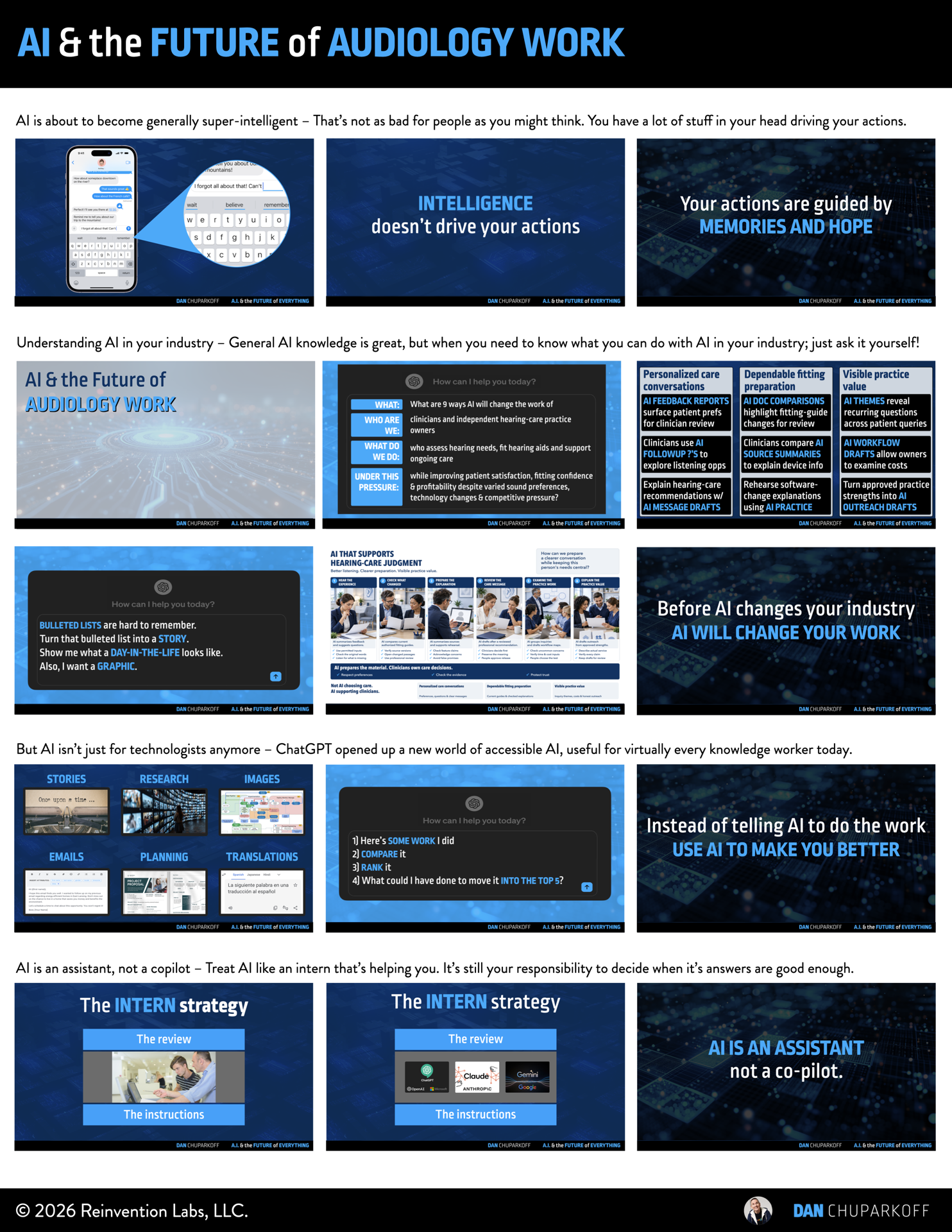
This “Slide Cheatsheet” was customized for your specific talk. It’s designed to help audience-members like you, by wrapping my AI & the Future of Everything keynote into an easy-to-skim, easy-to-share, or easy-to-print resource for future reference.
Download the 3 page
high-resolution PDF here:
Hope you find it helpful!
AI NOTES from Dan’s AI Keynote
*These notes were created using ChatGPT 5.6 pro.
Transcription errors or mistakes have not been fixed
in order to demonstrate the current state of AI notes.
Summary
Dan's first copy-and-paste experience changed how he thought about technology. As a teenager drawing parking lots by hand, he watched an architect use AutoCAD to finish repetitive work in moments. The computer helped the architect work; the architect still supplied the expertise. AI offers another opportunity to find that kind of assistance in everyday work.
The keynote's sentence-completion experiment, glue-in-pizza example, and autocomplete analogy explained why useful AI assistance still requires human review. A likely answer is not automatically the answer you need. Your experience, context, and hopes shape your judgment. Treat AI like an intern: give instructions, inspect the work, improve the instructions, and recognize where its capabilities stop.
For hearing-care clinicians and independent practice owners, Dan explored personalized care conversations, dependable fitting preparation, and visible practice value. He asked attendees to challenge the suggested opportunities using their own expertise. He also demonstrated a different use for AI: comparing your work with your previous attempts to help you improve. The goal is to create capacity for the human work of solving, deciding, and imagining, then use that capacity to serve patients and customers better.
Action Items
[ ] Run the hearing-care question below in your AI assistant. Review its suggestions as the expert: remove ideas that do not fit your practice, add missing priorities, and ask for a day-in-the-life story that makes the possibilities concrete.
[ ] Try the intern loop on one supporting task, such as drafting a practice update. Give instructions, review the result, and refine the instructions. Ask for sources and read them when accuracy matters; decide what is usable yourself.
[ ] Use AI to coach a recurring task. Give it a current example of your work and earlier examples you can share with the tool. Ask which are strongest, what they do well, and what your latest attempt is missing. Apply the useful feedback and compare again.
[ ] Identify one conversation where searchable notes would help you prepare or follow through. Confirm recording permission and your practice's privacy requirements before using a notetaker. Review the notes and use them to prepare the next conversation.
[ ] Identify one communication, process, or investigation task that AI could help you complete with less effort. Decide which unresolved problem, important decision, or new idea will receive the time you recover.
Key Ideas
Assistance expands what you can do
Look for the repetitive work surrounding your expertise. As copy and paste helped an architect draw, AI can help you handle supporting work while you remain responsible for the result. Keep developing the audiology expertise your patients depend on.
Useful answers still need judgment
The next likely word may be obvious after “once upon a,” but less obvious after “once upon a time.” The exercise illustrates why an answer can be plausible without being dependable enough for the task. Brainstorming and decisions involving patient health or privacy require different levels of confidence. Check the source and apply your context.
Your memories & hopes matter
Past experiences and the future you want to create influence your decisions. AI can bring information into the conversation, but you supply the judgment about what matters and what to do next.
Instruct, review, improve
The intern metaphor provides a practical operating loop. Explain the task, examine the work, clarify what is missing, and try again. Learning an assistant's limits is part of using it well; greater capability does not remove your responsibility.
Use AI to improve your own performance
Dan's breakthrough came when he asked AI to compare a post he had written with his earlier work. That changed the question from producing an output to identifying how he could improve. The same approach can support recurring writing, presentations, and appropriate customer conversations.
Protect time to solve, decide & imagine
Communication, process, and investigation can consume the week. Reducing their burden creates room to address hard problems, make considered decisions, and choose the future your team will work toward. Making a long list of ideas is only a beginning; people decide which idea deserves attention and resources.
Opportunities for hearing-care practices
A question to reuse
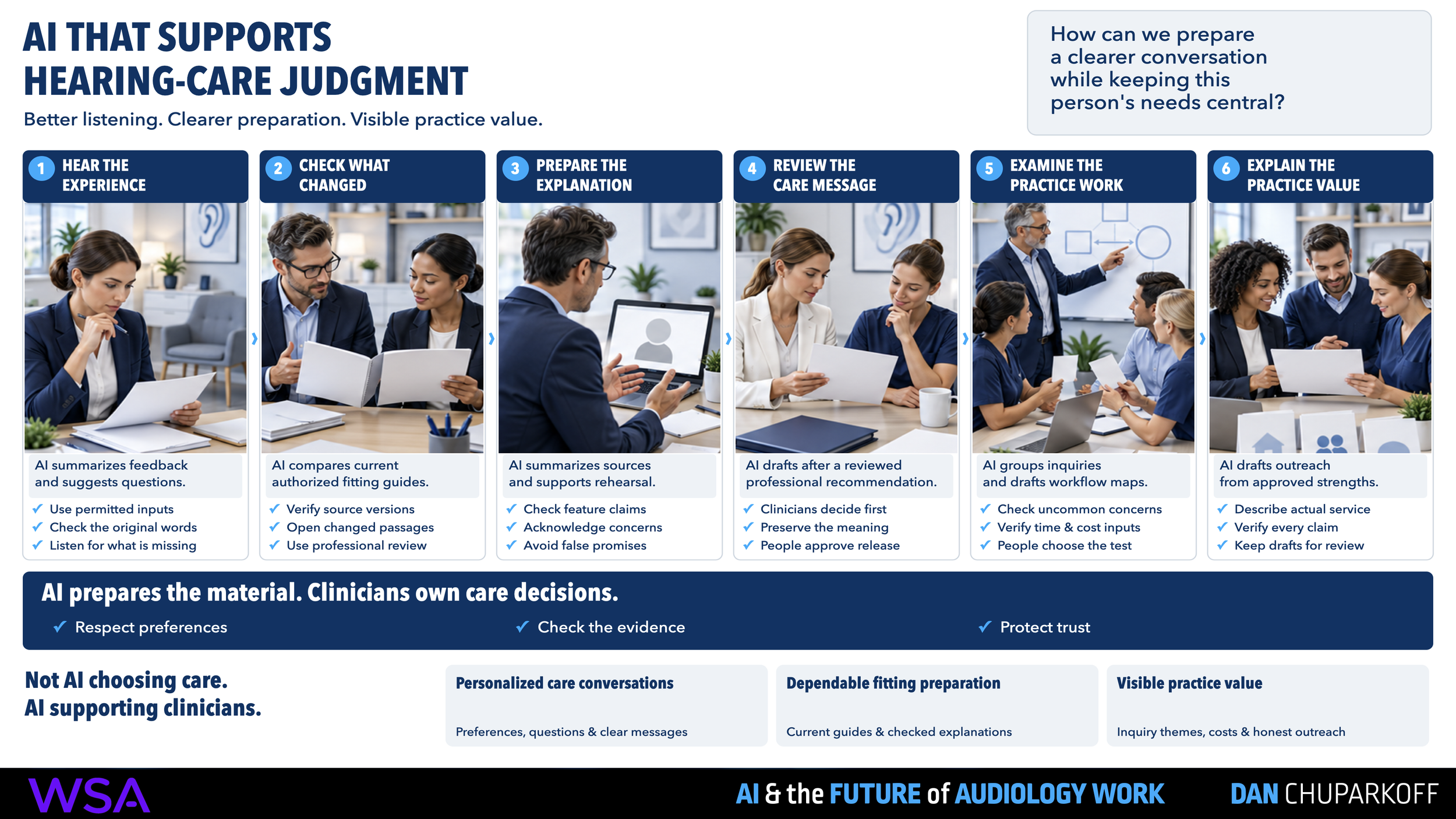
What are 9 ways AI will change the work of clinicians and independent hearing-care practice owners who assess hearing needs, fit hearing aids and support ongoing care while improving patient satisfaction, fitting confidence and profitability despite varied sound preferences, technology changes and competitive pressure?
Personalized care conversations
Use AI assistance to make messages and conversations more specific to the people you serve. Consider what each patient, customer, or prospective customer needs to understand, then review the draft before using it.
Dependable fitting preparation
Explore how AI can support preparation and clearer explanations. The day-in-the-life example included checking what had changed and preparing explanations for customers and stakeholders. Keep your professional judgment central when deciding how the information applies.
Visible practice value
Look for recurring themes in patient inquiries, use workflow drafts to examine service costs, and develop outreach drafts that explain your practice's value. These are starting points for your own assessment of what would help the practice and the people it serves.
Ask AI to turn the possibilities into a day-in-the-life story or picture. Use that concrete version to discuss what belongs, what is missing, and what you want to change. You remain the audiology expert who decides whether the suggested future makes sense.
Talk Flow
1. Recognize the next copy-and-paste opportunity
Technology changes how everyday work gets done.
The AI-generated introduction opened a discussion about improving tools and changing expectations.
Look for useful assistance inside the work you already do.
The parking-lot story made assistance tangible.
AutoCAD removed the repetition of drawing each parking line by hand while the architect continued directing the work.
A better way to complete a task can change what you expect from the whole workflow.
Find useful applications inside the AI piñata.
PCs, spreadsheets, the internet, mobile, and cloud became ordinary parts of work; AI is another shift to learn.
Examine which applications create value and where you should retain the work yourself.
2. Combine AI assistance with human judgment
Sentence prediction explained the limits of a likely answer.
“Once upon a time” demonstrated the pull of a common response.
Keep strengthening your specialist expertise while using AI to help with supporting work.
Confidence requirements depend on the task.
A brainstorming suggestion and a decision involving patient health have different stakes.
The glue-in-pizza example showed why popularity is not a substitute for a sound answer; ask for sources and read them.
Autocomplete demonstrated a familiar review habit.
Accept a useful suggestion and supply your own words when it misses.
Bring the context from your real conversations and experiences to the decision.
Memories and hopes shape judgment.
Past successes and disappointments influence what you want to repeat or avoid.
Your hopes help determine which future is worth pursuing.
The intern model made responsibility clear.
Give instructions, review the work, improve the instructions, and learn the assistant's limits.
Remain responsible for what you use, however capable the assistant becomes.
3. Apply the ideas to hearing care & improve your work
Ask how AI changes your actual responsibilities.
Name the roles, services, desired outcomes, and pressures in your question.
Use your expertise to challenge the answer and add what it misses.
Explore three areas of practice work.
Personalize care conversations, support dependable fitting preparation, and make practice value visible.
Turn the possibilities into a day-in-the-life story that people can discuss and revise.
Use AI for assistance and performance coaching.
An outline, research help, or a draft can provide a starting point; add your own experience and judgment.
Compare your current work with earlier attempts and ask what your best examples did differently.
4. Make room for the human work
Distinguish a job from the work inside it.
Taking repetitive tasks off your plate can create capacity for needs you have not been able to address.
Understand the lower layers of the work pyramid.
Communication means talking, listening, reading, and writing; process means following workflows; investigation means finding what needs attention.
Look for assistance in those layers so they consume less of the week.
Give solving, deciding, and imagining deliberate attention.
New problems require context, and decisions draw on your experience and hopes.
Imagining includes choosing which possibility deserves your team's effort and resources.
5. Share information differently & use the time you recover
Make communication easier to prepare and remember.
Searchable notes can help retrieve information and prepare future conversations when recording and privacy requirements permit.
Keep personal notes if they help you remember, alongside a record you can find again.
Make important learning worth revisiting.
The song reinforced “solve, decide, and imagine” in another format.
A strategy or training guide may benefit from a format people want to return to and share.
Consider the opportunities in language translation.
The multilingual demonstration and Dan's Italy experience illustrated ways to communicate across language barriers.
Consider what easier communication could mean for customers, teams, and learning.
CLOSING MESSAGE: Flip the pyramid of work!
Return to the work pyramid in a world of growing demands.
More information and more requests do not add hours to the week.
Use AI assistance to create more time to solve, decide, and imagine a better future for hearing healthcare.