
Beer Institute 2026: AI & the Future of Beer Industry Services
Listen to the
AI KEYNOTE SONG
The easiest way to review my keynote in 5 minutes! Share the key points of the AI Keynote with this song. It’s the full keynote, synced along with my slides!
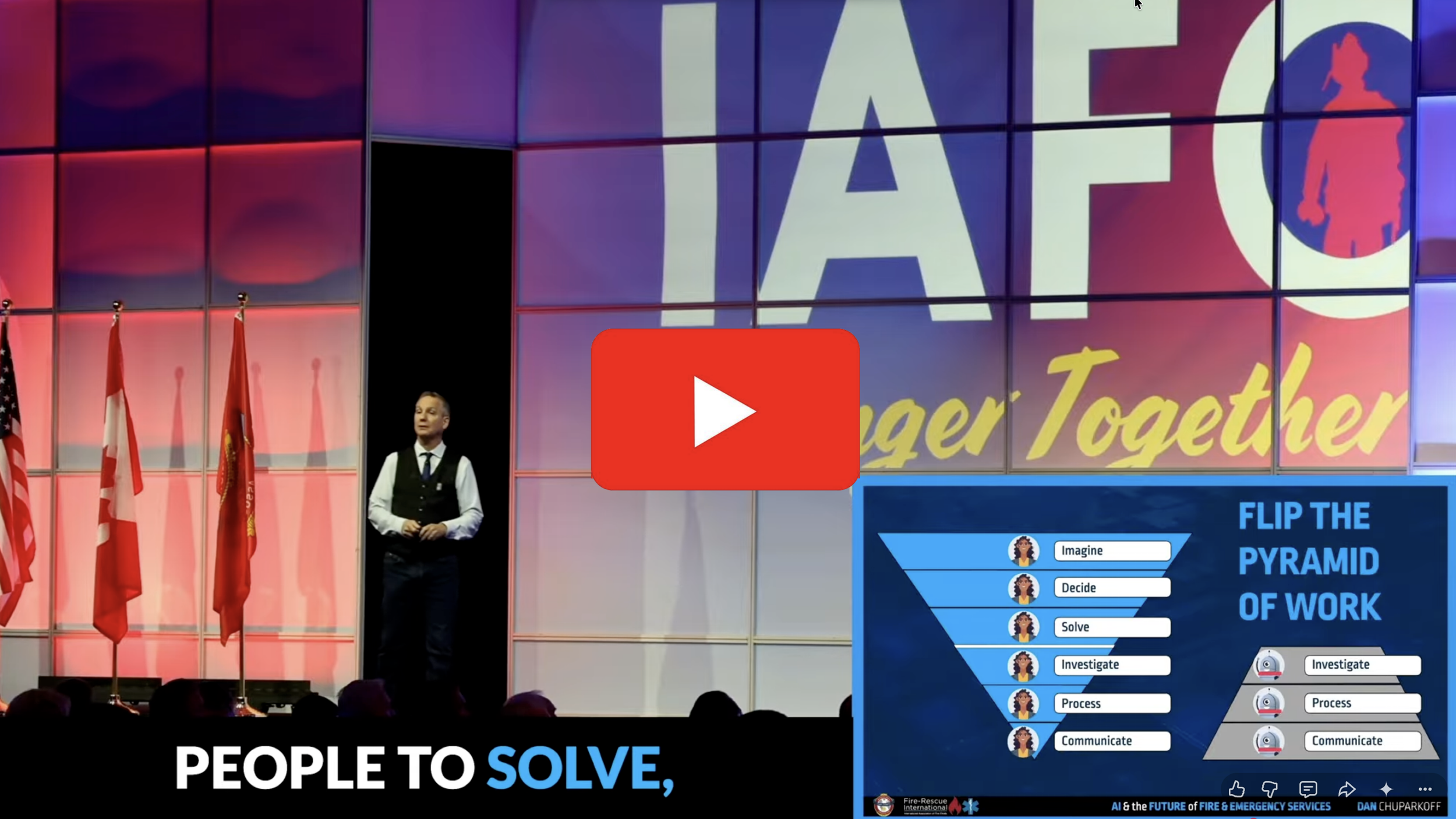
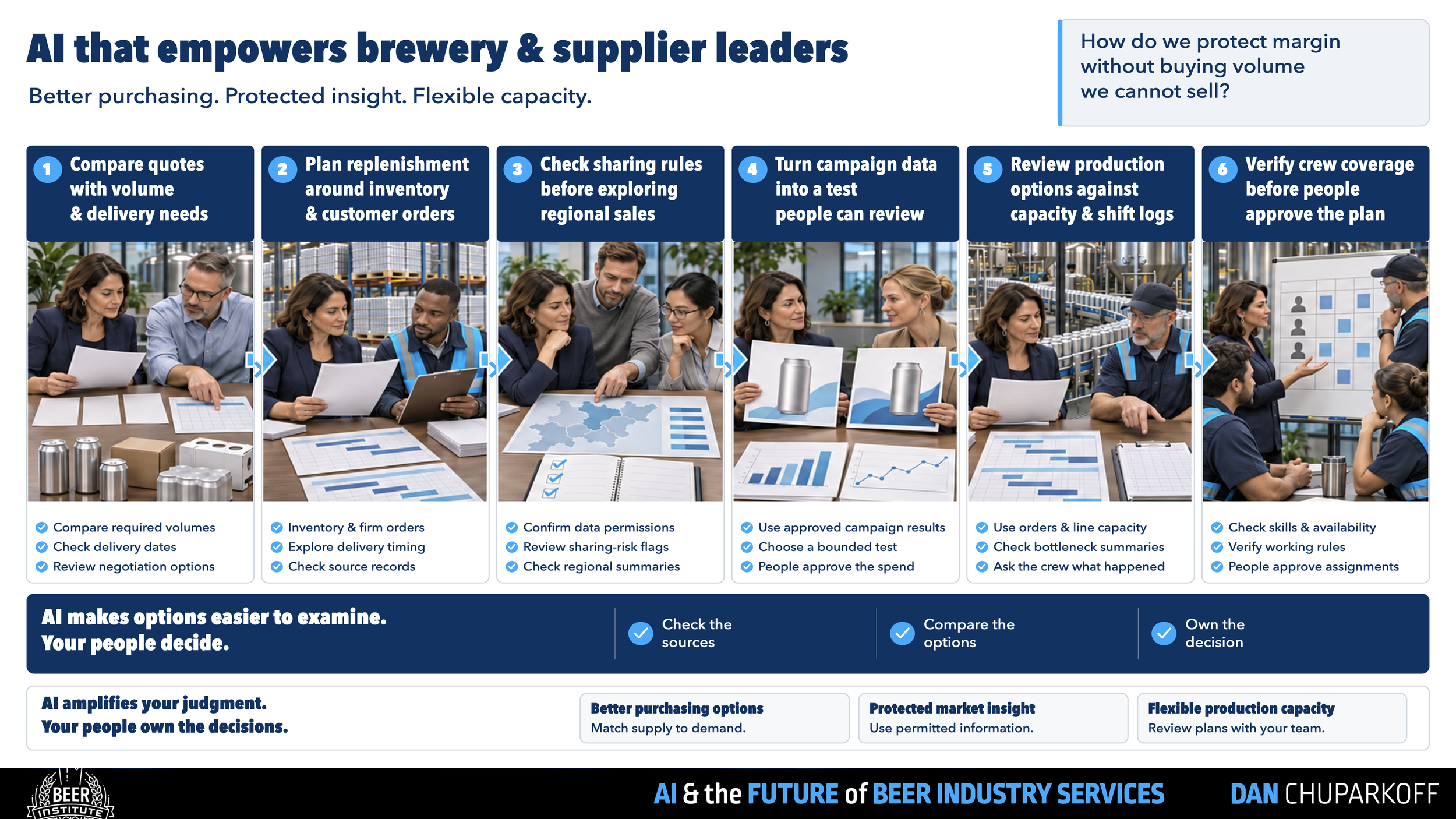
A day in the life in YOUR AI FUTURE

PDF SUMMARY of key slides
This “Slide Cheatsheet” was customized for your specific talk. It’s designed to help audience-members like you, by wrapping my AI & the Future of Everything keynote into an easy-to-skim, easy-to-share, or easy-to-print resource for future reference.
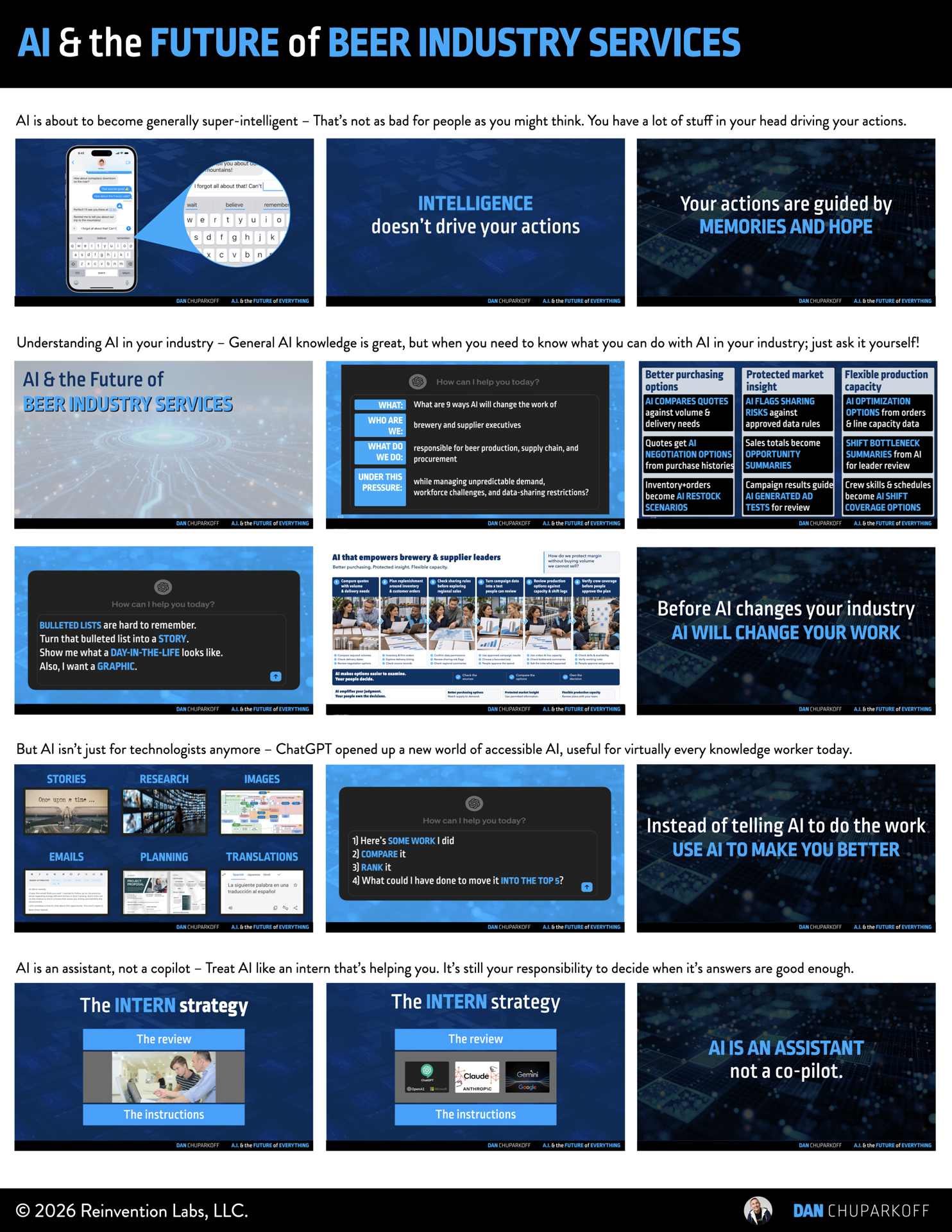
Download the 3 page
high-resolution PDF here:
Hope you find it helpful!
AI NOTES from Dan’s AI Keynote
*These notes were created using ChatGPT 5.6 pro.
Transcription errors or mistakes have not been fixed
in order to demonstrate the current state of AI notes.
Summary
AI changes what people can accomplish with assistance. Dan's first experience with AutoCAD showed him how copy and paste could transform a painstaking drafting task while leaving the architect responsible for the design. The same distinction matters today: AI can help brewery and supplier executives do better work while people retain expertise, judgment, and responsibility.
Useful assistance does not require a perfect answer. The next-word exercise, pizza-glue example, and familiar experience of phone autocomplete showed why suggestions need human judgment. Your experience, conversations, priorities, and hopes give you context that an AI assistant does not fully share. The confidence you need depends on the consequences of the decision.
For the beer industry, the keynote explored better purchasing options, protected market insight, and flexible production capacity. The invitation was to ask AI about your own responsibilities and constraints, challenge its suggestions, and explore the most useful opportunities more deeply. You can also use AI immediately as a performance coach: compare your work with your strongest previous examples, revise it, and learn from the differences. The purpose of recovered time is to solve, decide, and imagine more effectively.
Action Items
[ ] Choose one recurring piece of work you own, such as a proposal, customer conversation, or presentation. Using material you are permitted to share, ask AI to compare it with your previous examples against criteria you define. Identify what your strongest work does better, revise, and repeat. Obtain the customer's agreement before recording a customer call.
[ ] Ask AI how your role could change, naming your responsibilities and operating constraints. Pick one promising opportunity and ask about starting steps, required data, risks, and guardrails. Use your industry expertise to challenge the answer.
[ ] Review the specific AI tools and data settings your team uses. The keynote highlighted ChatGPT's “Improve the model for everyone” setting as an example. Establish how the tool handles information and what your organization permits before sharing proprietary data.
[ ] Identify one communication, processing, or investigation task AI could help with. Decide how you will review its recommendations and which neglected problem, important decision, or future opportunity will receive the time you recover.
Key Ideas
Assistance changes the work
AutoCAD helped an architect draw more efficiently; the architect still supplied the design judgment. Look for the parts of your work where AI can provide that kind of assistance.
A plausible answer still needs judgment
The most likely answer is not automatically good enough for every use. Ask where the information came from and whether it supports the confidence your decision requires. The pizza-glue example made the consequence of accepting a bad suggestion memorable.
Expertise remains yours
Dan's “B-minus” analogy described broad assistance across many activities while encouraging people to remain experts in their own field. Your memories and hopes shape which recommendations fit your situation and the future you want to create.
Improvement can compound
AI can compare a new piece of work with your prior work and help you identify specific changes. Keep ownership of the work and use the feedback to improve your capabilities over successive attempts.
Recovered time has a purpose
The work pyramid groups communication, processing, and investigation below solving, deciding, and imagining. AI assistance with the lower layers creates room for the higher layers. Keep the communication that builds trust and relationships while reducing the repeated movement of the same information.
Opportunities for brewery & supplier executives
Adapt the keynote's question to your own work:
> What are nine ways AI will change the work of brewery and supplier executives responsible for beer production, supply chain, and procurement while managing unpredictable demand, workforce challenges, and data-sharing restrictions?
The nine examples were organized into three areas to explore. Treat the answers as recommendations to examine with your team and your own expertise.
Better purchasing options
Compare supplier quotes more quickly.
Prepare options for challenging negotiations.
Explore restock scenarios as needs change.
Protected market insight
Flag sharing risks and conflicts with existing data-use rules.
Summarize market opportunities to help prioritize attention.
Develop advertising tests and more personalized communication.
Flexible production capacity
Explore options for improving production operations.
Summarize bottlenecks for leaders to review.
Support crew skills and schedules with training assistance and guidance.
Choose an area that matters to your operation and continue the conversation. Ask what information is needed, what the proposed change would involve, and where human review belongs. Find the holes in the answer before deciding how to proceed.
Talk Flow
1. Technology changes how work gets done
A changing standard of work
The opening AI-generated video illustrated how quickly assisted work is changing and why teams need to understand the tools available to them.
The AutoCAD copy-and-paste moment
A parking-lot drawing task that took days became dramatically faster when Dan saw an architect use AutoCAD.
Assistance can transform a task while the professional retains responsibility for the result.
Assistant versus automator
Dan's boss feared that the computer would replace architects; Dan saw a tool that helped them work better.
Start by identifying the work your AI assistant can help you do.
The next step in familiar technology change
PCs, spreadsheets, the internet, mobile tools, and cloud services became part of ordinary work. AI is another tool to learn to work with.
2. Use AI suggestions with human judgment
Replace vague AI questions with specific ones
Data-use questions become more useful when they name the tool, its settings, and the information involved.
The “Once upon a” exercise
Completing a familiar phrase illustrated prediction from patterns and the pull toward common answers.
Use AI to broaden your capabilities while continuing to develop your own expertise.
Confidence & glue in the pizza
A likely next word and an answer suitable for a consequential decision require different judgments.
The pizza example showed how mixed-quality source material can produce an unusable suggestion; inspect the answer before acting on it.
Autocomplete as a familiar assistant
You already accept, reject, and replace suggestions when texting. Bring that same ownership to more complex AI assistance.
Memories & hope
Past experiences and the future you want influence your choices. Use AI to bring information into view while you make the decision.
3. Explore AI in beer operations
Ask about the work you actually manage
Name the executive role, production and supply-chain responsibilities, and demand, workforce, and data-sharing constraints in the question.
Organize opportunities into three areas
Better purchasing options, protected market insight, and flexible production capacity connect AI assistance to recognizable work.
Comparisons, summaries, scenarios, and recommendations give leaders material to review.
Continue the conversation
The list and day-in-the-life picture were starting points for exploration. Apply your expertise to challenge them and investigate the opportunities that matter most.
4. Improve your performance & reclaim time
The personal performance coach
After rejecting an AI-written LinkedIn post, Dan wrote his own and asked AI to compare it with his earlier posts.
Use criteria you define to identify what your strongest work does well, revise the new work, and repeat the comparison.
Jobs contain many kinds of work
Greater efficiency creates capacity for work that has been neglected. Consider both what AI can help with and what you will do with that capacity.
The six layers of the work pyramid
Communicate, process, and investigate form the lower layers; solve, decide, and imagine form the upper layers.
Use assistance to reduce the demands of the lower layers while keeping ownership of decisions and the future you choose to pursue.
5. Make information easier to use & share
Meeting notes & communication support
Capturing and organizing conversations can reduce the effort of passing information around and help teams keep useful context available.
Notes turned into a song
The song demonstration showed how information can take a different form to help people revisit and share it.
Its central reminder was that people remain needed to solve, decide, and imagine.
Language translation & collaboration
The multilingual demonstration and English/Spanish crew example illustrated how translation assistance can help people collaborate in languages comfortable to them.
A world of more demands & fixed time
More information, tools, and expectations do not add hours to the week. Reduce repetitive information work while preserving communication that builds trust.
Put the recovered time into harder problems, better decisions, and imagining the future of the beer industry.