
RVDA 2026: AI & the Future of RV Dealer Services
Listen to the
AI KEYNOTE SONG
The easiest way to review my keynote in 5 minutes! Share the key points of the AI Keynote with this song. It’s the full keynote, synced along with my slides!
A day in the life in YOUR AI FUTURE

PDF SUMMARY of key slides
This “Slide Cheatsheet” was customized for your specific talk. It’s designed to help audience-members like you, by wrapping my AI & the Future of Everything keynote into an easy-to-skim, easy-to-share, or easy-to-print resource for future reference.
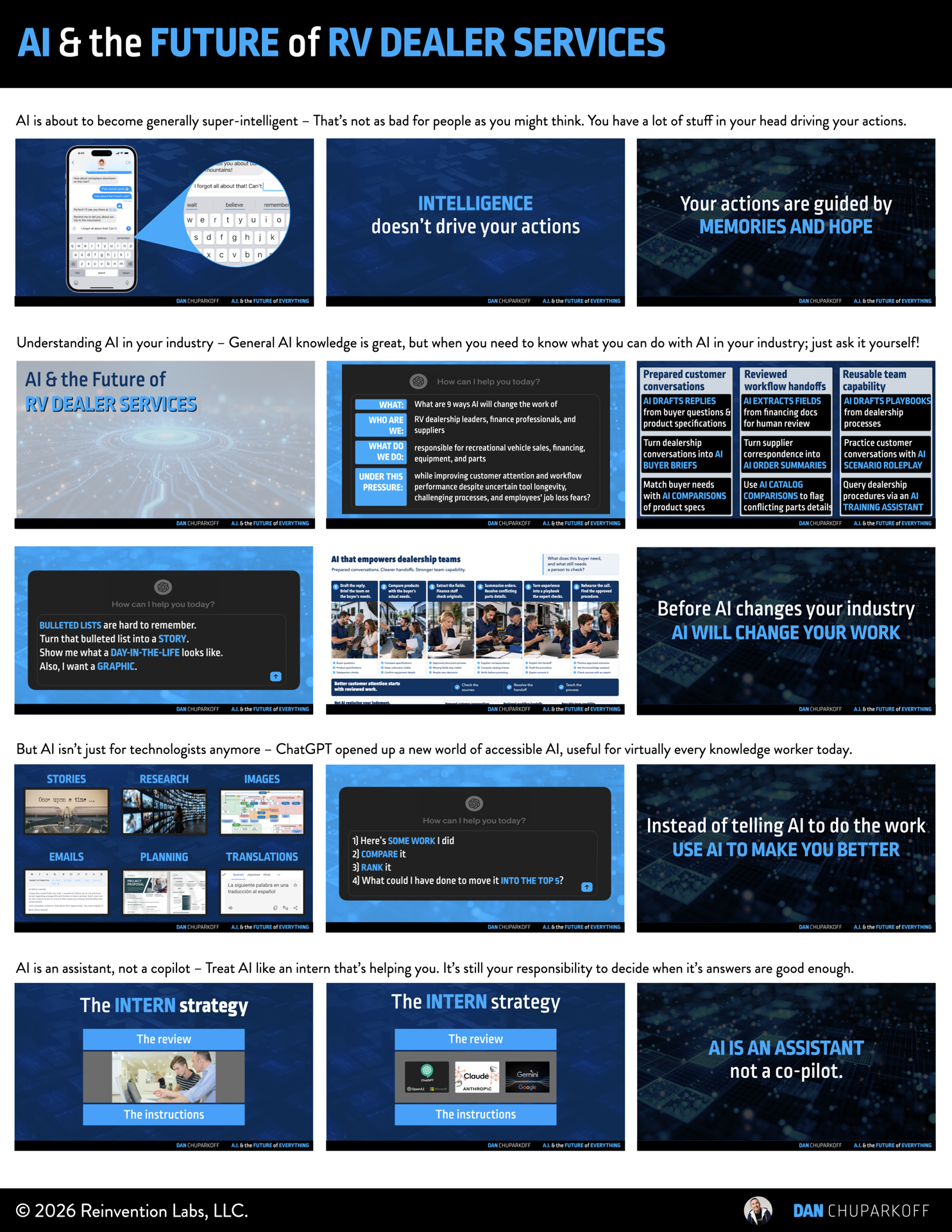
Download the 3 page
high-resolution PDF here:
Hope you find it helpful!
AI NOTES from Dan’s AI Keynote
*These notes were created using ChatGPT 5.6 pro.
Transcription errors or mistakes have not been fixed
in order to demonstrate the current state of AI notes.
Summary
Dan framed AI as an assistant that expands what people can accomplish. His first experience with AutoCAD turned a painstaking parking-lot drawing task into a copy-and-paste operation. The architect still supplied the purpose and judgment; the tool made the work faster and more precise. AI brings a similar opportunity to the information work inside a dealership.
Getting that value requires understanding the assistant. The sentence-completion exercise, glue-in-pizza example, and familiar experience of autocomplete illustrated why a plausible suggestion still needs human review. Your experience, memories, hopes, and knowledge of a customer give you context the tool does not share. The intern metaphor provides a practical working relationship: give clear instructions, review the result, refine the instructions, and recognize the limits of the work you can delegate.
For RV dealership leaders, finance professionals, and suppliers, the talk highlighted better preparation for conversations, more informed handoffs, and knowledge that stays useful as teams change. Dan also showed how to use AI as a performance coach for work you do yourself. The larger goal is to reduce the burden of communication, process, and investigation so you can spend more attention solving problems, deciding what matters, and imagining what comes next.
Action Items
[ ] Choose one RV workflow to improve. Ask AI how it could help with your role, responsibilities, desired outcomes, and constraints, then ask what information or support you need to begin. Treat its answer as a recommendation you evaluate.
[ ] Prepare for your next important customer conversation. Ask AI for three things to cover, then adapt its suggestions using what you know about that customer.
[ ] Improve a sales-to-finance handoff. Preserve why the buyer wants the RV and what matters to them alongside the transaction information. Review any AI-assisted summary before using it.
[ ] Use AI to coach your own work. Write a customer email yourself, compare it with your strongest previous examples, and ask what would make the next version better.
[ ] Make a recurring conversation’s notes easier to find and reuse. Record with the participants’ agreement, review the AI notes, and share the useful information with your team. Put the recovered time toward a problem or decision that has been waiting.
Key Ideas
Assistance expands capability
A tool can take over part of the work while people retain responsibility for the outcome. The AutoCAD story makes that distinction tangible: the architect gains a more capable way to work.
Likely answers still need review
The most likely next word is not necessarily the answer your situation needs. The pizza example shows how flawed source material can produce a confident-looking suggestion; autocomplete shows that you already know how to reject an unhelpful one.
Context shapes judgment
Your best customer experiences, difficult management experiences, and hopes for the future influence your choices. AI can provide information, but you decide how that information fits the situation.
Manage the assistant like an intern
Give instructions, inspect the work, and improve the instructions when necessary. Learn which assignments are within the assistant’s capability and keep responsibility for reviewing the result.
Improve yourself with feedback
Dan’s performance-coach approach starts with work you create. Ask AI to compare it with your own strongest work, explain the differences, and help you improve the next attempt.
Separate jobs from work
A job contains many kinds of work. Reducing routine tasks can create room for problems, decisions, and ideas that the team has not had enough time to address.
Information becomes more reusable
Searchable notes, translation, and different presentation formats can make the same information useful to more people. The talk demonstrated this through meeting records, multilingual communication, and a closing song made from keynote notes.
Opportunities for RV dealership teams
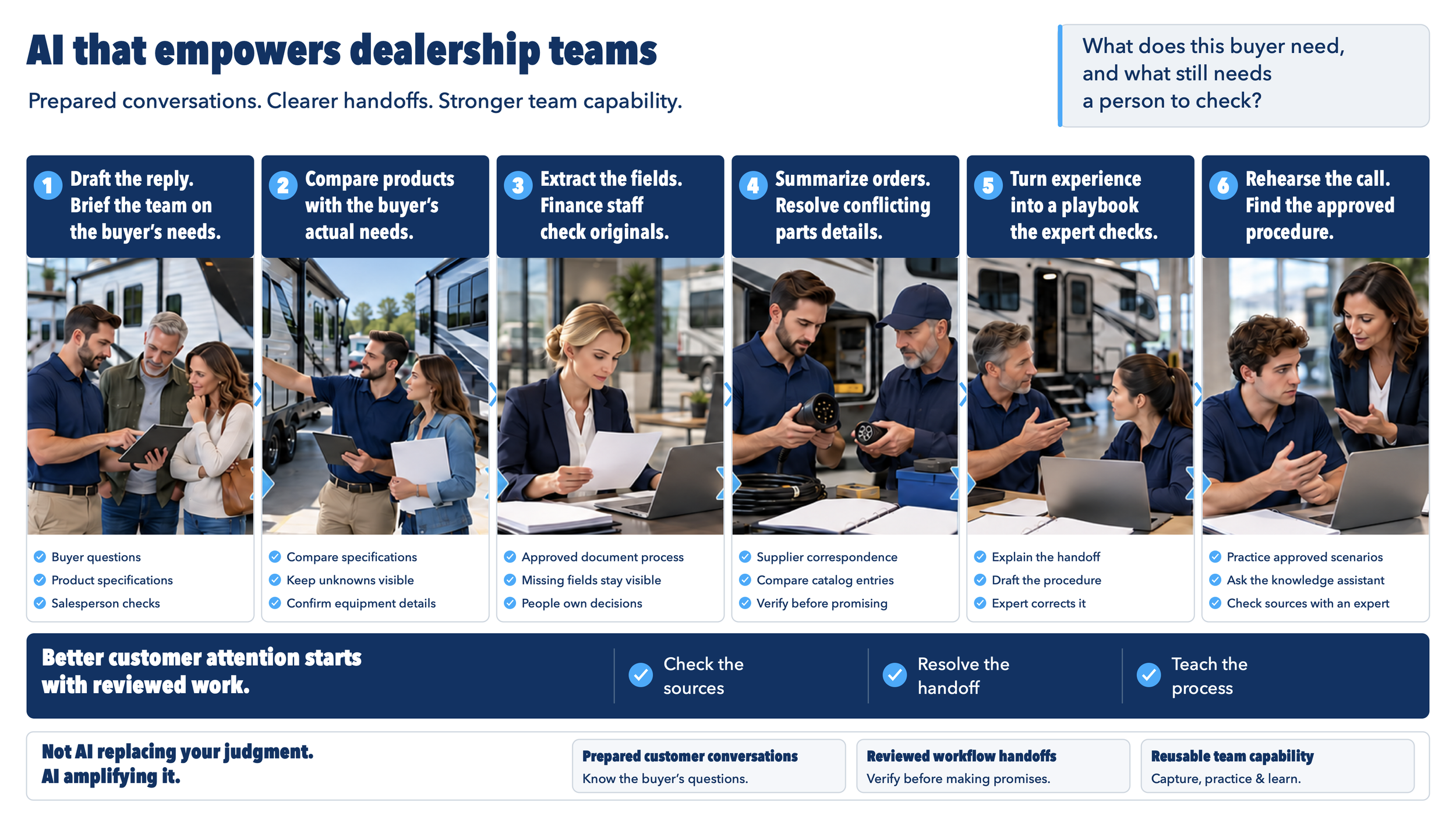
Prepared customer conversations
Use AI for a brief preparation conversation before an important customer, colleague, or networking interaction. Ask what you should cover and what you might be overlooking. Bring your own knowledge of the person and relationship to the suggestions.
Better workflow handoffs
Carry useful context from the website or marketing conversation to the person managing the customer relationship, then to finance. Dan’s example emphasized the buyer’s reason for wanting an RV: that motivation may be more useful to the next person than a completed form alone.
Reusable team capability
Employee departures and arrivals create repeated hiring and training work. Shared, searchable records help new colleagues recover information they missed and help the team retain knowledge across handoffs. Use AI to help preserve and retrieve that context while people review and apply it.
Talk Flow
See technology as assistance
AI-generated introduction
The opening video made AI capability visible before the explanation began.
The changing quality of AI-assisted work creates a reason to reconsider familiar ways of working.
The AutoCAD turning point
Copy and paste transformed Dan’s slow, precise parking-lot drawing task.
The tool expanded the architect’s capability while the architect continued to direct the work.
Resistance, then a new perspective
Danny’s concern about losing jobs contrasted with Dan’s view of technology as assistance.
The staircase from PCs and spreadsheets to cloud and AI showed how new capabilities become ordinary tools.
The AI piñata
Random experimentation makes it hard to identify useful value.
Leaders need to understand what the tools can help with and where their own expertise matters.
Understand AI & retain judgment
The sentence-completion experiment
“Once upon a…” made next-word prediction and consensus easy to experience.
The B-minus/A-plus comparison encouraged people to keep developing their expertise while using AI for surrounding tasks.
Confidence & flawed sources
The next word after “Once upon a time” had several possibilities, illustrating the difference between a likely answer and enough confidence to act.
The glue-in-pizza example showed why a popular answer can still be inappropriate.
Autocomplete as familiar assistance
Reject a bad suggestion and continue the work, just as you do when texting.
Customer-facing AI needs people who review conversations and can intervene when the assistant gets something wrong.
Memories & hopes
Experiences with customers and managers, together with what you want to happen next, shape your decisions.
Apply that context to the information AI provides.
The intern relationship
Give clear instructions, review the work, and refine the assignment when needed.
Recognize a capability ceiling instead of assuming the assistant can handle every task independently.
Apply AI to RV work & improve your performance
Ask a question about your actual work
Include the roles, responsibilities, desired outcomes, and constraints that define the opportunity.
Improve conversations, handoffs & team knowledge
Prepare for important conversations with timely coaching.
Carry customer motivation through marketing, sales, and finance handoffs.
Make useful information available as people join and leave the team.
Turn opportunities into a next step
A day-in-the-life story and picture made the list of possibilities easier to imagine as a workflow.
Ask AI what to work on next, then evaluate its recommendation using your own context.
Use a performance-coach loop
Dan’s rejected LinkedIn drafts led to a more useful question: how does work he wrote compare with his own best examples?
Apply the same loop to customer calls, emails, and other recurring work so each attempt helps improve the next one.
Create capacity for more demanding work
Jobs contain many kinds of work
Reducing a routine task does not exhaust the problems and opportunities a team needs to address.
The work pyramid
Communication, process, and investigation can consume the time available for other work.
Solving problems, making decisions, and imagining possibilities require people to bring experience and direction.
Use assistance in the lower layers to make more time for the upper layers.
Reusable communication records
Meeting notes can help teams retrieve information, revisit a conversation, and share what new colleagues missed.
Keep personal notes if they help you learn, while also maintaining a record the team can search and reuse.
Connect people & put the capacity to work
Translation as a collaboration tool
The multilingual video and translation examples illustrated how language barriers can shrink.
Consider what easier communication could change for customer relationships and teams that use different languages.
More expectations, limited hours
Reduce the routine burden at the bottom of the work pyramid to create room for customer problems, better decisions, and new ideas.
The closing returned that opportunity to the future of RV dealer services.
Notes become a song
After the closing message, the full song demonstrated another way to share and revisit the keynote’s ideas.
Its recurring message reinforced the human work of solving, deciding, and imagining.