
LM Leaders 2026: AI & the Future of Defense Services
Listen to the
AI KEYNOTE SONG
The easiest way to review or share the key points of my AI Keynote is with this song: the full keynote, matched with slides, in 4m32s!
A day in the life in YOUR AI FUTURE

PDF SUMMARY of key slides
This “Slide Cheatsheet” was customized for your specific talk. It’s designed to help audience-members like you, by wrapping my AI & the Future of Everything keynote into an easy-to-skim, easy-to-share, or easy-to-print resource for future reference.
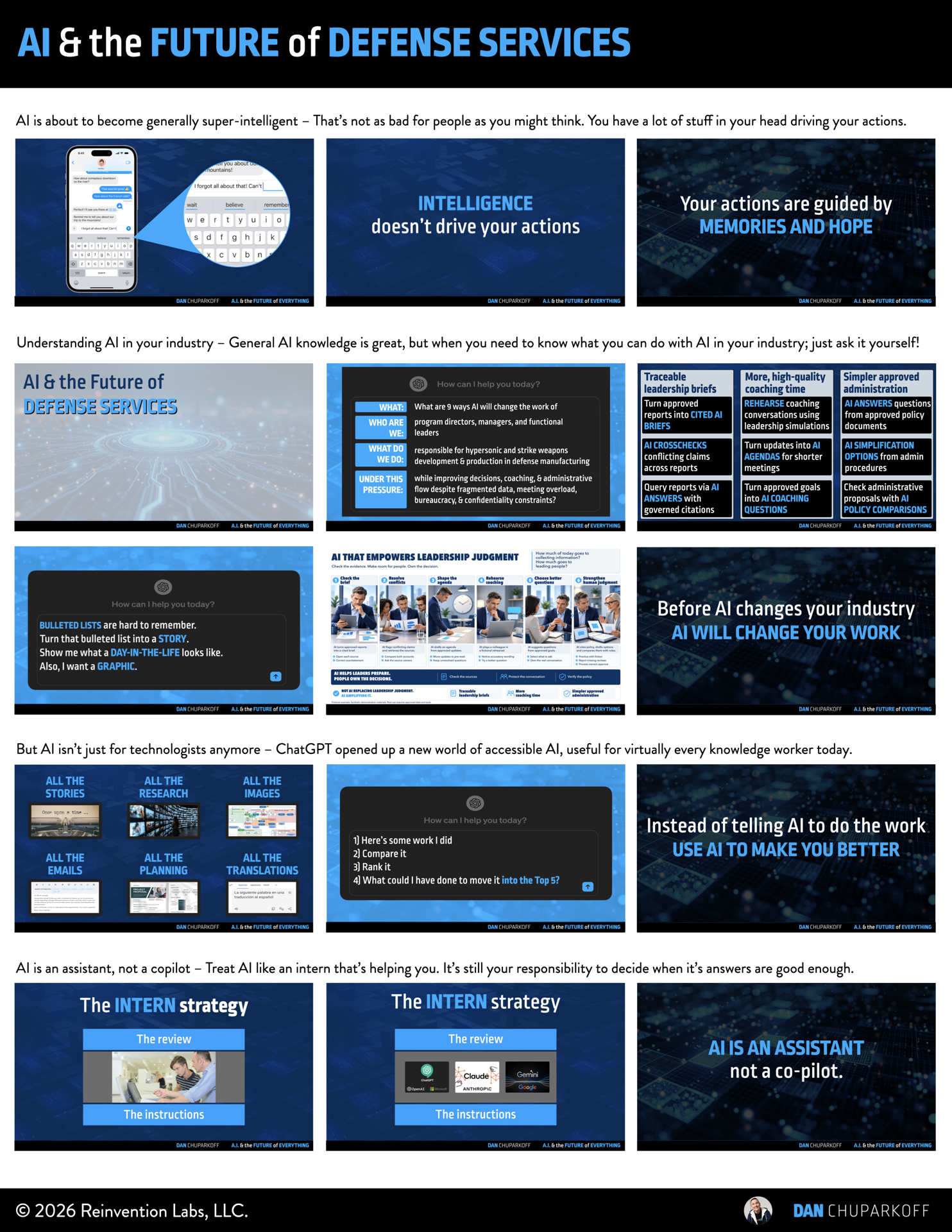
Download the 3 page
high-resolution PDF here:
Hope you find it helpful!
An AI Transformation Roadmap
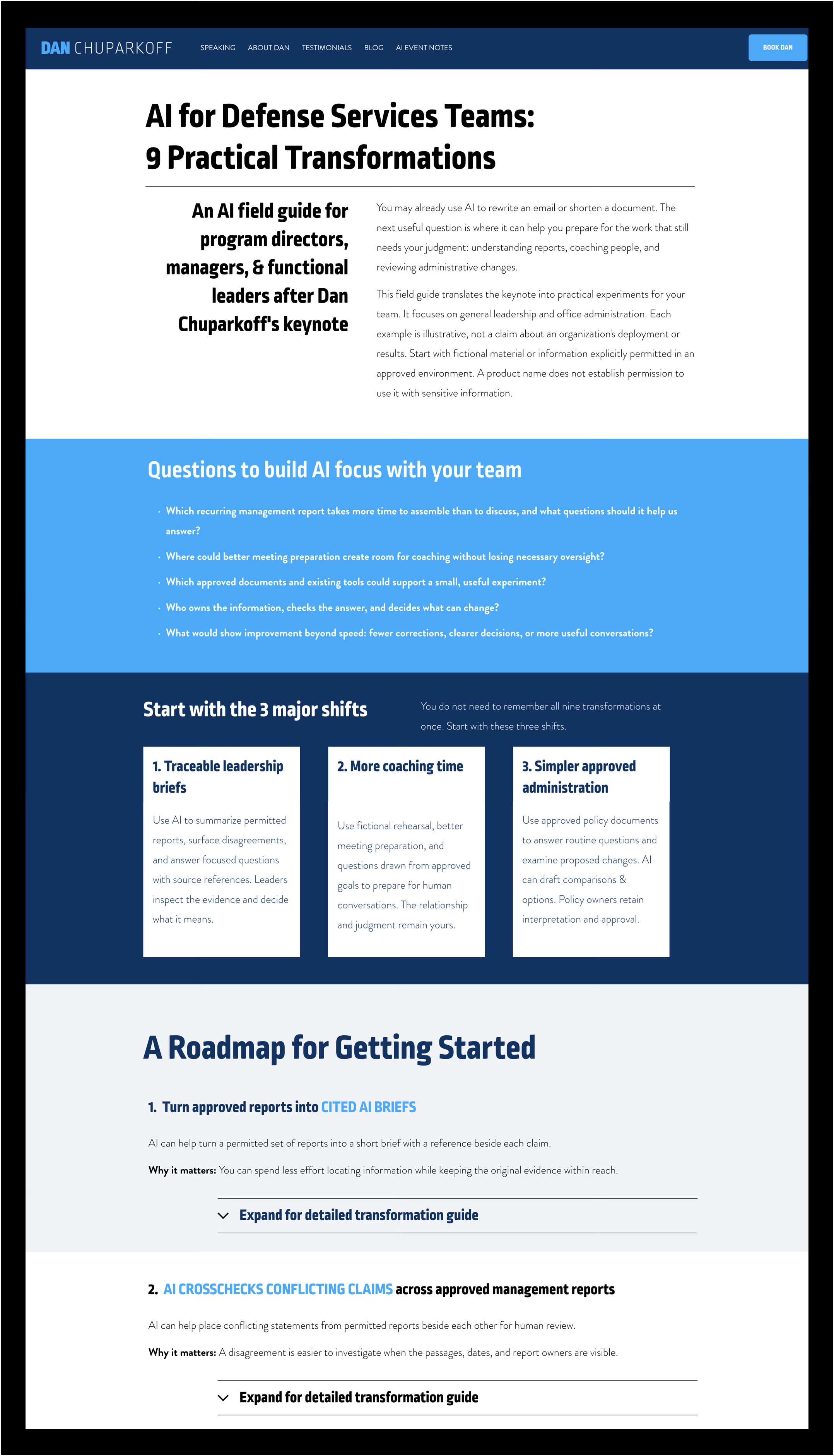
AI NOTES from Dan’s AI Keynote
*These notes were created using ChatGPT 6.0 pro.
Transcription errors or mistakes have not been fixed
in order to demonstrate the current state of AI notes.
Summary
AI is another opportunity to change how work gets done, much as copy and paste changed repetitive drafting. Dan's AutoCAD story illustrated the distinction between a tool that assists a skilled person and a system expected to take over that person's entire job. The useful starting question is where assistance can remove effort while leaving human expertise and responsibility in place.
That assistance needs review. The word-completion and glue-in-pizza examples explain why a plausible answer can still be uncertain or draw on poor source material. Autocomplete already gives us a familiar way to use imperfect suggestions without surrendering control. Decisions require more than information: our memories, experience, and hopes for the future shape judgment. Treat AI like an intern by giving instructions, inspecting the work, correcting the guidance, and recognizing its limits.
For this leadership team, the practical opportunities center on traceable leadership briefs, more coaching time, and simpler approved administration. Describe your role, goals, and constraints; ask for relevant possibilities; turn them into a picture of a future workday; and ask for steps to get started. Use AI as a performance coach that helps you improve your own work. The larger purpose is to recover capacity from communication, process, and investigation so people can solve harder problems, make better decisions, and imagine what comes next.
Action Items
[ ] Describe your role, goals, and constraints to an approved AI assistant. Ask how AI could change your work, what a future workday could look like, and what three steps would help you get started.
[ ] Choose one AI-assisted task and make its review loop explicit. Give clear instructions, inspect the output, check linked source material where relevant, and improve the instructions before trying again.
[ ] Choose a brief, draft, or other work sample you are allowed to use. Give AI your quality criteria, compare the work with your own strongest examples, and apply one improvement yourself.
[ ] Review one recurring meeting. Identify who needs to contribute, who could use reviewed notes instead, and how the useful information will reach the people who need it.
[ ] Pick one communication, process, or investigation task to simplify. Decide which problem, decision, or coaching conversation will receive the time you recover.
Key Ideas
Assistance changes the work
Copy and paste removed repetitive drafting effort while the architect continued to direct the design. Look for the equivalent in your own work: a useful task for AI assistance and a clear role for the person responsible for the result.
Useful answers still need review
Fluent wording is not the same as a dependable answer. AI draws on material of varying quality, including jokes and mistakes. Use its suggestions as inputs you can inspect, much as you accept or reject autocomplete suggestions.
Memories, hope & judgment
Information is an ingredient in a decision. Experience with a difficult project, the example of a great boss, and the future you want to create also shape the choice. AI can help you gather and consider information while you retain that judgment.
The intern relationship
Give instructions, review the work, and improve the guidance. Repeat until the result is useful or you discover the assistant's current limits. The person directing the work remains responsible for its use.
Ask AI how to use AI
Describe who you are, what you want to accomplish, and what makes that difficult. A role-specific conversation can move from possible changes to a future workday and then to concrete starting steps. Adapt the suggestions using your own expertise.
A coach for your own performance
Do the work, define what good looks like, and ask AI to compare your attempt with stronger examples. Use the feedback to improve the next attempt. The goal is to develop your ability, not just generate another finished draft.
Jobs contain different kinds of work
Communication, process, and investigation can consume the time needed to solve problems, decide what to do, and imagine new possibilities. Break a task into these parts. Use assistance in the lower layers to create room for the human work above them.
More ways to share an important idea
The notes-to-song demonstration and translation examples showed how AI can change the form and reach of information. Choose a format that helps people understand or revisit a message, with review suited to its use.
Opportunities for LM Leaders
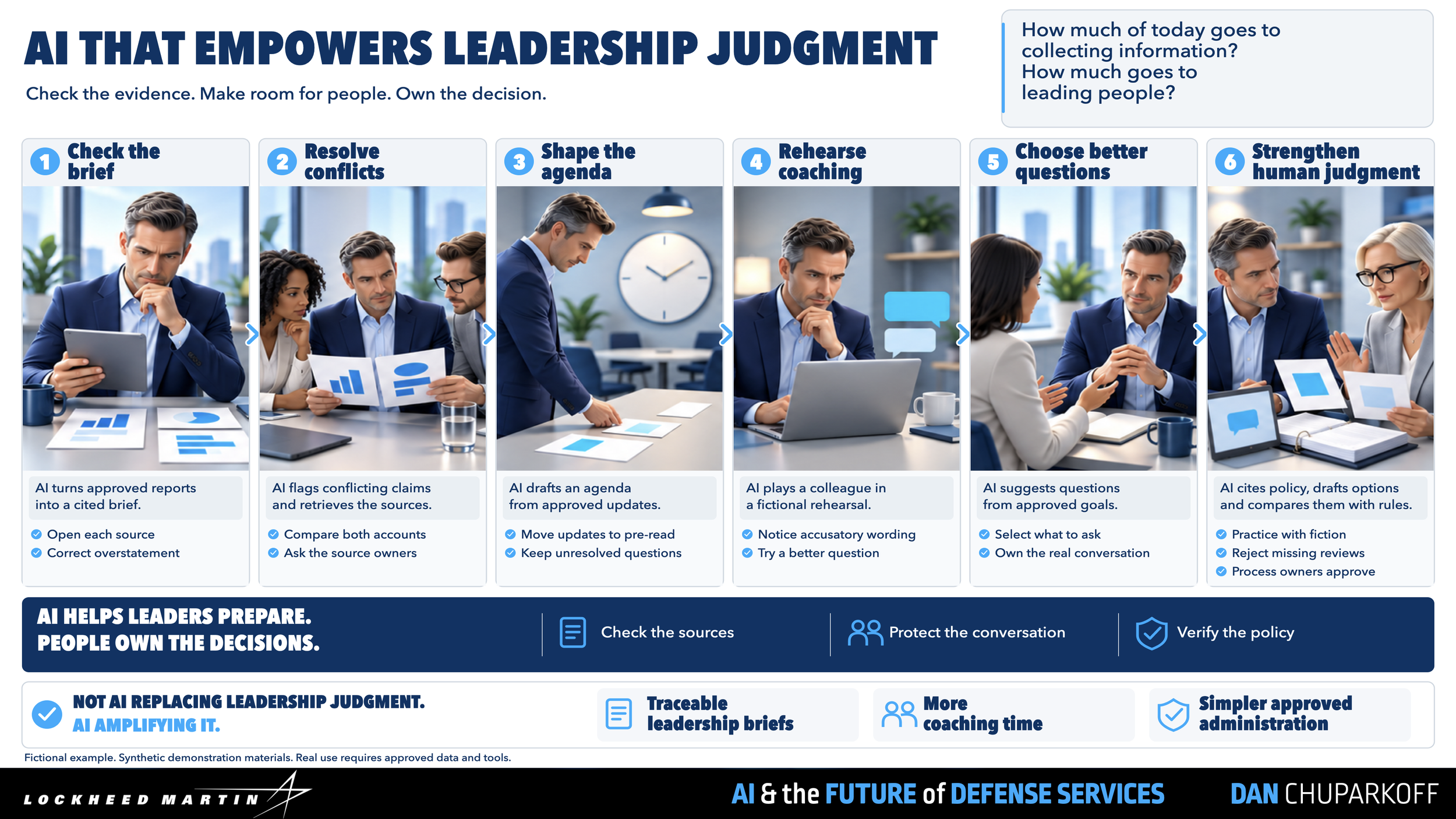
The keynote organized nine leadership opportunities into three groups. These are starting points for a conversation about your team's work, drawn from the session's presentation material. Use approved sources and tools, keep information traceable, and retain human review of the resulting options.
Traceable leadership briefs
Turn approved reports into CITED AI BRIEFS
AI CROSSCHECKS conflicting claims across approved management reports
Query approved reports through AI ANSWERS with citations
More coaching time
AI REHEARSES coaching conversations using fictional leadership scenarios
Turn updates into AI AGENDAS for shorter meetings
Turn approved goals into AI COACHING QUESTIONS
Simpler approved administration
AI ANSWERS administrative questions from approved policy documents
Draft AI SIMPLIFICATION OPTIONS from administrative procedures
Check administrative proposals with AI POLICY COMPARISONS
Start the conversation
Adapt the question used to develop these opportunities:
What are 9 ways AI will change the work of program directors, managers, and functional leaders responsible for hypersonic and strike development and production in defense manufacturing while improving decisions, coaching, and administrative flow despite fragmented information, meeting overload, bureaucracy, and confidentiality constraints?
Then ask for a picture of a future workday with the useful changes in place. For each promising change, ask why it matters, what it could look like, and three steps to get started. Use your knowledge of the team to decide which suggestions fit and what order makes sense.
Talk Flow
1. Technology changes how we work
A changing baseline
The digital emcee introduced a practical example of AI-assisted communication.
Look at familiar tasks in your workday to identify where a new tool could make a meaningful difference.
The copy-and-paste moment
Dan's parking-lot drafting story showed how AutoCAD could remove repetitive effort while a skilled person directed the work.
Once a better method becomes visible, the old process looks different.
Assistance & human ownership
AutoCAD helped an architect draw; the architect still owned the design and its decisions.
Ask where AI can assist your work and where your judgment remains essential.
The next step in familiar technology
Spreadsheets, the internet, mobile devices, and cloud tools changed how people store, share, and use information.
Learn AI as another practical work tool, much as copy and paste became an everyday capability.
2. Understand the help & its limits
Open the AI piñata
Learn what a tool does well and where it struggles before expecting value from it.
Choose a useful application rather than experimenting without a clear purpose.
“Once upon a …”
A familiar phrase illustrates how patterns and common usage can suggest a likely next word.
A fluent continuation still needs your attention; it may not be the answer you intended.
Keep your expertise
The B-minus-student metaphor describes useful general assistance across unfamiliar tasks.
Keep applying your deeper expertise while using AI to help with the other work around it.
Confidence & uncertainty
When several answers are possible, the most likely one can still be uncertain.
Decide whether the result is dependable enough for the decision and its stakes.
Glue in your pizza
The pizza example shows how jokes, sarcasm, and popular bad advice can become ingredients in an AI answer.
Review the output and its source material instead of treating a plausible answer as automatically useful.
3. Keep judgment & review in human hands
Familiar autocomplete
You can accept a useful suggestion and reject one that misses without abandoning the tool.
AI assistance still needs the context and judgment of the person doing the work.
Memories & hope
Past experience and the future you want to create shape judgment in ways information alone cannot.
Use AI to help gather intelligence while you decide how to apply it.
The intern relationship
Give clear instructions, inspect the result, and improve the guidance.
Review establishes whether the work is useful and where the assistant reaches its limits.
4. Build a roadmap & a personal coaching loop
A question specific to your work
Tell AI who you are, what you want to accomplish, and what makes that difficult.
Ask how assistance could improve decisions, coaching time, and administration within those constraints.
Nine leadership opportunities
Explore traceable briefs, more coaching time, and simpler approved administration.
Keep links to source material so the information and recommendations can be checked.
From ideas to first steps
Turn an opportunity list into a picture of a future workday, then ask what to do first.
For each useful change, ask why it matters, what it could look like, and three starting steps.
Your own performance coach
Dan's drafting example moved from dissatisfaction with generated posts to learning from a comparison with his own strongest work.
Define quality, compare examples, and use the feedback to improve your next attempt.
5. Make room to solve, decide & imagine
Jobs & the work pyramid
Separate communication, process, and investigation from solving problems, making decisions, and imagining possibilities.
Untangle the different kinds of work inside a task so assistance creates capacity for the choices people remain responsible for making.
Time recovered from meetings
The no-meeting-week example and the idea of meeting spectators invite a closer look at how attendance creates value.
Make reviewed notes useful to people who do not need to be in the room, and identify when needed expertise is missing.
New formats for important information
Turning keynote notes into a song demonstrated another way to share and revisit an important message.
Consider which training or strategy messages could benefit from a different format; the format should serve the purpose.
Collaboration across languages
Translation can help people collaborate in their preferred language, as the construction-team example illustrated.
Review requirements depend on the use; language support and professional translation review serve different needs.
CLOSING MESSAGE: Expand collaboration & flip the pyramid
More demands, the same week
Growing demands do not create more hours in the week.
Reduce time spent in the lower layers of work so people can tackle harder problems, make better decisions, and imagine a better future.