
ALIS FWD 2026: AI & the Future of Senior Living Operations
Listen to the
AI KEYNOTE SONG
The easiest way to review or share the key points of my AI Keynote is with this song: the full keynote, matched with slides, in 4m32s!
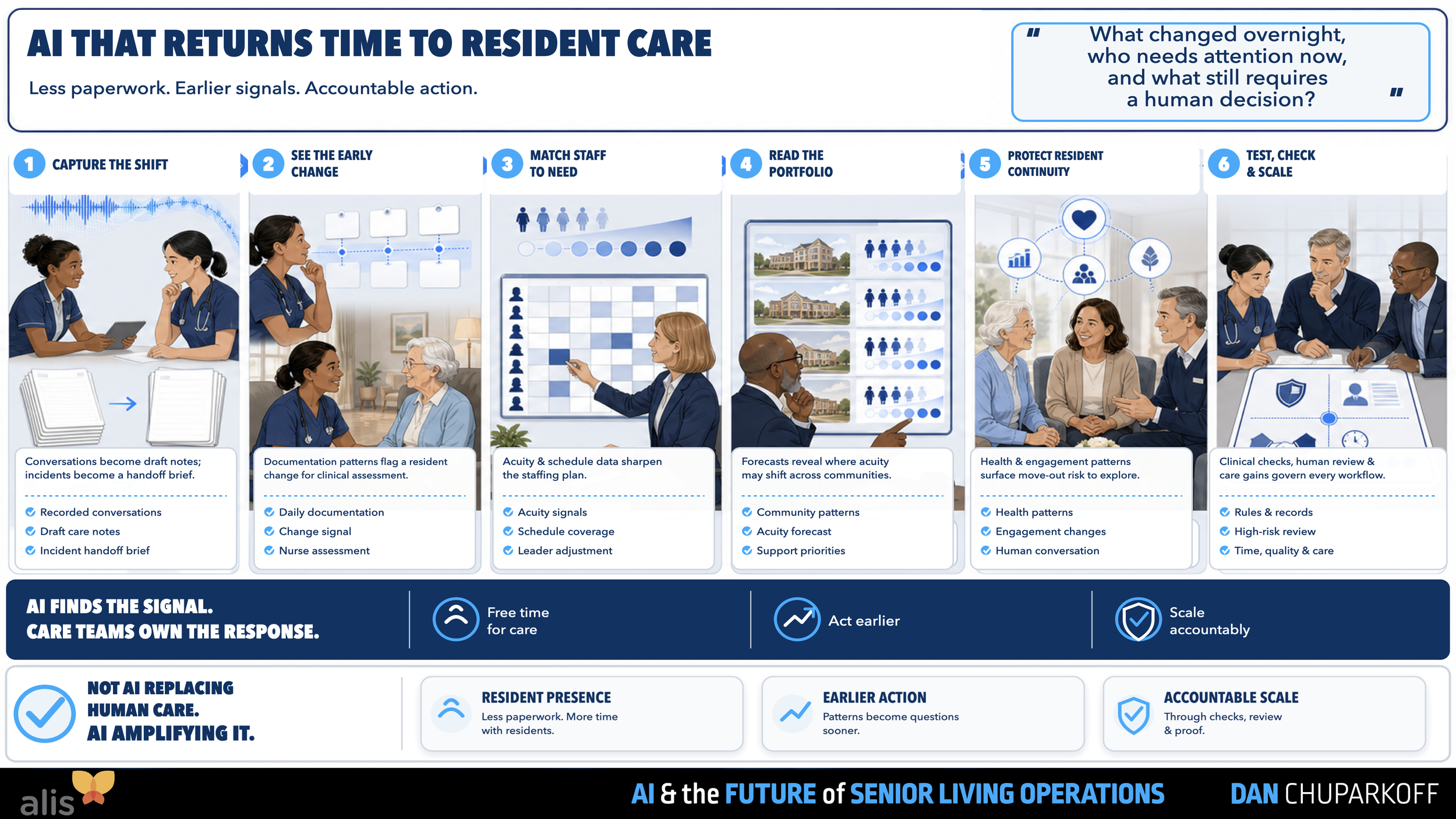
A day in the life in YOUR AI FUTURE

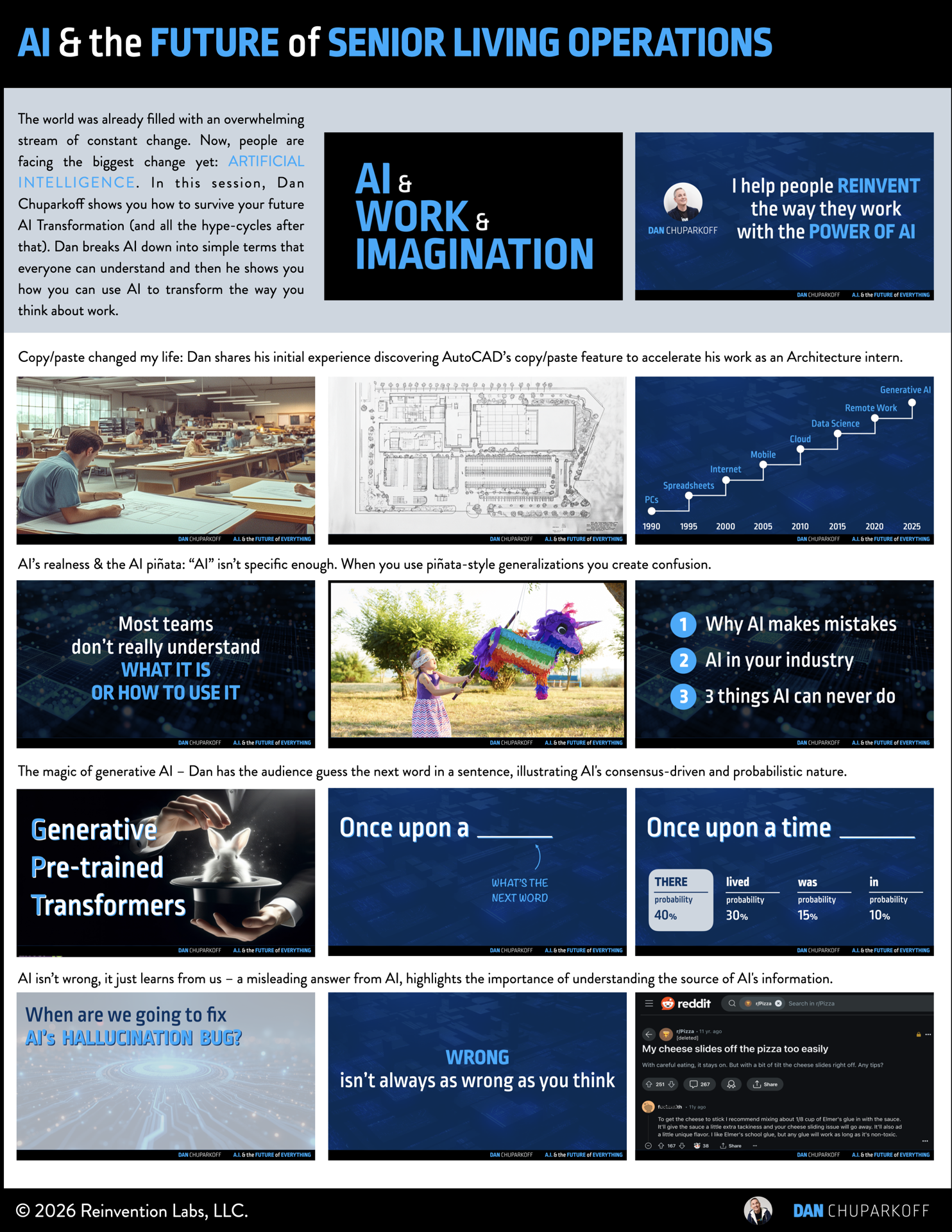
PDF SUMMARY of key slides
This “Slide Cheatsheet” was customized for your specific talk. It’s designed to help audience-members like you, by wrapping my AI & the Future of Everything keynote into an easy-to-skim, easy-to-share, or easy-to-print resource for future reference.
Download the 3 page
high-resolution PDF here:
Hope you find it helpful!
AI NOTES from Dan’s AI Keynote
*These notes were created using ChatGPT 5.6 pro.
Transcription errors or mistakes have not been fixed
in order to demonstrate the current state of AI notes.
One-Sentence Takeaway
Use AI to compress communication, process, and investigation work so people have more time to solve problems, make decisions, and imagine better futures for residents.
Summary
AI is the next major assistant layer in how work gets done. The AutoCAD copy-and-paste story showed the pattern: technology can make part of a job dramatically faster without becoming the professional who owns the work. The useful distinction is assistant versus automator. AI can help people move faster and improve their work, but it should not own human judgment.
Generative AI predicts likely words, pixels, and patterns. That makes it powerful, but not certain. It tends toward common answers, carries the weaknesses of its training material, and can present low-confidence output with a confident tone. Treat it like autocomplete: consider the suggestion, check it against evidence and context, and remain responsible for what happens next. Your expertise, memories, goals, and hopes give you a context advantage that AI does not have.
For senior living, the opportunity is to reduce paperwork pressure, connect scattered signals, and move from isolated experiments to accountable workflows. Start now with practical assistance, including drafting, research, planning, information capture, and feedback. Then reinvest the time saved in the work people do best: solving unfamiliar problems, making responsible decisions, and imagining better resident experiences.
Action Items
[ ] Inventory one week of work and label each activity as communication, process, investigation, problem solving, decision-making, or imagination.
[ ] Choose one repeatable, low-stakes task from the first three layers and test AI as an assistant, with a person responsible for reviewing the result.
[ ] Use AI as a performance coach: complete an important piece of work, compare it with previous examples, ask where it ranks, and request specific improvement advice.
[ ] Before acting on AI output, assess the stakes and specificity of the request, check important claims against trusted evidence, and apply your own context and judgment.
[ ] Test one privacy-appropriate communication workflow, such as meeting notes, shift handoffs, or translation, and evaluate its effect on time, quality, and resident care.
Key Ideas
AI is an assistant, not an automator
Use AI to support professionals, accelerate parts of the work, and improve access to information. Keep accountable people in charge of decisions and outcomes.
Probability is not certainty
AI generates the most likely continuation from patterns in its training data. A polished answer can still be uncertain, incomplete, or wrong.
Humans have the context advantage
People make choices using lived experience, current circumstances, relationships, values, and goals. AI can add information, but it cannot replace that full human context.
Ask AI to improve work
Do not limit AI to producing a first draft. Use it to compare, rank, critique, and strengthen work you and your team already do.
Flip the work pyramid
Compress the time spent communicating, processing, and investigating. Reinvest that capacity in solving, deciding, and imagining.
Senior Living opportunities
From paperwork pressure to resident presence
Draft care notes from recorded staff conversations.
Auto-summarize incident reports into shift handoff briefs.
Predict staffing needs from acuity and schedule data.
From scattered signals to earlier action
Flag resident health changes from daily documentation patterns.
Use portfolio data models to forecast acuity shifts.
Use health and engagement models to forecast move-outs.
From AI experimentation to accountable scale
Test AI workflows against time, quality, and care gains.
Check model outputs against clinical rules and records.
Route high-risk decisions to accountable human review.
Talk Flow
See AI as the next assistant layer
The moving baseline
AI-generated material is improving quickly enough to change expectations for everyday work.
Look for manual routines where assistance could improve speed, quality, or access to information.
The AutoCAD copy-and-paste moment
A parking-lot design that once took days could be completed in seconds with computer assistance.
Once a useful form of assistance becomes visible, returning to the old manual method can feel unreasonable.
Assistant versus automator
AutoCAD amplified architects; it did not become the architect responsible for complex choices.
Apply the same mental model to AI: give it work, but do not hand it ownership of judgment.
The technology staircase and AI piñata
PCs, spreadsheets, the internet, mobile tools, cloud systems, data science, and remote work all became part of normal work.
Move beyond vague AI enthusiasm by identifying what is useful, what is risky, and what can be applied now.
Use AI with informed skepticism
“Once upon a time”
Generative AI predicts the next likely word; image systems perform a similar prediction with pixels.
Its answers tend toward consensus and the middle of the bell curve, not automatically toward expert truth.
The B-minus baseline
AI can raise your baseline across tasks outside your deepest expertise.
Keep building and applying A-plus human expertise where the work carries real responsibility.
The hidden confidence table
Every generated answer contains uncertainty, even when the wording sounds confident.
Unique, niche, and high-stakes questions deserve more scrutiny because fewer relevant patterns may support the answer.
Hallucinations and glue in the pizza
Wrong answers are a consequence of probabilistic generation and imperfect source material, not a temporary inconvenience that can simply be ignored.
Online jokes, sarcasm, weak advice, and expert knowledge can all enter the same training mixture.
Autocomplete, memories, and hope
Treat AI output as a suggestion you can accept, reject, or revise.
Human judgment draws on lived experience and the future you are trying to create.
Put AI to work in senior living
Ask a better industry question
Frame the prompt around the people doing the work, the service they provide, the outcomes they need, and the constraints they face.
Use the response to begin a practical conversation about what to test and prepare for.
Three operating shifts
Reduce paperwork pressure so teams can spend more time present with residents.
Connect scattered signals so leaders can see changes earlier and act with a fuller picture.
Move from isolated experiments to governed workflows with human accountability.
The AI-assisted day in the life
AI can help surface what changed, organize information, support staffing and portfolio views, and identify issues that need attention.
The leader's role shifts toward designing and guiding the system, not merely executing its instructions.
The performance-coach loop
Complete the work, then ask AI to compare it with previous examples and identify how it could improve.
Use repeated feedback to strengthen capability rather than creating passive dependence on generated output.
Protect the work only people can own
An infinite supply of work
AI can take tasks off an overloaded plate, while people decide which work to delegate.
Efficiency can create capacity to address problems that previously remained in triage.
The six layers of work
Communication, process, and investigation occupy much of the base of the work pyramid.
Problem solving, decision-making, and imagination sit above them and often receive too little time.
Solve, decide, and imagine
New and unfamiliar problems still require human interpretation and expertise.
Decisions require context and accountability; imagining requires a view of the future people want to create.
Flip the pyramid through better communication
Information capture
AI-supported notes can make conversations searchable, reusable, and easier to share.
Select tools and workflows that fit the privacy and governance needs of the conversation.
Notes transformed into new formats
The keynote song demonstrated how the same information can become a more memorable and shareable experience.
Match the communication format to how the audience will best understand and reuse the material.
Real-time translation
Translation assistance can reduce language barriers across teams and communities.
Evaluate capability, privacy, and fit before adopting a specific tool.
Closing Message - Managing in the world of more
Information, systems, collaboration demands, and expectations keep growing while available time does not. Compress the lower layers of work and reinvest the recovered capacity in better decisions, harder problems, and better futures for residents.