
FPDA+ISD 2026: AI & the Future of Fluid Power & Sealing
Listen to the
AI KEYNOTE SONG
The easiest way to review or share the key points of my AI Keynote is with this song: the full keynote, matched with slides, in 4m32s!
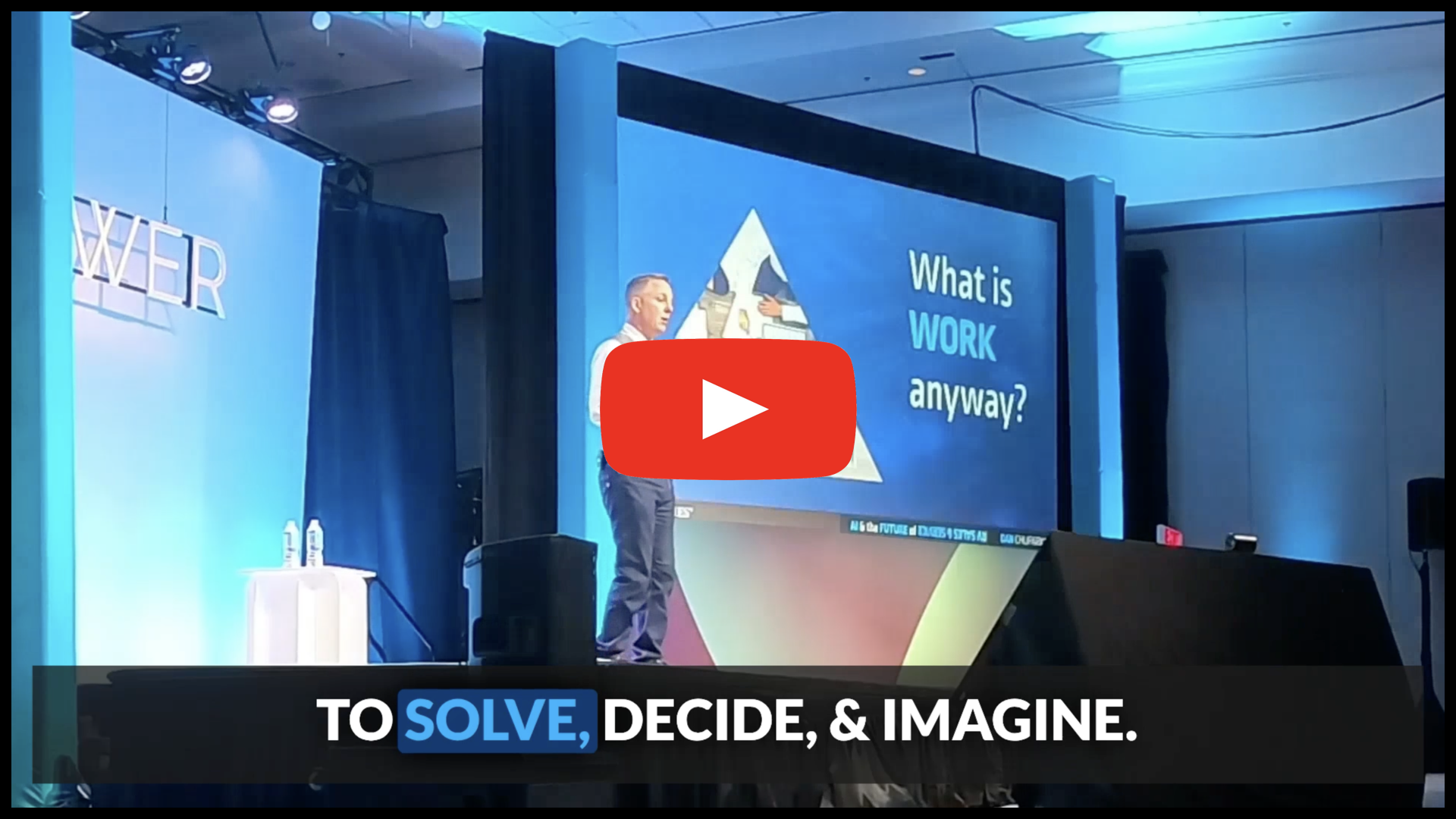
A day in the life in YOUR AI FUTURE

PDF SUMMARY of key slides
This “Slide Cheatsheet” was customized for your specific talk. It’s designed to help audience-members like you, by wrapping my AI & the Future of Everything keynote into an easy-to-skim, easy-to-share, or easy-to-print resource for future reference.
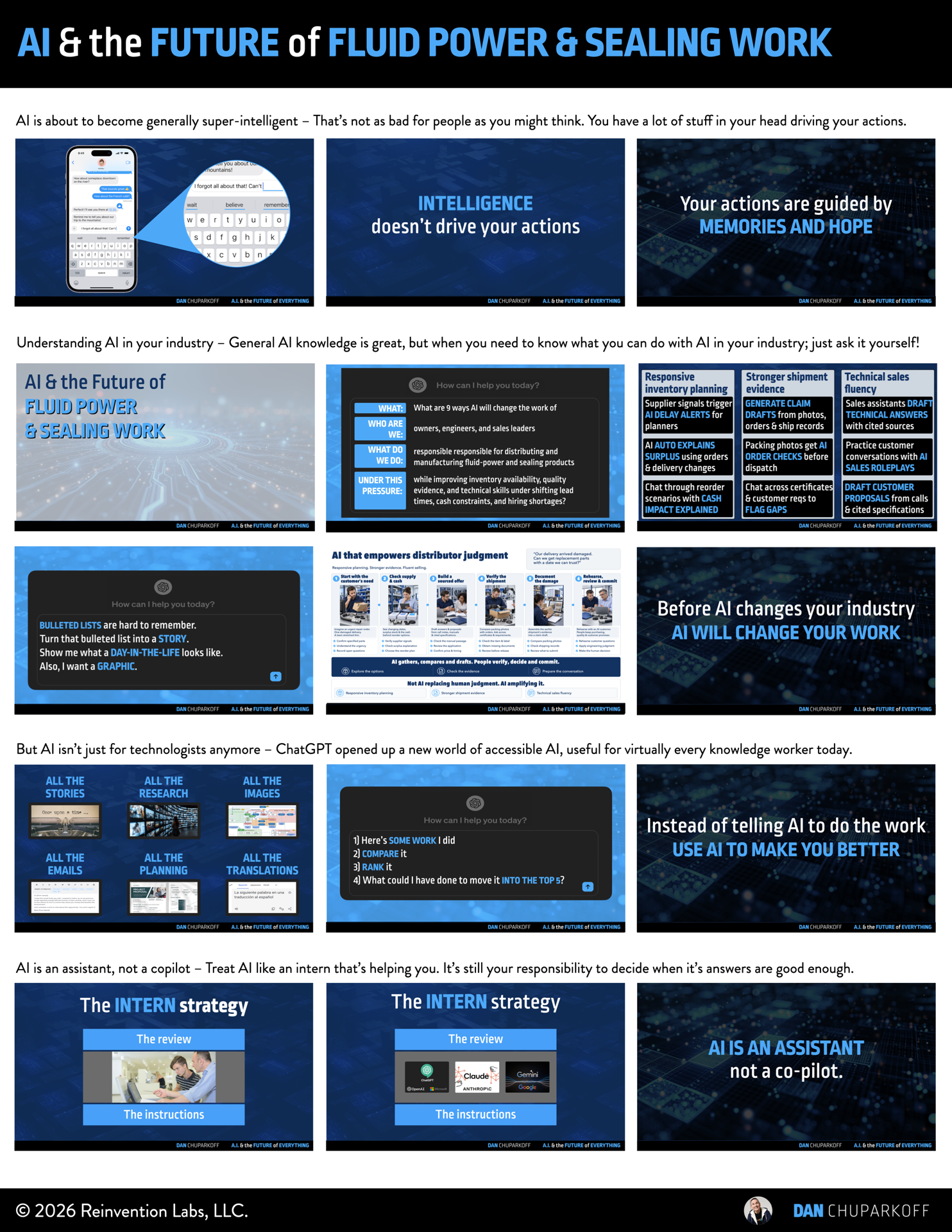
Download the 3 page
high-resolution PDF here:
Hope you find it helpful!
AI NOTES from Dan’s AI Keynote
*These notes were created using ChatGPT 5.6 pro.
Transcription errors or mistakes have not been fixed
in order to demonstrate the current state of AI notes.
One-Sentence Takeaway
Use AI to make communication, process, and investigation more efficient so people have more time to solve problems, make decisions, and imagine a better future.
Summary
AI is another major change in how people get work done. Dan's first encounter with AutoCAD turned drawing parking-lot lines by hand into a copy-and-paste task. The important distinction was between assisting an architect and replacing one. The same distinction applies to AI: useful assistance can change the work while people remain responsible for the result.
The keynote explained AI through familiar experiences. Predicting the next word in “Once upon a…” showed how a likely answer can emerge from patterns. The glue-in-pizza example showed why popular source material can still produce a bad suggestion. Autocomplete offered a practical response: use a suggestion when it helps, reject it when it does not, and keep applying your own judgment. The intern metaphor added a management process: give instructions, inspect the work, improve the instructions, and learn which tasks the assistant can handle.
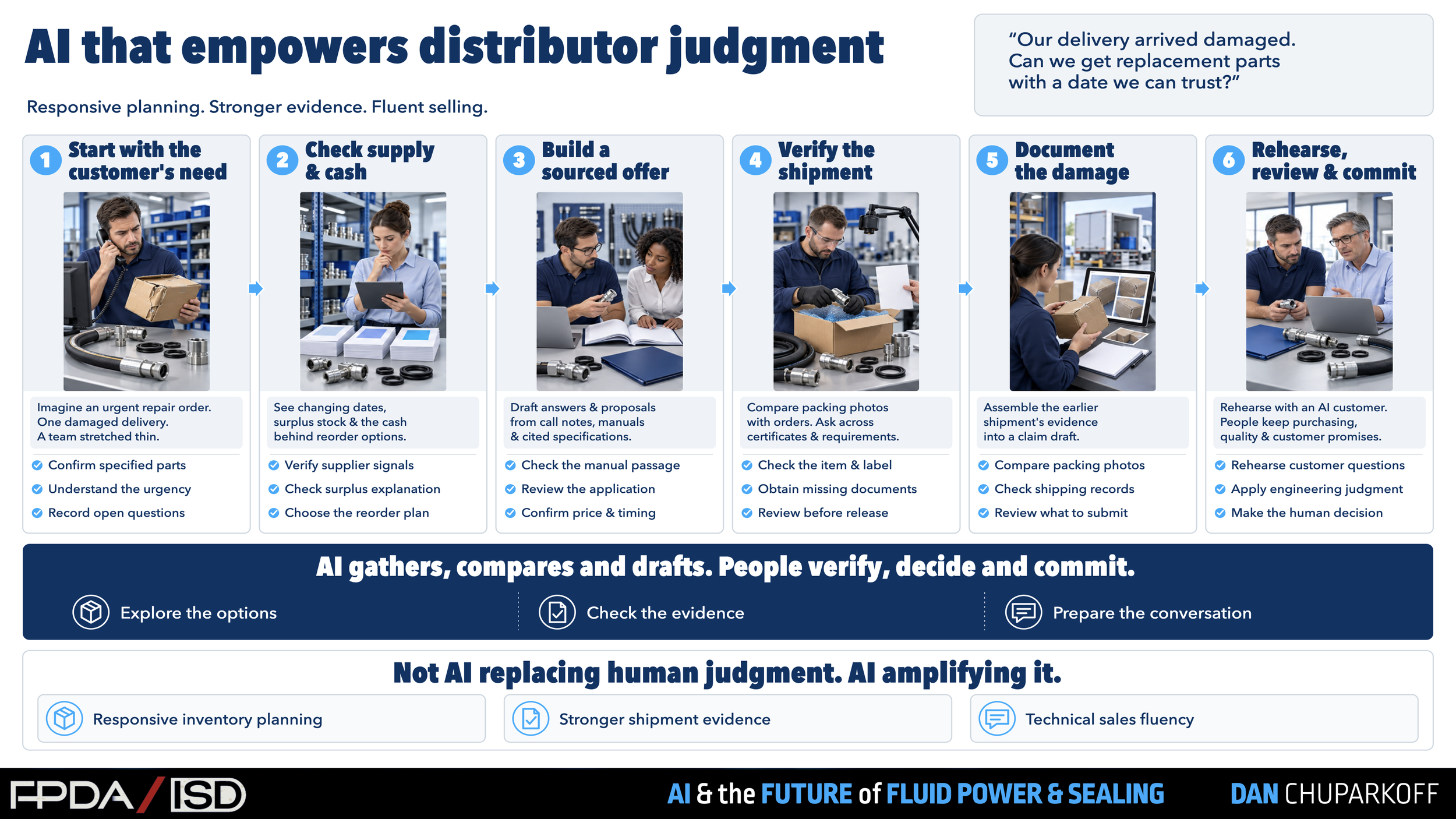
For fluid-power and sealing leaders, the industry opportunities centered on responsive inventory planning, stronger shipment evidence, and technical sales fluency. Dan also demonstrated a personal starting point that does not require waiting for an IT project: do your work, then ask AI to compare it with your earlier work and help you improve. Better communication, meeting support, new learning formats, and translation can create more room for the most valuable human work: solving, deciding, and imagining.
Action Items
[ ] Ask an AI assistant how your work could change using your role, responsibilities, desired outcomes, and operating constraints. Use the industry question below as a starting point, then investigate the answer most relevant to your business.
[ ] Choose one piece of your own work, such as a customer email, proposal, or permitted call transcript. Ask AI to compare it with earlier examples, identify what your strongest work did differently, and suggest a specific improvement.
[ ] Keep a human review step for AI-assisted customer work. Read the output, inspect its sources, and decide whether it is suitable before using it. If you use a customer chatbot, review its conversations and arrange a way for a person to take over.
[ ] Try a meeting notetaker permitted by your team's privacy policy. Use its transcript and notes to recover a decision or earlier discussion instead of relying only on scattered handwritten notes.
[ ] Pick one recurring communication, process, or investigation task to make more efficient. Decide which unresolved problem, important decision, or future opportunity should receive the time you recover.
Key Ideas
Assistance keeps you responsible
An AI assistant needs direction and review. Like an intern, it can help with useful work while you remain the person deciding whether that work is good enough.
A likely answer still needs judgment
A confident response does not settle whether an answer is appropriate for your situation. The autocomplete example provides a familiar habit: accept helpful suggestions and move past the ones that do not fit.
Watch for glue in your pizza
AI can draw on material containing jokes, mistakes, and novice advice as well as expertise. Check what sits behind an answer before acting on it.
Your memories & hopes shape decisions
Experience tells you what to repeat or avoid. Hope tells you which future you want to build. Bring both into decisions instead of handing those decisions to an assistant.
Use AI to improve your own work
The performance-coach loop starts with work you did yourself. Compare it with previous attempts, examine the strongest examples, and use the feedback in your next attempt.
Put more time at the top of the pyramid
Communication, process, and investigation consume time needed for problem solving, decision making, and imagining. Make the lower layers more efficient so the upper layers receive more attention.
Fluid power & sealing opportunities
Dan grouped the industry discussion into three shifts. The nine examples below come from the session's transformation list and provide starting points for investigating your own business needs. A reusable question from the session:
What are 9 ways AI will change the work of owners, engineers, and sales leaders responsible for distributing and manufacturing fluid-power and sealing products while improving inventory availability, quality evidence, and technical and commercial skills under shifting lead times, cash constraints, and hiring shortages?
Responsive inventory planning
Supplier signals trigger AI DELAY ALERTS for planners
Inventory assistants EXPLAIN SURPLUS using orders & delivery changes
Chat through reorder scenarios with CASH IMPACT EXPLAINED
Stronger shipment evidence
GENERATE CLAIM DRAFTS from photos, orders & shipping records
Packing photos get AI ORDER CHECKS before dispatch
Chat across certificates & customer requirements to FLAG GAPS
Technical sales fluency
Sales assistants DRAFT TECHNICAL ANSWERS with cited manual passages
Engineers practice customer conversations with AI SALES ROLEPLAYS
DRAFT CUSTOMER PROPOSALS from calls & cited specifications
Use the question repeatedly as your priorities change. The value is in learning to investigate your own operating problems, with people retaining purchasing, quality, and customer accountability.
Talk Flow
1. Recognize the next change in how work gets done
AI-generated content & changing expectations
Dan opened with an AI-generated introduction to show how quickly the quality of assistance is changing.
Look at the work you do today and consider where that assistance could change the way you do it.
A technology journey & the AutoCAD discovery
Dan connected his early work experience to a career building technology used at much greater scale.
Copying and pasting parking-lot lines showed how a tool could remove repetitive effort while an architect still directed the work.
Assistant versus automator
Fear of a tool taking over can obscure the useful assistance it offers.
PCs, spreadsheets, mobile technology, and other changes became ordinary ways of working; AI is another step in that progression.
2. Understand the help while keeping your judgment
Open the AI piñata
Investigate what AI can actually help with instead of trying tools without understanding their role.
The GPT explanation and “Once upon a…” experiment introduced generated answers built from learned patterns.
Probability & glue in your pizza
When several answers are possible, the most likely answer can still be wrong for the task.
The insurance analogy illustrated uncertainty; the pizza story showed how flawed source material can turn into a confident suggestion.
Autocomplete as a familiar model
You already know how to accept a useful suggestion and ignore one you did not intend.
Apply that habit to AI assistance, especially when customers will see the result.
Memories & hope
Your past experiences and desired future shape choices in ways an assistant does not own.
Keep responsibility for decisions with people.
Manage AI like an intern
Give instructions, inspect the result, refine the instructions, and learn the assistant's limits.
AI works with you, and you are still the boss.
3. Apply AI to the business & your own work
Ask a question shaped by your work
Name who you are, what you do, and what makes it difficult.
Ask about opportunities for your responsibilities instead of relying on a generic list of AI capabilities.
Three industry shifts
Responsive inventory planning connects changing information to planning decisions.
Stronger shipment evidence helps teams examine orders, documentation, and gaps.
Technical sales fluency helps people build capability across engineering and customer conversations.
A personal performance coach
You can start improving your own work before a larger software project is available.
Dan's LinkedIn example changed the request from writing for him to comparing his work with his best earlier work.
Use the same compare-and-improve loop for customer calls, writing, presentations, and other repeated work.
4. Make room for solving, deciding & imagining
Distinguish work from jobs
AI assistance can take on some work while an unfinished list of problems and decisions remains.
Greater efficiency creates capacity to address work that was previously left waiting.
Understand the six layers of work
Communication, process, and investigation form the lower layers of the work pyramid.
Problem solving, decision making, and imagining require attention to new situations, judgment, and the future you want to pursue.
The purpose of improving the lower layers is to make more room for those higher-value activities.
5. Change collaboration & flip the pyramid
Communication & meeting support
AI can help summarize, recover, and connect information that people struggle to keep track of.
Meeting notes and the facilitator example showed opportunities to make conversations more useful and less repetitive.
Notes can become a song
The chorus reinforced the need for people to solve, decide, and imagine.
Changing information into another format can make it easier to revisit, remember, and share; Dan suggested a training guide as one possible application.
Collaboration across languages
The multilingual video and headphone examples showed people communicating in the languages comfortable for them.
Translation can help coworkers and customers share information across language barriers
CLOSING MESSAGE: Expand collaboration & turn the pyramid over
More demands, the same hours
Customer expectations, systems, supply-chain problems, and other demands keep adding work to the day.
Make communication, process, and investigation more efficient so you can address problems, make decisions, and imagine a better future for fluid power and sealing.