
TEC 2026: AI & the Future of Electric Coop Leadership
Listen to the
AI KEYNOTE SONG
The easiest way to review or share the key points of my AI Keynote is with this song: the full keynote, matched with slides, in 4m32s!
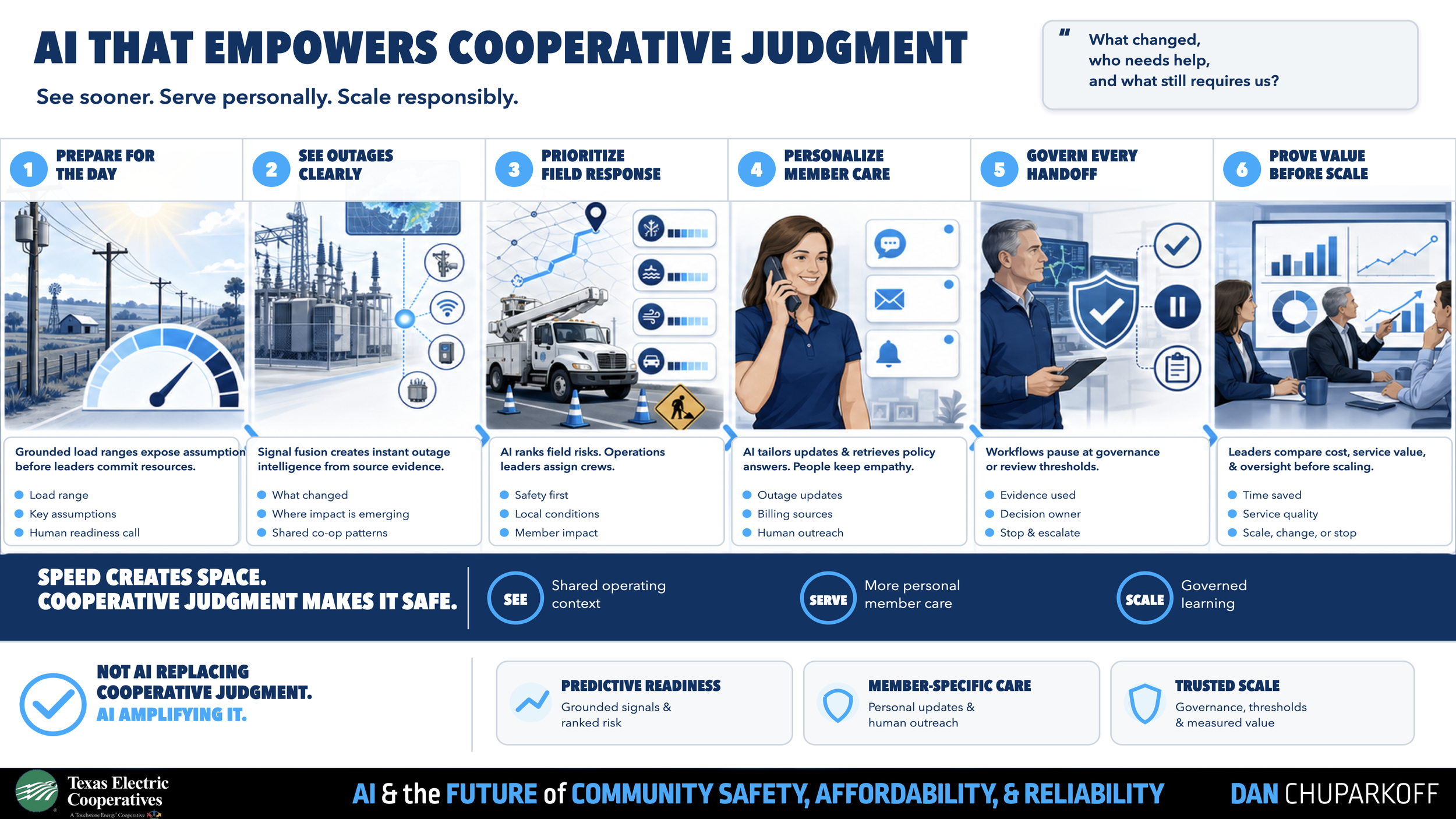
A day in the life in YOUR AI FUTURE

PDF SUMMARY of key slides
This “Slide Cheatsheet” was customized for your specific talk. It’s designed to help audience-members like you, by wrapping my AI & the Future of Everything keynote into an easy-to-skim, easy-to-share, or easy-to-print resource for future reference.
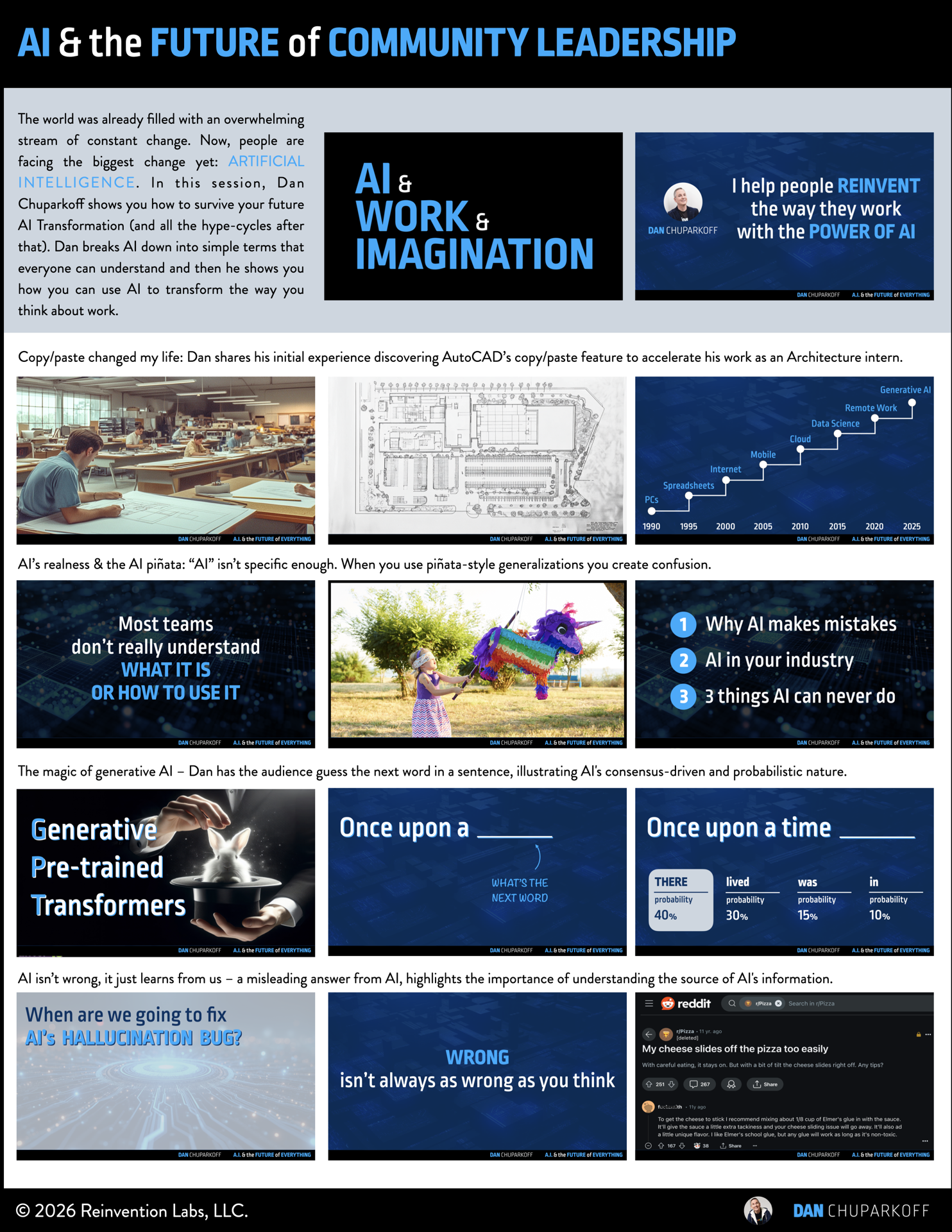
Download the 3 page
high-resolution PDF here:
Hope you find it helpful!
AI NOTES from Dan’s AI Keynote
*These notes were created using ChatGPT 5.6 pro.
Transcription errors or mistakes have not been fixed
in order to demonstrate the current state of AI notes.
One-Sentence Takeaway
Use AI as a B-minus assistant to compress communication, process, and investigation work, while cooperative leaders keep responsibility for safe, affordable, and reliable service, member trust, decisions, and local quality of life.
Summary
AI is becoming part of the normal fabric of work, much as PCs, spreadsheets, the internet, mobile devices, cloud tools, data science, and remote work did before it. The AutoCAD story established the keynote's central distinction: technology can create extraordinary leverage as an assistant without becoming the expert, decision-maker, or accountable professional.
Generative AI predicts likely output from patterns in existing information. That makes it broadly useful, but also probabilistic, consensus-driven, and vulnerable to weak source material. Dan described AI as a B-minus assistant that can raise a person's baseline across unfamiliar tasks. Cooperative leaders still provide the A-plus industry expertise, local context, memories, hopes, judgment, and accountability.
For Texas electric cooperatives, the practical opportunity is to improve outage awareness, field coordination, member communication, recurring work, and governed experimentation. The goal is not to transfer consequential service, member, regulatory, or community decisions to AI. It is to create more capacity for people to solve new problems, make thoughtful decisions, and imagine a better quality of life for the communities they serve.
Action Items
[ ] Ask your AI assistant how your specific role may change, including the service you provide, the outcomes you need, and the trust, regulatory, affordability, reliability, and local-context constraints you must preserve.
[ ] Identify one recurring communication, process, or investigation task that takes time away from member service, field leadership, difficult decisions, or community problem solving.
[ ] Complete one important message, plan, meeting, report, or workflow yourself, then ask AI to compare it with prior strong examples and explain how the next version could be better.
[ ] Before acting on consequential AI-supported work, inspect its sources, assumptions, missing context, uncertainty, and required human-review threshold.
[ ] Track whether an AI-supported workflow creates real capacity and value before scaling it, then reinvest the time in solving, deciding, imagining, and serving members.
Key Ideas
Assistant, not automator
AutoCAD helped an architect create precise work faster without becoming an architect. AI should be framed the same way: people supply intent, expertise, review, judgment, and accountability.
AI is a B-minus assistant
AI can raise a person's baseline in research, communication, planning, facilitation, and other supporting work. It should extend the expertise a cooperative leader owns, not replace it.
Probability is not certainty
AI chooses the most likely answer even when its confidence may be lower than the situation requires. A polished response does not reveal the uncertainty, source quality, or missing context underneath it.
The internet is part of the training data
The glue-in-the-pizza example showed how jokes, sarcasm, trolls, novices, and experts can become mixed source material. A popular or plausible answer is not automatically a trustworthy answer.
Treat output as a recommendation
Autocomplete provides a familiar model: accept useful suggestions, reject weak ones, and continue with the work you intended to do. Consequential work requires the same human control with stronger review.
Memories and hopes shape judgment
People make decisions with experience, context, relationships, and a future they want to create. Different memories and hopes are also part of why collaboration among cooperative leaders remains valuable.
Use AI as a performance coach
Do not only ask AI to create work. Ask it to compare new work with prior strong work, rank it against clear criteria, identify gaps, and coach the next iteration.
AI is more like an intern than a copilot
Give it instructions, review the work, improve the instructions, and learn its capability ceiling. The leader remains responsible for the quality and consequences of everything the assistant touches.
Protect the top of the work pyramid
AI is strongest at helping with communication, process, and investigation. The capacity created should be reinvested in solving new problems, making judgment-rich decisions, and imagining better outcomes.
Make information easier to use
Searchable meeting notes, memorable formats, and real-time translation show how AI can change the way teams capture, share, and understand information without removing the people responsible for acting on it.
Texas Electric Cooparative Opportunities
From reactive grids to predictive readiness
Surface instant outage intelligence through machine-learning signal fusion.
Forecast demand with AI-grounded load models.
Route field crews through AI-ranked risk priorities.
From generic service to member-specific care
AI-personalize member updates during outages without losing empathy.
Answer billing questions through grounded AI over cooperative policies.
Prioritize human outreach using AI-ranked member needs.
From isolated pilots to trusted scale
Flag governance gaps before agentic decisions reach members.
Monitor autonomous workflows with human-review thresholds.
Compare pilots through AI-tracked cost and value before scaling.
These are candidates for governed exploration, not instructions to transfer accountability. Cooperative leaders remain responsible for approved tools and information, member trust, regulatory obligations, operational judgment, service outcomes, and the consequences of action.
Talk Flow
Technology assistance changes the baseline
The AI-generated opening
The quality threshold for AI-supported work is moving quickly.
Assistance that improves information, communication, and process will increasingly become part of normal work.
The AutoCAD copy-and-paste moment
Work that once took days could be completed in seconds with greater precision.
Once technology assistance becomes dramatically better, returning to the old way feels unreasonable.
Assistant vs automator
AutoCAD increased an architect's leverage without becoming an architect.
AI should help experts create more value while people retain responsibility for the work.
The technology staircase
PCs, spreadsheets, the internet, mobile devices, cloud tools, data science, and remote work each changed how work gets done.
Generative AI is the next copy-paste moment moving into the operating baseline.
Understand the assistant before trusting it
Cracking open the AI piñata
Leaders need to separate useful assistance from novelty, cost, and risk.
The goal is to find applications that create more value than friction.
Prediction, consensus, and the B-minus assistant
The `Once upon a time` exercise showed AI predicting what comes next.
Consensus-driven output tends toward the middle of the available answers.
AI can raise a person's baseline in supporting tasks without replacing chosen expertise.
Confidence and hallucinations
AI selects the most likely answer even when confidence may be lower than the situation requires.
Fluent output does not reveal the uncertainty underneath it.
Review should become stronger as the consequences increase.
Glue in the pizza and autocomplete
Training material contains experts, novices, jokes, sarcasm, and deliberate nonsense.
Accept useful suggestions, reject weak ones, and keep the human in control.
Apply AI to safe, affordable, and reliable service
The cooperative-leadership question
Ask how AI will change the work of CEOs, board directors, and key staff, not only which tools are popular.
Include member trust, regulated accountability, and local quality of life in the question.
Three cooperative shifts
Move from reactive grids to predictive readiness.
Move from generic service to member-specific care.
Move from isolated pilots to trusted scale.
A cooperative day in the life
AI assistance can surface preparedness needs, improve outage clarity, prioritize field response, personalize member care, and coordinate handoffs.
People remain responsible for validating the information and deciding what happens next.
AI as a transformation consultant
Use the first answer to begin a conversation, explore one priority, and expose requirements, risks, and next steps.
Test and simulate ideas before committing to scale.
Improve the work without surrendering judgment
AI as a performance coach
Complete important work yourself, then ask AI to compare it with prior strong examples.
Use ranking and critique to improve the next attempt instead of delegating away expertise.
Intern, not copilot
An intern receives instructions, attempts work, receives review, and improves through feedback.
Repeated review reveals the assistant's capability ceiling.
The leader remains accountable for everything the assistant touches.
Memories, hopes, and collaboration
Decisions draw on experience, local knowledge, relationships, and the future people want to create.
Cooperative leaders bring different memories and hopes together to make stronger choices.
Solve, decide, and imagine
People remain responsible for novel problems that require local expertise.
Decisions require judgment, context, preferences, and responsibility.
Imagining requires choosing which possible future deserves commitment.
Reinvest capacity in cooperative communities
The lower layers of the work pyramid
Communication, process, and investigation form the broad base of work.
AI can help organize information and compress parts of those layers.
Searchable and memorable communication
AI-supported notes can preserve useful context and make it searchable.
Turning notes into a song showed that information can be repackaged into a form people are more likely to remember.
Translation and access
AI can reduce language barriers and help people collaborate in the language most comfortable for them.
Leaders still need to consider the privacy and governance of the tools they choose.
Closing Message - Managing in the world of more
Information, systems, expectations, and possible work keep growing while available hours remain fixed. The closing challenge was to flip the work pyramid and reinvest saved capacity in solving, deciding, and imagining the future of design, make, and engineering.