
Tennessee Hospital Association 2026:
AI & the Future of Hospital Leadership
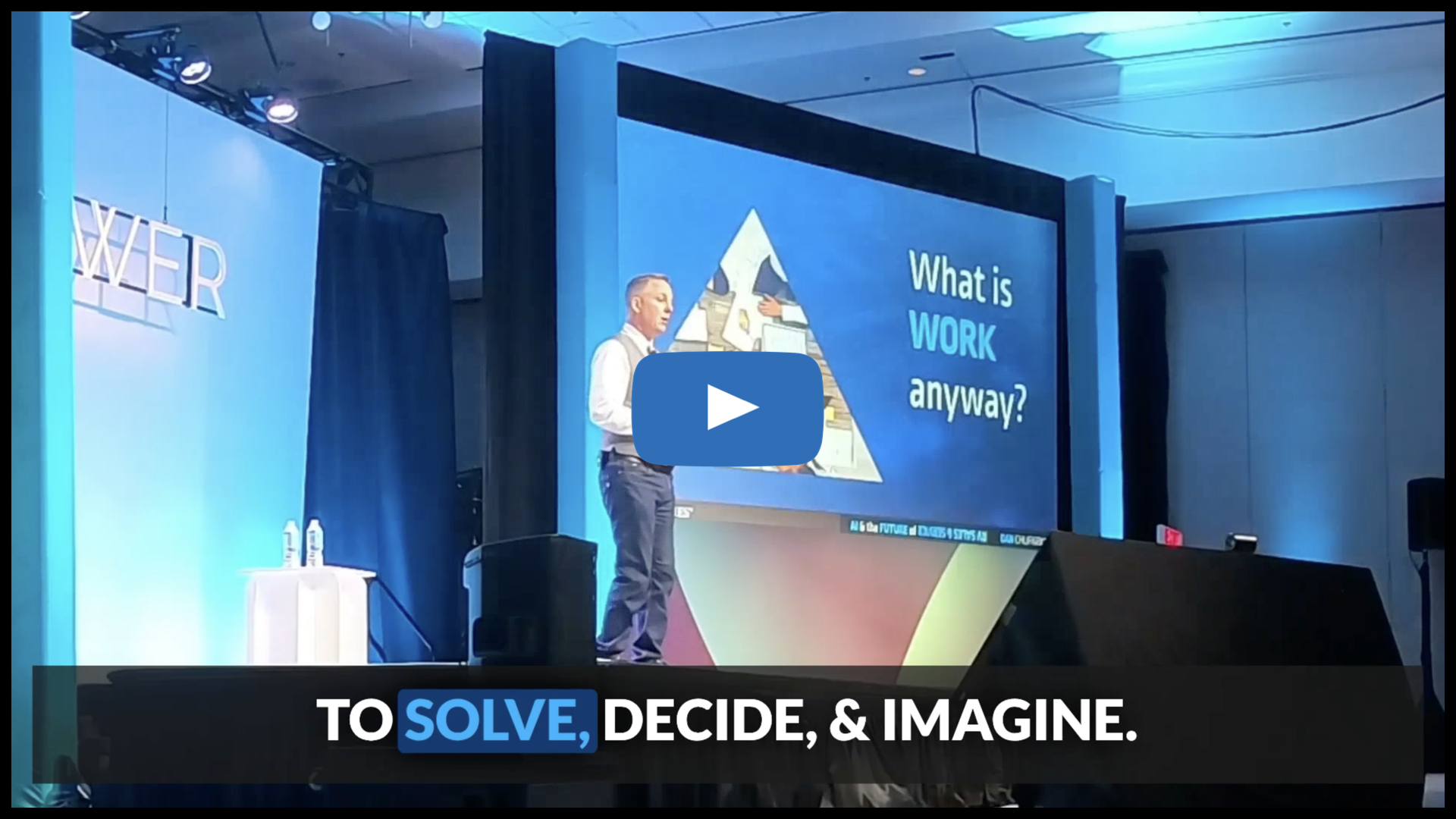
Listen to the
AI KEYNOTE SONG
The easiest way to review or share the key points of my AI Keynote is with this song: the full keynote, matched with slides, in 4m32s!

PDF SUMMARY of key slides
This “Slide Cheatsheet” was customized for your specific talk. It’s designed to help audience-members like you, by wrapping my AI & the Future of Everything keynote into an easy-to-skim, easy-to-share, or easy-to-print resource for future reference.
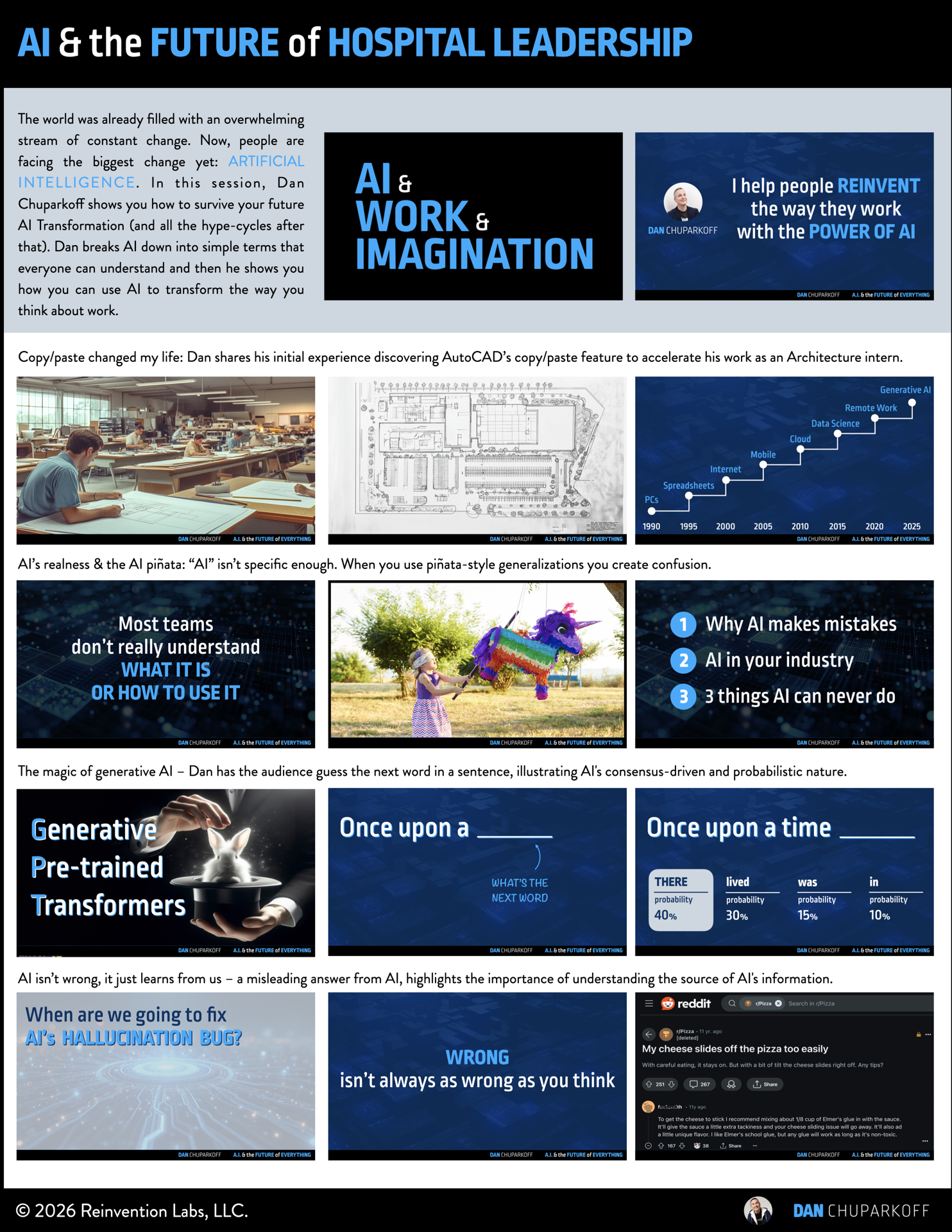
Download the 3 page
high-resolution PDF here:
Hope you find it helpful!
AI NOTES from Dan’s AI Keynote
*These notes were created using GPT 5.5 pro.
Transcription errors or mistakes have not been fixed
in order to demonstrate the current state of AI notes.
One-Sentence Takeaway
AI is most useful when hospital leaders use it as an assistant that reduces lower-level work while keeping people responsible for judgment, risk, decisions, and imagination.
Summary
Dan opened with an AI-generated video to show that AI-generated work has crossed an important threshold. The old signal used to be, "This looks a little off, so it must be AI." Now the threshold is changing: work that looks off may increasingly signal that someone tried to do it without AI assistance. That shift matters because AI is changing the baseline for how work gets done.
The keynote used Dan's first "copy and paste" moment with AutoCAD as the central analogy. AutoCAD did not replace architects. It took repetitive drafting work and made architects more valuable by letting them create more value faster. Dan framed AI the same way: not as a work automator, but as a work assistant.
The middle of the keynote explained why AI is powerful and risky at the same time. AI generates probable answers, which means confidence matters. Leaders need to ask AI where its answer came from, how confident it is, what assumptions it made, and what decisions it made along the way. In a healthcare environment, that human review is not optional.
For hospital and health-system executives, Dan focused on practical places AI can help: reducing administrative burden, improving revenue-cycle insight, and modernizing clinical workflows under governance. The closing message was that AI gives leaders a chance to spend less time on the bottom of the work pyramid and more time solving problems, making decisions, and imagining better ways to serve patients and teams.
Action Items
[ ] Pick one repetitive administrative, revenue-cycle, or documentation workflow where AI could draft, summarize, route, or prioritize work with human review.
[ ] When using AI for an important answer, ask: "How sure are you, what sources did you use, and what assumptions did you make?"
[ ] Use AI as a coach on your own work: create the draft yourself, then ask AI to compare it against prior examples and suggest how to improve it.
[ ] Define guardrails before expanding AI use: what data can be used, what must stay private, what requires human approval, and what should never be automated.
[ ] Look for work that can safely move lower on the pyramid so leaders and teams can spend more time solving, deciding, and imagining.
Key Ideas
AI as assistant, not automator
The keynote's core analogy was AutoCAD. The technology made repetitive drafting work faster, but architects still made the architectural decisions. AI should be treated the same way: useful assistance with human ownership still in place.
Probability needs supervision
AI does not retrieve truth the way people often imagine a search engine does. It generates likely answers. That means confidence, sources, assumptions, and review matter, especially in healthcare settings where privacy, compliance, reimbursement, and patient trust are at stake.
Your context advantage matters
AI can be trained on enormous amounts of information, but it does not have your lived experience, goals, ethics, memory, or hope for the future. Those are the inputs that shape better decisions, and they remain human responsibilities.
Use AI to get better, not just to get done
Dan recommended a different way to work with AI: do the work, then ask AI to evaluate it, rank it, compare it, and coach improvement. That keeps skill development in the human loop instead of making teams dependent on AI to do the thinking for them.
Work shifts up the pyramid
AI is well suited to communication, process, and investigation work. The opportunity is to create more room for the work that does not end: solving problems, making decisions, and imagining better systems.
Hospital & health-system opportunities
Move from overloaded teams to lighter admin work by using AI to auto-draft payer responses, summarize policy changes into executive action lists, and route staff questions through trusted workflow assistants.
Move from reimbursement fights to faster revenue insight by detecting denial patterns, forecasting payer friction before claims are submitted, and prioritizing appeals with documented win signals.
Move from cautious pilots to governed clinical modernization by testing AI in controlled sandboxes, using HIPAA-safe assistance where appropriate, and looking for low-capital starting points that can work for rural and regional hospitals as well as large systems.
Treat governance as part of the work, not a blocker after the fact. Teams need clear rules for data access, privacy, human approval, and what AI is not allowed to decide.
Use AI to reduce burden without weakening trust. The goal is not unchecked automation. The goal is more capacity for leaders and teams to solve hard problems sooner.
Talk Flow
AI-generated opening
Dan began with an AI-generated video to show how quickly content quality is changing. The point was not to show a novelty, but to make the audience feel that the baseline for work product is moving.
AutoCAD & copy paste
The first major story came from Dan's high-school co-op job drawing parking-lot lines by hand. Seeing AutoCAD copy and paste those lines was a 1400x productivity moment. The lesson: great tools do not automatically replace experts. They make experts capable of more valuable work.
AI piñata
Dan described AI as a piñata people are hitting without knowing what is inside. Hospital leaders need to open it carefully and identify where AI creates more value than risk.
GPTs, probability & confidence
The "once upon a time" exercise showed that AI predicts likely next words. That makes AI useful, but it also means its answers can look confident even when the underlying certainty is low. The practical behavior change is to ask AI about confidence, sources, and assumptions.
Hallucination as a feature of probability
Dan explained hallucination through actuarial tables and the "glue in pizza" example. AI is working from probability tables built from messy internet-scale data. The answer can be useful and still require review.
Autocomplete & context
Autocomplete was the first everyday AI assistant. It helps sometimes, fails often, and never removes the human's responsibility for the message. Today's AI assistants are more capable, but the same oversight principle applies.
Memories, hope & judgment
Intelligence is not the whole basis for human decisions. Memories, hopes, ethics, experience, and goals shape judgment. AI can provide intelligence, but leaders still have to supply the judgment.
AI in hospital leadership
Dan gave hospital-specific examples organized around three shifts: lighter admin work, faster revenue insight, and governed clinical modernization. The examples included payer responses, policy summaries, staff questions, denial patterns, payer friction, appeals, clinical notes, AI sandboxes, and rural low-capital starters.
Everyday AI work
Before large IT projects arrive, AI is already changing individual work: writing stories, researching, creating diagrams, managing email, planning, and translating. The advice was to use approved tools and apply them to real work with review.
AI as coach
Dan recommended using AI to evaluate and improve human-created work rather than simply asking AI to do the work. This turns AI into a performance coach and helps people get better over time.
Intern, not copilot
The copilot metaphor suggests redundancy. Dan argued AI is more like an intern: it needs instructions, review, iteration, and a clear understanding of its capability ceiling.
The work pyramid
The keynote defined six kinds of work: communicate, process, investigate, solve, decide, and imagine. AI is strongest at the lower layers. People remain essential for the upper layers, where problems, decisions, and imagination are ongoing and context-heavy.
Communication efficiency
AI can reduce the cost of communication through smarter meeting notes, summaries, and facilitation. Dan showed how notes can even become a song to make key ideas easier to remember.
Real-time translation
AI translation is making language feel more like a setting on a device. For healthcare systems, that has implications for collaboration, equity of access, and how teams communicate with people who prefer different languages.
Closing Message - The impossible world of more
The keynote closed by returning to the work pyramid. AI creates the opportunity to spend less time buried in communication and process, and more time imagining new ways to solve problems faster, decide with confidence, and improve healthcare systems.