
NFPA 2026: AI & the Future of Fire Protection
Listen to the
AI KEYNOTE SONG
The easiest way to review or share the key points of my AI Keynote is with this song: the full keynote, matched with slides, in 4m32s!

PDF SUMMARY of key slides
This “Slide Cheatsheet” was customized for your specific talk. It’s designed to help audience-members like you, by wrapping my AI & the Future of Everything keynote into an easy-to-skim, easy-to-share, or easy-to-print resource for future reference.
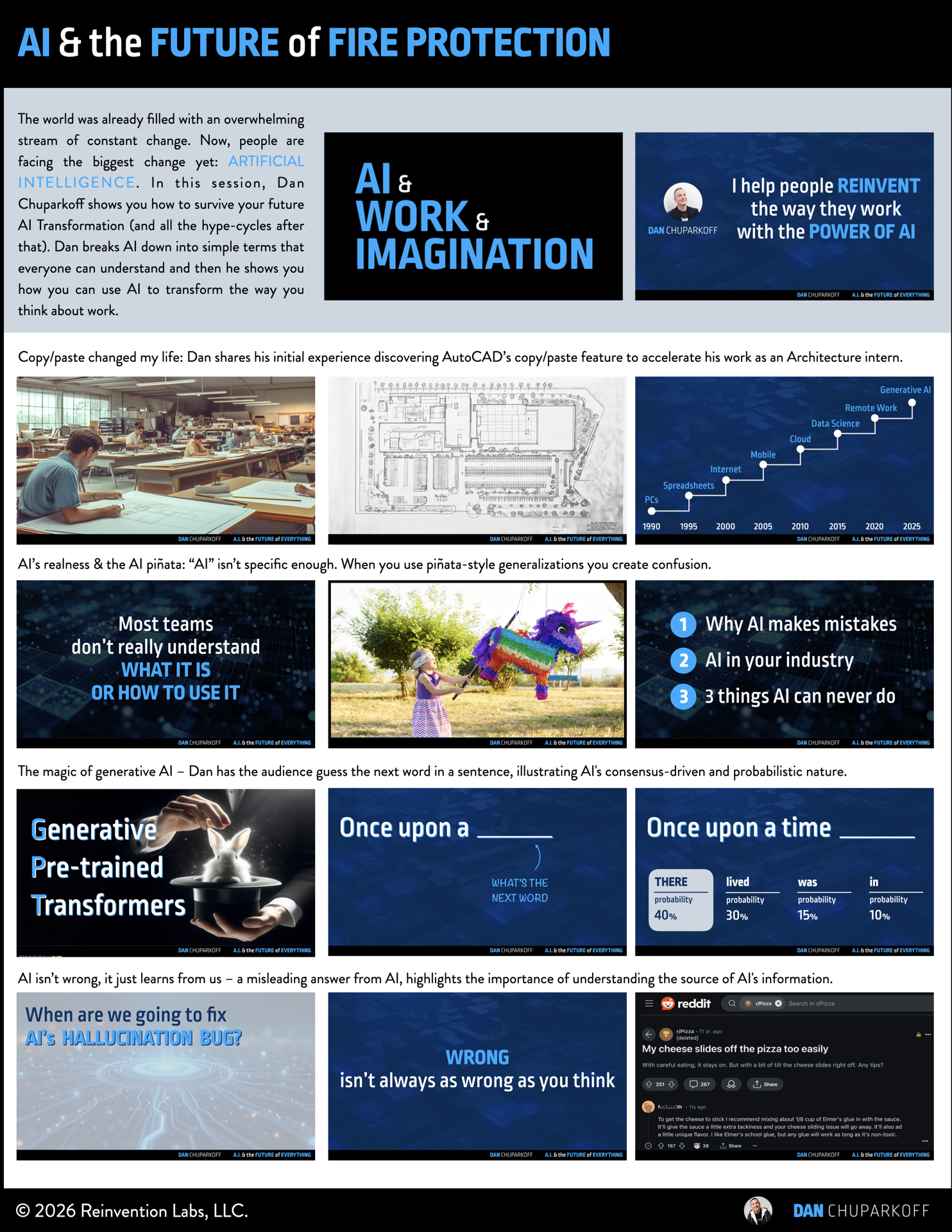
Download the 3 page
high-resolution PDF here:
Hope you find it helpful!
AI NOTES from Dan’s AI Keynote
*These notes were created using GPT 5.5 pro.
Transcription errors or mistakes have not been fixed
in order to demonstrate the current state of AI notes.
One-Sentence Takeaway
AI can help fire and life safety professionals move faster through information, communication, and routine analysis, but safety-critical judgment, source verification, and accountability still belong with people.
Summary
Dan Chuparkoff opened by showing AI-generated video to make the current shift visible. His point was that the baseline for professional work is already changing. AI is becoming part of how people gather context, improve quality, move faster, and package information more clearly.
The keynote's central story came from Dan's first technology transformation: seeing AutoCAD copy and paste precise parking lot lines in minutes after months of drawing them by hand. AutoCAD did not become an architect. It became an assistant that helped architects work with more precision and speed. Dan used that distinction for AI: the useful frame is assistant, not automator.
Dan then explained why AI is powerful and unreliable at the same time. Generative AI predicts likely next words from patterns. That makes it useful for drafting, summarizing, comparing, translating, finding signal, and coaching work. It also means AI can be consensus-driven, overconfident, outdated, or wrong. In fire and life safety, that matters because a confident but unsupported answer is not good enough.
For NFPA, Dan connected AI to verified code knowledge, changing hazards, field decisions, inspections, global collaboration, and shared safety intelligence. The opportunity is not to bypass expertise. It is to give experts better access to trusted information so they can solve hard problems, make careful decisions, and imagine safer ways to work.
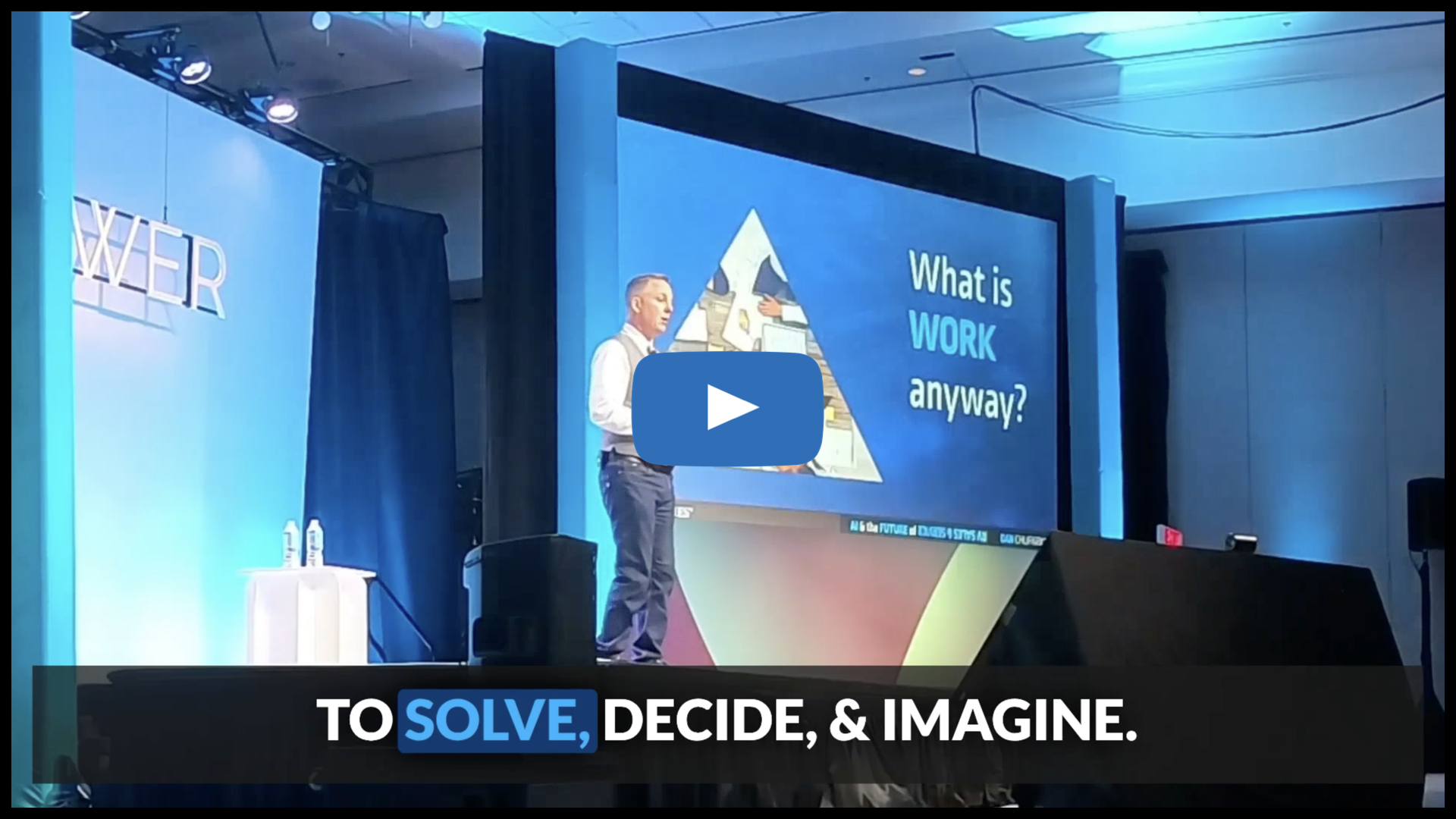
Dan closed with the work pyramid: communication, process, and investigation sit at the bottom, while problem solving, decision making, and imagination sit at the top. AI is strongest at the lower layers. The practical move is to compress lower-level work so people have more time for the safety-critical human work that matters most.
Action Items
[ ] Ask an approved AI assistant the question Dan used: "What are nine ways AI will change the work of fire safety engineers, code officials, fire leaders, designers, installers, contractors, and vendors responsible for fire protection, electrical safety, code compliance, and emergency response as hazards change and trusted code knowledge gets harder to apply?"
[ ] Pick one recurring code, inspection, training, communication, or planning task and ask AI how it could improve the process without replacing the responsible expert.
[ ] When AI gives an important answer, ask: "How sure are you? What sources did you use? What assumptions did you make? What should a fire and life safety expert verify?"
[ ] Treat AI like an intern. Give it instructions, review the work, improve the instructions, and learn where its capability ceiling is.
[ ] Use AI as a coach on work you already created. Ask it to compare your draft, plan, meeting notes, or communication against clear criteria and suggest improvements.
[ ] Identify one place where your team spends too much time communicating, searching, documenting, or translating. Test a small AI-assisted workflow there before handing AI higher-risk judgment work.
[ ] Keep final safety decisions with qualified people, especially when code interpretation, jurisdictional requirements, installation context, emergency response, or public safety is involved.
Key Ideas
AI is an assistant, not an automator.
The AutoCAD story showed the central distinction. A tool can remove tedious effort and improve precision without replacing the professional judgment that makes the work valuable.
The baseline has moved.
AI-generated content and AI-assisted work are improving quickly. The practical question is not whether AI exists. It is where AI can improve the work without creating unacceptable risk.
AI predicts, it does not know.
Generative AI works from probability. It can be useful, but it can also sound certain when confidence is low. Ask for sources, confidence, assumptions, and review points.
Average is not enough for safety-critical work.
Dan described AI as a "B-minus student" across many domains. That can be helpful for support work, but fire and life safety often requires A-plus judgment.
Trusted sources matter.
In safety-critical environments, AI needs bounded, verified, current source material. A general internet-trained answer is not the same as a cited code-based answer.
Human context still wins.
People bring memories, hopes, ethics, jurisdictional context, field experience, and accountability. AI can recommend, but people still decide.
Use AI as a coach.
Instead of only asking AI to create drafts, ask it to rank, critique, compare, and improve work against your standards. That helps people get better, not just faster.
The work pyramid should rebalance.
AI is strongest at communication, process, and investigation. The goal is to free more time for problem solving, decision making, and imagination.
Language barriers are shrinking.
Dan showed AI translation as a practical communication shift. For global teams and communities, language is becoming easier to bridge.
Fire & life safety opportunities
Move from searching codes to verified answers by asking code questions through grounded safety models.
Compare local requirements with AI-cited code context so reviewers can see source material, edition context, and differences faster.
Give field teams installation answers on site, with clear escalation paths when professional or jurisdictional judgment is required.
Move from static inspections to live risk by using AI to spot changing patterns in batteries, data centers, warehouses, and other emerging hazards.
Predict battery hazards from incident, permit, inspection, complaint, and location patterns.
Flag warehouse designs with AI-scored fire loads so experts can focus review on the highest-risk assumptions.
Monitor data centers for emerging risk signals across power, cooling, battery, maintenance, and fire protection data.
Move from separate roles to shared intelligence by helping prevention, inspection, response, design, installation, and vendor teams see the same operational picture.
Translate safety guidance for global teams while preserving technical review for safety-critical language.
Train inspectors with scenario-based code coaching built from approved standards, procedures, and expert-reviewed examples.
Coordinate emergency plans through shared incident intelligence that combines pre-plans, inspections, occupancy hazards, maps, contacts, and response notes.
Talk Flow
Speaker introduction
The introduction positioned Dan as a technology leader who helps people turn complex technology into practical action, with a focus on what to hand to AI, what to keep human, and how to move faster without losing judgment.
AI-generated video & the new threshold
Dan opened with AI-generated video to show how fast AI content quality is improving. He argued that work without AI assistance may soon look slower or less complete than work where AI helps put information at people's fingertips.
The AutoCAD copy-paste moment
Dan told the story of drawing parking lot lines by hand as a teenager, then watching AutoCAD copy and paste precise lines in minutes. That moment became the keynote's main metaphor for technology assistance.
Assistant vs automator
Dan contrasted AutoCAD as an assistant with his boss's fear that it would take architecture jobs. He applied the same distinction to AI: a useful assistant can raise quality and speed without owning the expert work.
Technology stair steps
Dan connected PCs, spreadsheets, the internet, mobile, cloud, data science, remote work, and generative AI as a sequence of work-changing tools. Each one eventually became part of normal work.
Cracking open the AI pinata
Dan warned that many people are talking about AI without understanding what is inside it. Leaders need to know which uses create more value than risk.
What GPT is doing
Dan explained generative, pre-trained, and transformer in plain language. The main point was that AI generates likely output from patterns rather than searching for perfect truth.
Once upon a time
The audience exercise showed that AI is consensus-driven. It often picks the most likely next word, which can be useful for common patterns but weak for ambiguity, novelty, or expert judgment.
Confidence & low-certainty answers
Dan explained that AI may give answers that are only partly confident while presenting them in the same tone as stronger answers. For fire safety, hidden low confidence can create the kind of failure the room exists to prevent.
Glue in the pizza
The pizza example showed why AI can repeat bad information from the internet. AI can be useful without being reliable enough to trust blindly.
Autocomplete & human context
Dan used autocomplete as a familiar model for AI assistance. The tool suggests likely words, but the person still owns the message because the person has context, judgment, and intent.
Memories & hopes
Dan argued that decisions are not driven by intelligence alone. People make decisions with memories, experience, hopes, goals, ethics, and accountability.
AI & the future of fire protection
Dan showed the audience the AI question he asked about fire safety engineers, code officials, fire leaders, designers, installers, contractors, and vendors. He encouraged attendees to ask their own AI assistant this kind of question to start seeing industry change more clearly.
Nine fire & life safety transformations
Dan walked through three groups of AI shifts: searching codes to verified answers, static inspections to live risk, and separate roles to shared intelligence. He connected those shifts to grounded safety models, AI-cited code context, field answers, battery hazards, warehouse fire loads, data center signals, translation, code coaching, and shared incident intelligence.
AI before the big IT project
Dan noted that large AI capabilities will arrive through software, services, and internal technology work over time. Before that, AI is already changing how people think, write, plan, coach, train, triage, diagram, translate, and communicate.
Critique before drafting
Dan described a shift in his own AI usage. Instead of asking AI to write for him first, he creates the work and then asks AI to rank, critique, compare, and improve it. That turns AI into a coach.
AI as intern
Dan rejected the copilot metaphor and replaced it with the intern metaphor. An intern receives instructions, tries the work, gets reviewed, and improves through feedback. AI needs the same review loop.
The hierarchy of work
Dan introduced six kinds of work: communicate, process, investigate, solve, decide, and imagine. AI is strongest at the first three. People should protect the last three.
Problem solving, decision making & imagination
Dan explained why AI struggles with new problems, real decisions, and imagined futures. Those areas depend on human context, values, experience, and desired outcomes.
Communication as leverage
Dan described how much time is spent in meetings, email, chat, phone calls, and information exchange. AI-supported notes, summaries, facilitation, and retrieval can compress that communication load.
AI notes & AI song
Dan used AI notes and an AI-generated song version of the keynote to show that AI can change how people capture, remember, package, and share information.
Translation & global collaboration
Dan showed AI translation as a practical communication shift. He connected it to global collaboration and the possibility that people can work across language differences more naturally.
Closing Message - The impossible world of more
Dan closed by naming the pressure of more expectations, more information, more standards, and the same number of hours. The way forward is to use AI to compress lower-level work so people can spend more time solving hard problems, making thoughtful decisions, and imagining safer futures.