
FedEx Central 2026: AI & the Future of Delivery Operations
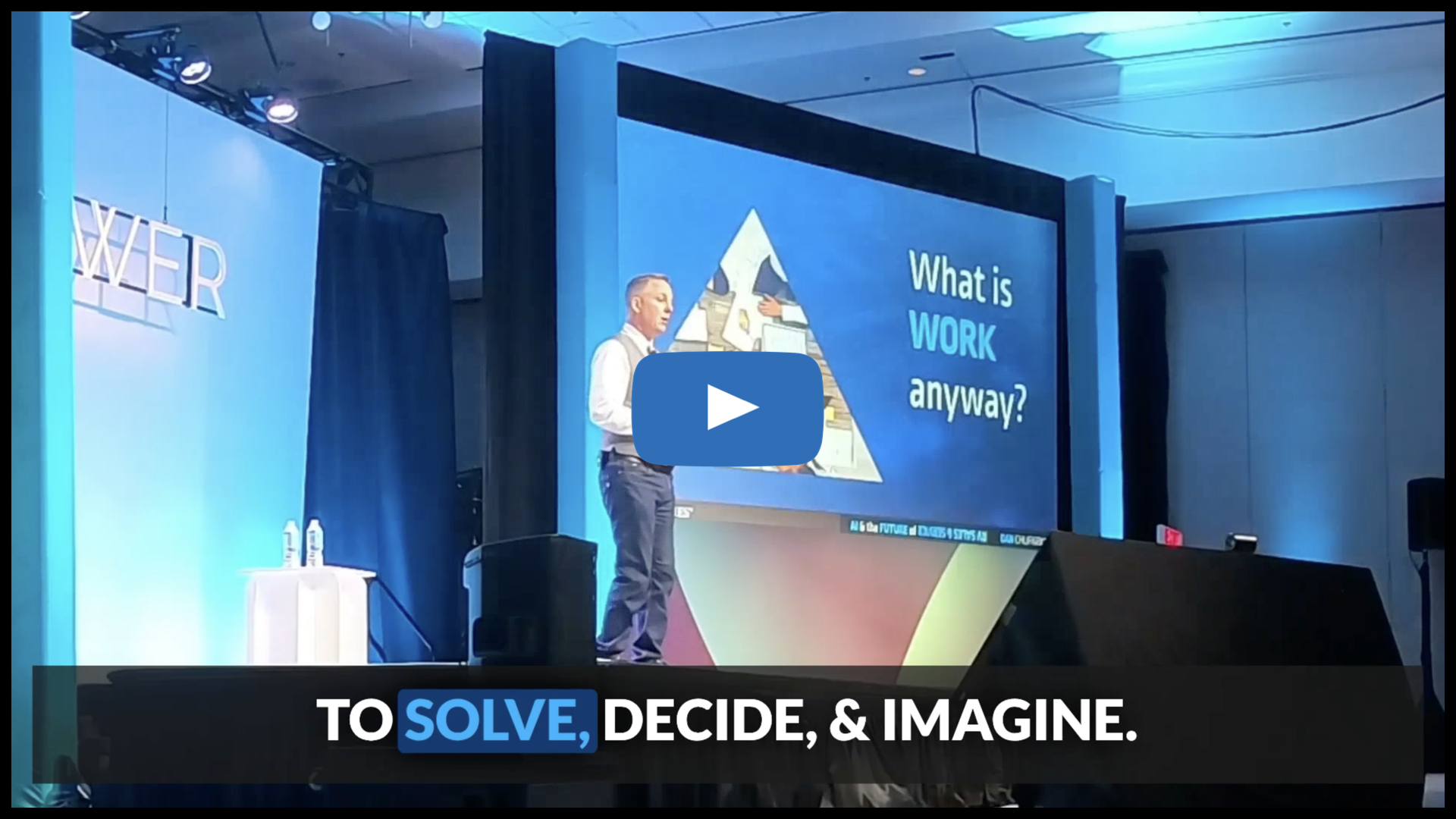
Listen to the
AI KEYNOTE SONG
The easiest way to review or share the key points of my AI Keynote is with this song: the full keynote, matched with slides, in 4m32s!

PDF SUMMARY of key slides
This “Slide Cheatsheet” was customized for your specific talk. It’s designed to help audience-members like you, by wrapping my AI & the Future of Everything keynote into an easy-to-skim, easy-to-share, or easy-to-print resource for future reference.
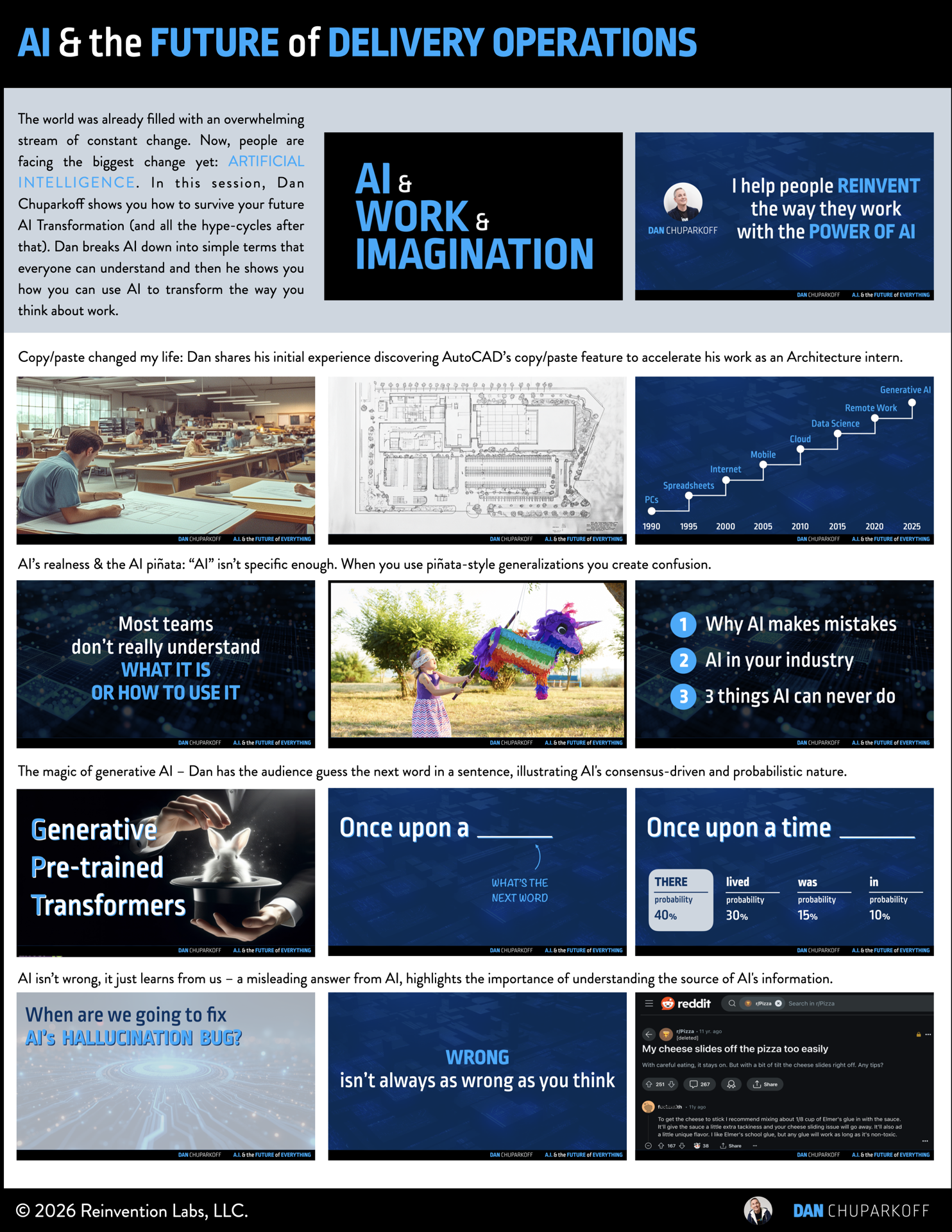
Download the 3 page
high-resolution PDF here:
Hope you find it helpful!
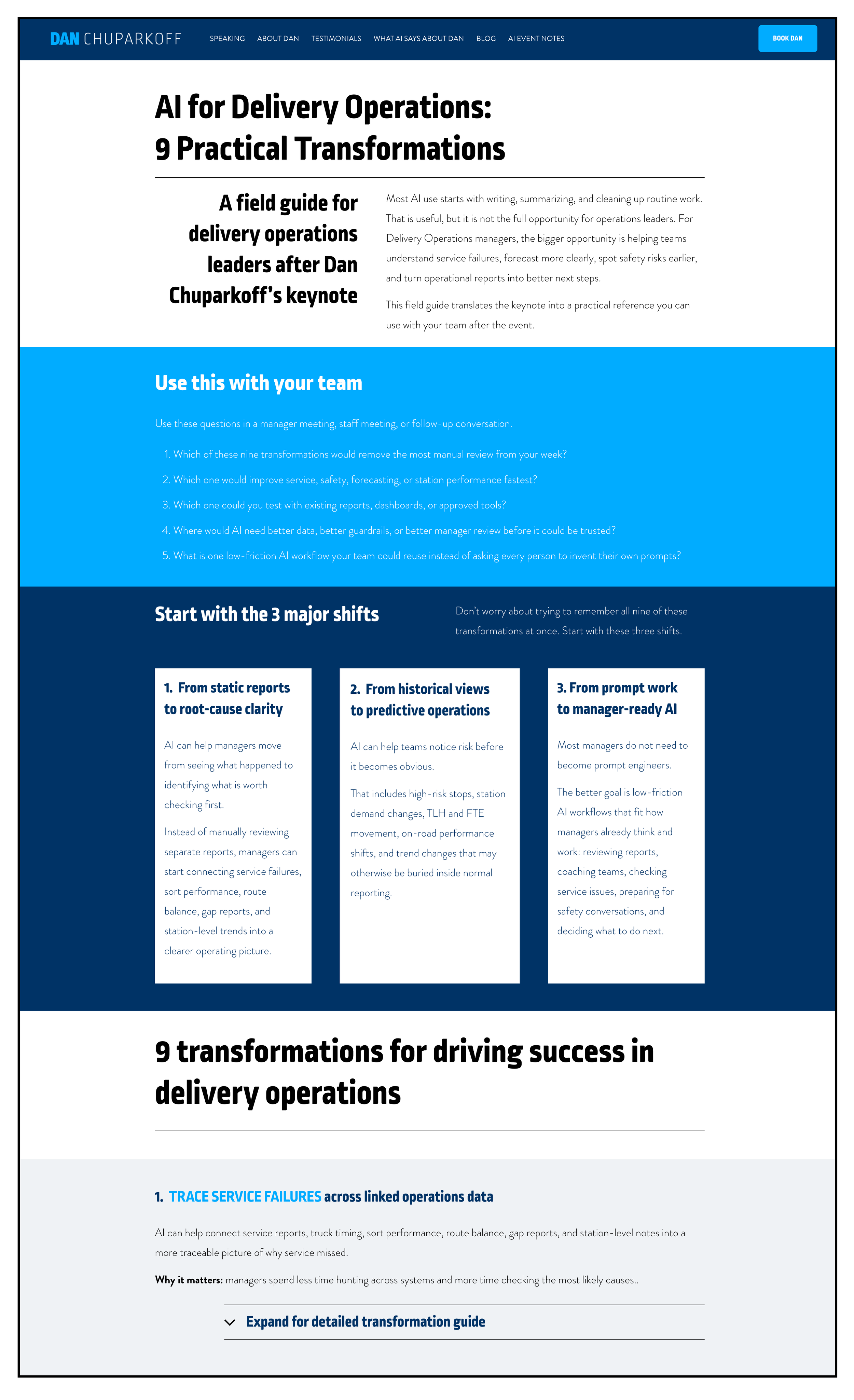
Check out the
Delivery Operations
FIELD GUIDE
In my keynote, we didn’t have time to go into all the detail on the AI transformations. But here, you can see all of the amazing detail.
AI NOTES from Dan’s AI Keynote
*These notes were created using GPT 5.5 pro.
Transcription errors or mistakes have not been fixed
in order to demonstrate the current state of AI notes.
One-Sentence Takeaway
AI is most useful for delivery operations when it helps leaders compress report chasing, exception digging, communication, and routine analysis so people have more time to solve problems, make decisions, coach teams, and improve the operation.
Summary
Dan opened with an AI-generated video to show that the quality baseline for work is moving. AI-assisted work is becoming faster, more polished, and more complete because the tool can put useful context at people's fingertips while they solve problems, make decisions, and create new value.
The AutoCAD parking-lot story introduced the keynote's central frame: useful technology is an assistant, not an automator. AutoCAD did not replace architects. It helped them remove tedious work, improve precision, and create more value. Dan applied that same idea to AI for delivery operations: AI should help managers find signal, summarize information, and prepare action, while people stay responsible for judgment, context, coaching, and decisions.
Dan explained that generative AI is powerful because it predicts likely words, images, and answers from patterns. That also means it can be wrong, overconfident, outdated, or too average. The practical response is not to avoid AI. The practical response is to ask for confidence, sources, assumptions, and review points before using important outputs.
For FedEx Central, Dan connected those ideas to regional package delivery operations. The custom prompt asked how AI will change the work of leaders responsible for pickup, sorting, linehaul, routing, and delivery while turning fragmented reports, service exceptions, staffing, safety, route, and asset signals into faster manager action. The central opportunity is to move from report chasing to daily focus, from exception digging to root-cause patterns, and from reactive oversight to coached execution.
Dan closed with the work pyramid: communication, process, and investigation sit at the bottom, while problem solving, decision making, and imagination sit at the top. AI is strongest at the lower layers. The goal is to use AI to make those layers more efficient so leaders have more room for the work only people can own: solving new problems, making real decisions, and imagining better ways to run the operation.
Action Items
[ ] Ask an approved AI assistant the question Dan showed: "What are nine ways AI is going to change the work of regional package delivery operations leaders who are responsible for pickup, sorting, line haul routing, and delivery, while turning fragmented reports, service exceptions, staffing, safety, route, and asset signals into faster manager action?"
[ ] Pick one recurring report, dashboard review, scorecard, meeting recap, safety message, or manager update and ask AI to turn it into a short daily action brief.
[ ] When AI gives an important answer, ask: "How sure are you? What sources did you use? What assumptions did you make? What should a manager verify before acting?"
[ ] Use AI as a coach before using it as a substitute. Create the work yourself, then ask AI to compare it against stronger examples and suggest how to improve it.
[ ] Treat AI like an intern. Give clear instructions, review the work, improve the instructions, and learn where the tool's capability ceiling is.
[ ] Look for one place where your team spends too much time communicating, searching, documenting, or reconciling information across systems. Test a small AI-assisted workflow there before moving into higher-risk decisions.
[ ] Keep final operational judgment with people, especially when the situation involves service commitments, safety, staffing, employee coaching, customer impact, or protected FedEx data.
Key Ideas
AI is an assistant, not an automator.
The AutoCAD story showed the central distinction. A good tool removes repetitive burden and improves precision, but the professional still owns the work.
The baseline has moved.
AI-assisted work is improving quickly. The practical question is where AI can help the operation move faster and clearer without creating unacceptable risk.
AI predicts likely answers.
Generative AI works from patterns. That makes it useful for summaries, drafts, comparisons, translations, and signal finding, but it also means the answer is not automatically true.
Average is useful, but not enough.
Dan described AI as a "B-minus student" across many domains. That can be powerful for support work, but delivery operations still need A-plus human judgment.
Confidence matters.
Every AI answer has some confidence level underneath it. Leaders should ask how sure the tool is, what it used, and what a person should verify.
Bad training data creates bad answers.
The glue-in-your-pizza example showed why internet-trained systems can surface nonsense. AI output should be reviewed before it affects real work.
Autocomplete is a useful mental model.
People already know how to accept, reject, or ignore a suggestion. AI should be treated the same way: helpful when it helps, challenged when it does not.
Human context still wins.
People make decisions with memories, hopes, goals, experience, responsibility, and the conversations they just had. AI can recommend, but people still decide.
Use AI as a performance coach.
Instead of asking AI to write the work first, create the work and ask AI to rank, critique, compare, and improve it. That helps people get better, not just faster.
People still solve, decide, and imagine.
AI can help with communication, process, and investigation. People should protect the higher-judgment work of solving new problems, making decisions, and imagining better futures.
Delivery Operations-specific AI Opportunities
Move from report chasing to daily focus by generating daily briefs from siloed report streams.
Turn Power BI, Spotfire, Business Objects, email, scorecards, and other signals into role-specific briefs for leaders and managers.
Rank manager action lists so urgent follow-ups, service issues, staffing needs, and safety priorities are easier to see.
Move from exception digging to root-cause patterns by tracing package exceptions across linked tracking samples.
Group similar service issues even when the exact cases are not identical, so recurring address, route, scan, or operational patterns are easier to spot.Prioritize service failures by commonalities so managers can move from finding the issue to acting on the issue faster.
Move from reactive oversight to coached execution by using AI to summarize safety, staffing, route, and asset signals into better manager guidance.
Score safety patterns by maneuver, location, and time so local teams can target communication and coaching.
Match volume timing to staffing needs so leaders can plan people and assignments with more context.
Watch asset wear signals so replacement and maintenance conversations can happen earlier, with human review and operational judgment.
Talk Flow
Speaker introduction
The introduction positioned Dan as a technology leader who helps people turn complex technology into clear practical action, with a focus on what to hand to AI, what to keep human, and how to move faster without losing judgment.
AI-generated video and the new threshold
Dan opened with an AI-generated video and explained that AI-assisted content is improving quickly. The point was that work without AI help may soon look slower or less complete than work where AI helps with context, polish, and speed.
Trailer park to Google
Dan used his personal journey from a trailer park in Tampa to a Google product leader with billions of users to frame the keynote as a story about technology-enabled reinvention.
The AutoCAD copy-paste moment
Dan told the story of drawing parking lot lines by hand as a teenager, then seeing AutoCAD copy and paste precise parking lot lines in minutes. That became the keynote's main image for technology assistance.
Assistant vs automator
Dan contrasted AutoCAD as an architect's assistant with his boss's fear that it would take architecture jobs. He used that distinction to frame AI as a tool for leverage, not a replacement for expertise.
Productivity creates more demand
Dan pointed out that AutoCAD did not lead to 1,400 times fewer architects. Productivity gains can increase the amount of value teams can create, especially when demand is constrained by available people.
Technology stair steps
Dan connected PCs, spreadsheets, the internet, mobile, cloud, data science, remote work, and generative AI as a sequence of work-changing tools. Each one eventually became part of normal work.
Cracking open the AI pinata
Dan described the current AI conversation as people swinging at a pinata without knowing what is inside. Leaders need to know which AI uses create value and which create risk.
What GPT is doing
Dan explained generative, pre-trained, and transformer in plain language. The useful behavior is not magic. AI generates likely output from patterns it has already learned.
Once upon a time
The audience sentence exercise showed that AI predicts likely next words and often follows the consensus answer. That makes AI helpful for common patterns and weaker for originality, ambiguity, and expert judgment.
B-minus in everything
Dan described AI as a B-minus student across many skills. The value is that it gives people useful support in adjacent tasks, while they still need to bring A-plus expertise to their core work.
Confidence and uncertainty
The second sentence exercise showed that AI can choose a statistically likely answer even when confidence is not high enough for an important decision. Dan encouraged the audience to ask AI how sure it is.
Hallucinations and probability
Dan explained that hallucinations are not just a temporary bug. They are part of using probability to answer questions from past patterns. Human review remains part of responsible use.
Glue in your pizza
The pizza example showed how AI can surface bad advice from messy internet training data. The lesson was to watch for bad output, especially when the stakes are real.
Autocomplete and human context
Dan used autocomplete as a familiar model for AI assistance. Sometimes the suggestion helps. Sometimes the person ignores it because the person has context the tool does not.
Memories and hopes
Dan argued that people make decisions with memories, hopes, goals, conversations, and context. AI can inform those decisions, but it cannot fully own them.
AI and delivery operations
Dan introduced the FedEx Central prompt about regional package delivery operations leaders responsible for pickup, sorting, linehaul, routing, delivery, fragmented reports, service exceptions, staffing, safety, routes, assets, and faster manager action.
Nine delivery operations shifts
Dan grouped the AI answer into three practical shifts: from report chasing to daily focus, from exception digging to root-cause patterns, and from reactive oversight to coached execution.
Daily focus from fragmented reports
Dan described how AI can help generate daily or weekly briefs, role-specific summaries, and prioritized manager action lists across the many dashboards, reports, and signals competing for attention.
Root-cause patterns from exceptions
Dan explained that AI can help group package exceptions, compare responses, and rank commonalities so teams can see recurring service patterns faster.
Coached execution
Dan connected future AI assistants to real-time guidance, questions, and recommendations that could support managers as they work through operations, collaboration, and execution.
AI before the big IT project
Dan noted that enterprise tools and integrations will come gradually, but individual behavior can start changing now with writing, research, images, diagrams, email, planning, and translation.
Critique before drafting
Dan described changing his own AI use. Instead of asking AI to write for him first, he creates the work and asks AI to rank, critique, compare, and improve it.
Personal performance leaderboards
Dan showed how he uses AI to rank his keynotes and other repeated work. The larger point was that AI can become a real-time performance coach.
AI as intern
Dan rejected the copilot metaphor and described AI as an intern: give instructions, review the work, improve the instructions, and learn the tool's capability ceiling.
The hierarchy of work
Dan introduced six kinds of work: communicate, process, investigate, solve problems, make decisions, and imagine. AI is strongest at the lower layers.
Problem solving, decision making, and imagination
Dan explained why people should keep owning new problems, real decisions, and future imagination. Those depend on human context, judgment, values, and desired outcomes.
Communication as leverage
Dan cited the large share of work time spent in meetings, phone calls, email, and chat. AI can make communication more efficient through notes, summaries, retrieval, and meeting support.
AI notes and AI song
Dan showed how AI notes and an AI-generated song version of the keynote can help capture, remember, package, and share information in new ways.
Real-time translation
Dan demonstrated AI translation and connected it to collaboration across languages. The point was that language is becoming easier to bridge for teams and customers.
Closing Message - Managing in a world of more
Dan closed by naming the pressure of more demands, more packages, more information, more systems, more email, and the same number of hours. The way forward is to use AI to compress lower-level work so people can solve, decide, and imagine better.