
Baptist 2026: AI & the Future of Healthcare
Listen to the
AI KEYNOTE SONG
The easiest way to review or share the key points of my AI Keynote is with this song: the full keynote, matched with slides, in 4m32s!

PDF SUMMARY of key slides
This “Slide Cheatsheet” was customized for your specific talk. It’s designed to help audience-members like you, by wrapping my AI & the Future of Everything keynote into an easy-to-skim, easy-to-share, or easy-to-print resource for future reference.
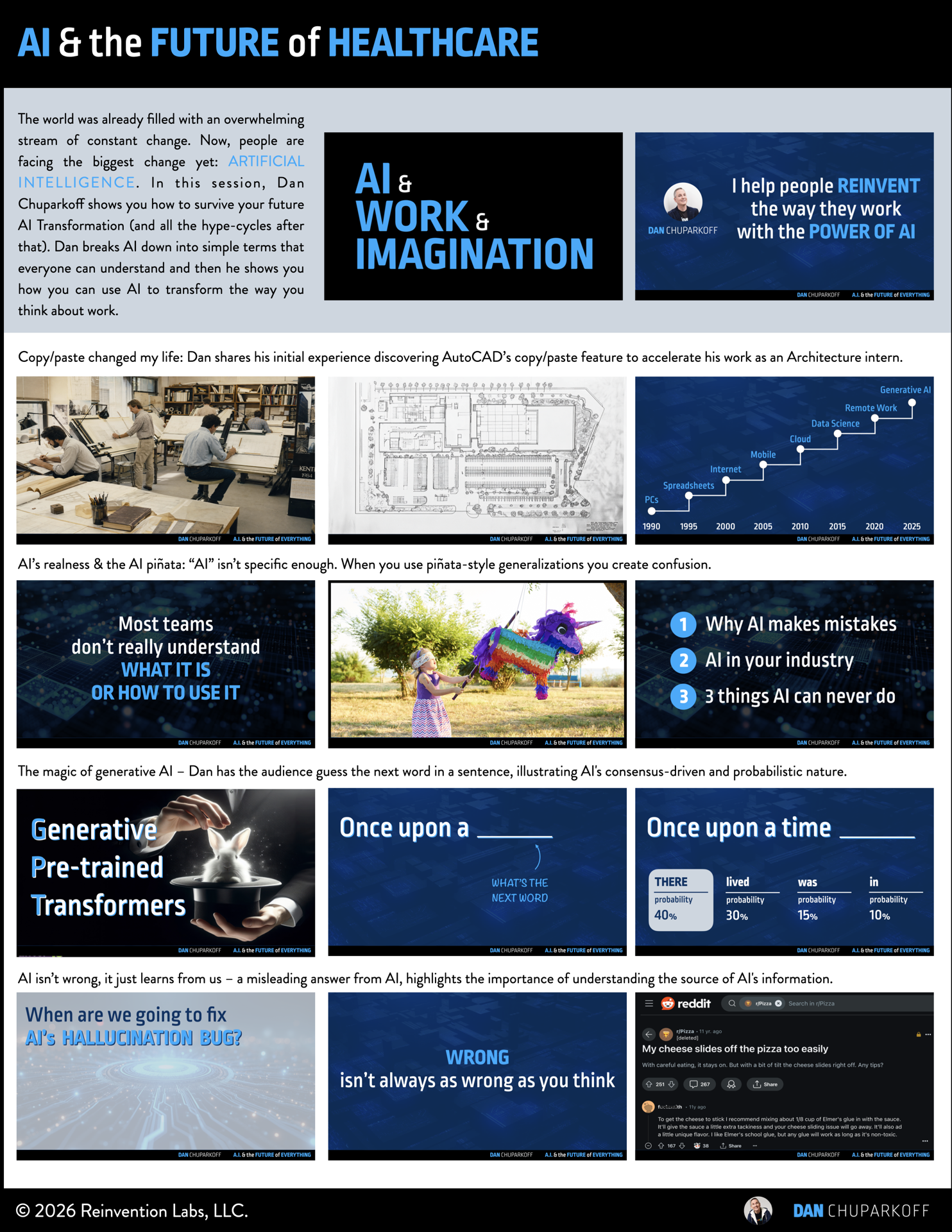
Download the 3 page
high-resolution PDF here:
Hope you find it helpful!
AI NOTES from Dan’s AI Keynote
*These notes were created using ChatGPT 5.6 pro.
Transcription errors or mistakes have not been fixed
in order to demonstrate the current state of AI notes.
One-Sentence Takeaway
Use AI as a B-minus assistant and performance coach to compress communication, process, and investigation work, while people keep responsibility for solving problems, making decisions, imagining better healthcare, and protecting human connection.
Summary
AI is becoming part of the normal fabric of work, much as PCs, spreadsheets, the internet, mobile devices, cloud tools, data science, and remote work did before it. The AutoCAD story established the keynote's central distinction: technology can create extraordinary leverage as an assistant without becoming the expert, decision-maker, or accountable professional.
Generative AI predicts likely output from patterns in existing information. That makes it broadly useful, but also probabilistic, consensus-driven, and vulnerable to weak source material. Dan described it as a B-minus assistant that can raise a person's baseline across unfamiliar tasks. Baptist leaders still provide the A-plus expertise, patient context, organizational memory, judgment, ethics, and hopes for what healthcare should become.
For clinical and non-clinical leaders, the practical opportunity is to use approved AI assistance to reduce scattered work, prepare teams, surface friction, strengthen communication, and improve recurring work. The goal is not to transfer patient-care, hiring, compliance, or leadership decisions to AI. It is to create more capacity for people to solve hard problems, make thoughtful decisions, support patients and families, and imagine better ways to deliver care.
Action Items
[ ] Identify one recurring communication, process, or investigation task that takes time away from team leadership, patient support, or difficult human moments.
[ ] Test how an approved AI assistant could summarize, compare, organize, prepare, or critique that work without placing sensitive information in an unapproved tool.
[ ] Complete one important brief, plan, message, meeting, or workflow yourself, then ask AI to compare it with prior strong examples and explain how the next version could be better.
[ ] Ask AI how your specific role may change, using your responsibilities, the service you provide, the outcomes you need, and the constraints you must preserve.
[ ] Before acting on consequential AI-supported work, inspect its sources, assumptions, missing context, uncertainty, and required human review.
[ ] Define the human decision point before using AI in a workflow involving patients, applicants, employees, clinical judgment, privacy, billing, coding, or compliance.
[ ] Track whether the workflow creates real capacity, then reinvest that time in solving, deciding, imagining, and human connection.
Key Ideas
Assistant, not automator
AutoCAD helped an architect create precise work faster without becoming an architect. AI should be framed the same way: people supply intent, expertise, review, judgment, and accountability.
AI is a B-minus assistant
AI can help people reach a useful baseline in research, communication, planning, facilitation, and other supporting work. It should extend expertise rather than replace the expertise a person deliberately develops and owns.
Probability is not certainty
The most likely answer may still be less reliable than the situation requires. A polished answer does not reveal the confidence, source quality, or missing context underneath it.
Treat output as a recommendation
Useful suggestions can be accepted, weak suggestions can be rejected, and important work can receive deeper review. The human remains responsible for deciding what is appropriate.
Memories and hopes shape judgment
People make decisions with experience, ethics, context, relationships, and a future they want to create. Those human inputs are essential to leadership and care.
Use AI as a performance coach
Do not only ask AI to create work. Ask it to compare new work with prior strong work, rank it against clear criteria, identify gaps, and coach the next iteration.
Protect the top of the work pyramid
AI is strongest at helping with communication, process, and investigation. The capacity created should be reinvested in solving novel problems, making judgment-rich decisions, and imagining better outcomes.
Preserve human connection
Efficiency matters when it creates more space for coaching a team member, supporting a patient, comforting a family, or handling a difficult decision with care.
Baptist healthcare opportunities
From scattered work to guided action
Ask grounded questions across approved policies and workflows.
Prioritize AI-surfaced bottlenecks before leader handoffs.
Draft leader messages with AI-personalized context.
From reactive staffing to prepared teams
Predict staffing gaps before schedules break.
Use AI-synthesized role evidence in interview guides.
Coach frontline leaders through AI-guided practice.
From workflow friction to governed capacity
Flag patient friction from cross-channel journey signals.
Create AI-drafted encounter notes for clinician review.
Escalate uncertain AI outputs through human review gates.
These are candidates for governed exploration. Baptist professionals remain responsible for approved tools and sources, privacy controls, hiring decisions, clinical judgment, patient care, compliance, and the consequences of action.
Talk Flow
The AI-generated opening
The opening video showed how quickly the quality threshold is moving. AI-supported work is becoming part of how work gets done, and people will increasingly notice when available assistance was not used.
The AutoCAD copy-and-paste moment
As a teenager, Dan spent days drawing precise parking-lot lines by hand. Watching AutoCAD create and copy those lines in seconds revealed how dramatically a new assistant could improve speed, precision, and customer value.
Assistant vs automator
Dan's manager feared that AutoCAD would replace architects. Dan saw that the software could assist architects without solving complex architectural problems or imagining schools on its own. He applied the same distinction to AI, especially where healthcare mistakes carry serious consequences.
The technology staircase
PCs, spreadsheets, the internet, mobile devices, cloud tools, data science, remote work, and generative AI were presented as successive shifts that eventually become normal parts of work.
Cracking open the AI piñata
AI is often discussed as one large, undefined promise. Leaders need to separate useful assistance from confusion and determine what creates value, what creates risk, and what still requires people.
Prediction, consensus, and the B-minus assistant
The `Once upon a time` exercise demonstrated next-word prediction and consensus behavior. AI can provide a useful average across many unfamiliar tasks, while people continue to own the areas where expertise matters.
Confidence and hidden uncertainty
When several next words are possible, AI chooses the most probable option even when confidence is low. The audience may see a fluent answer without seeing the uncertainty underneath it, so review should rise with the consequences.
Glue in the pizza
The pizza example showed how jokes, sarcasm, trolls, novices, and experts can become mixed source material. A popular or plausible answer is not automatically a trustworthy answer.
Autocomplete and human control
Autocomplete supplied a familiar model for AI assistance. People accept useful suggestions, ignore bad ones, and continue with the work they intended to do. More consequential uses require the same control with stronger review.
Memories and hopes
Intelligence is only one ingredient in action. People also use memories of what worked, what failed, and what mattered, along with hopes for their teams, patients, families, and future.
The healthcare question
Dan asked how AI will change the work of clinical and non-clinical people leaders responsible for care delivery while increasing capacity, strengthening talent workflows, reducing patient friction, and preserving trust, fairness, judgment, and connection.
Nine healthcare transformations
The answer was organized into three shifts: from scattered work to guided action, from reactive staffing to prepared teams, and from workflow friction to governed capacity.
AI before the large technology rollout
Some capabilities depend on internal platforms and vendor roadmaps. Leaders can begin now with approved assistance for writing, research, workflow thinking, email, planning, and translation.
AI as a performance coach
Dan described writing his own work, then asking AI to compare it with prior work and explain what would put it in his top five. The same improvement loop can strengthen recurring leadership and communication work.
The hierarchy of work
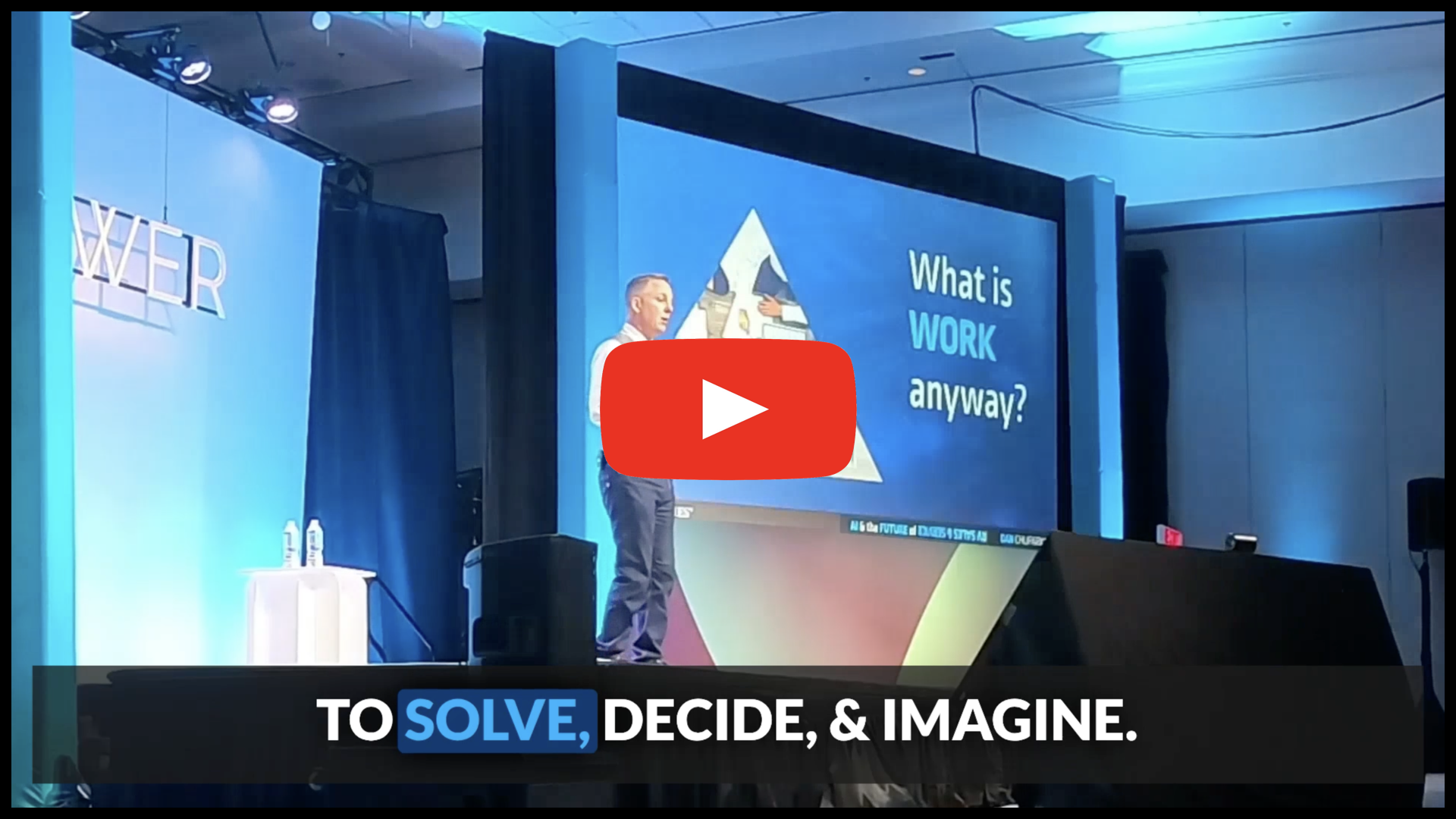
The work pyramid begins with communication, process, and investigation, then rises to problem solving, decision making, and imagining. AI can help compress parts of the lower layers, but people remain responsible for novel problems, consequential choices, and futures that do not yet exist.
Notes and memorable communication
AI-supported notes can create a searchable record and help useful context reach people who were not in the original conversation. Turning the keynote into a song demonstrated that the same information can be packaged in a form people are more likely to revisit.
Translation and access
Information, expectations, systems, and possible work keep growing while available hours remain fixed. Dan closed by challenging leaders to flip the work pyramid and create more capacity to solve, decide, imagine, and build better healthcare for patients and teams.
Closing Message - Managing in the world of more
Information, systems, expectations, and possible work keep growing while available hours remain fixed. The closing challenge was to flip the work pyramid and reinvest saved capacity in solving, deciding, and imagining the future of design, make, and engineering.