
PAEA 2026: AI & the Future of PA Education
Listen to the
AI KEYNOTE SONG
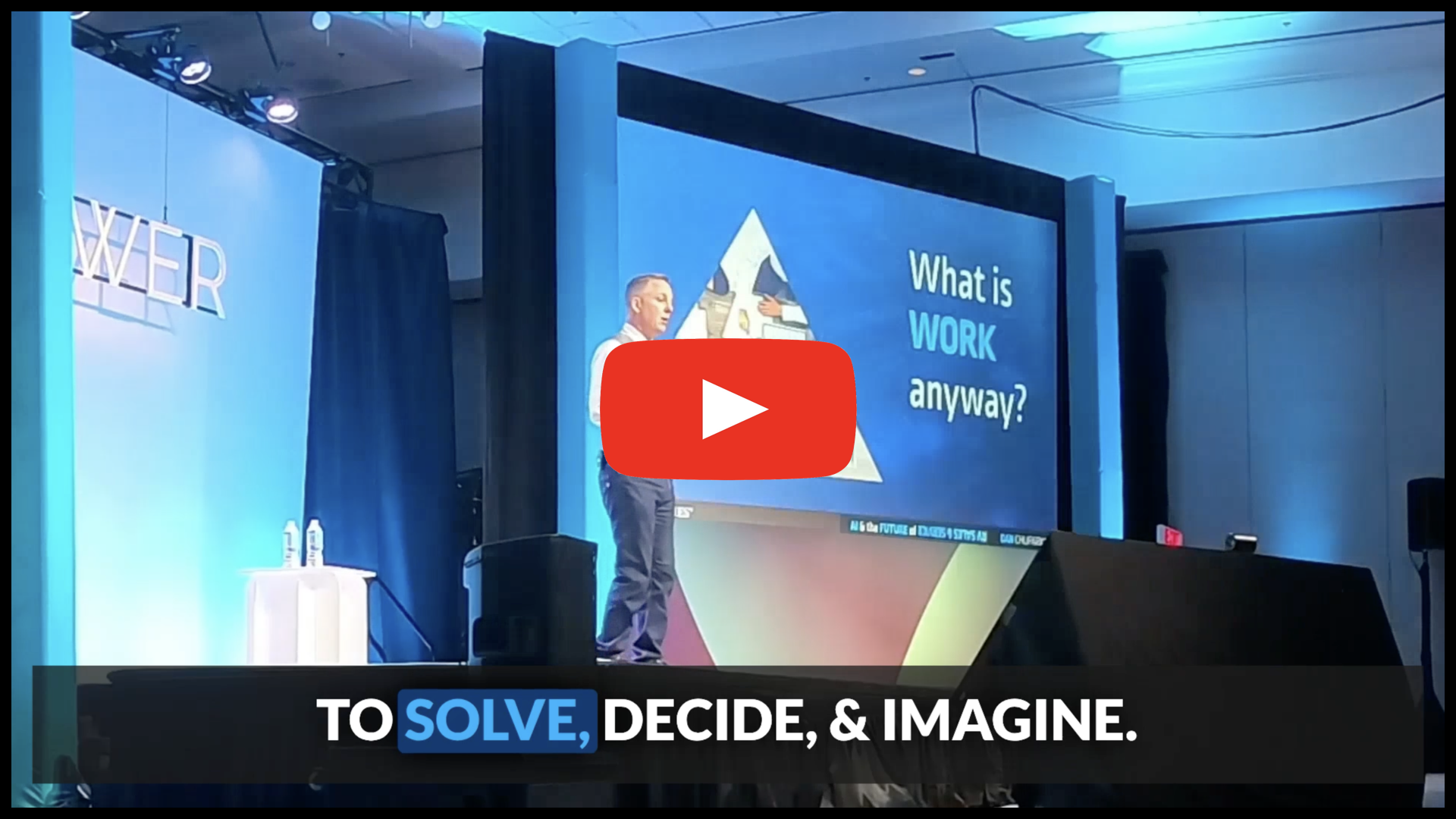
The easiest way to review or share the key points of my AI Keynote is with this song: the full keynote, matched with slides, in 4m32s!
A day in the life in YOUR AI FUTURE

PDF SUMMARY of key slides
This “Slide Cheatsheet” was customized for your specific talk. It’s designed to help audience-members like you, by wrapping my AI & the Future of Everything keynote into an easy-to-skim, easy-to-share, or easy-to-print resource for future reference.
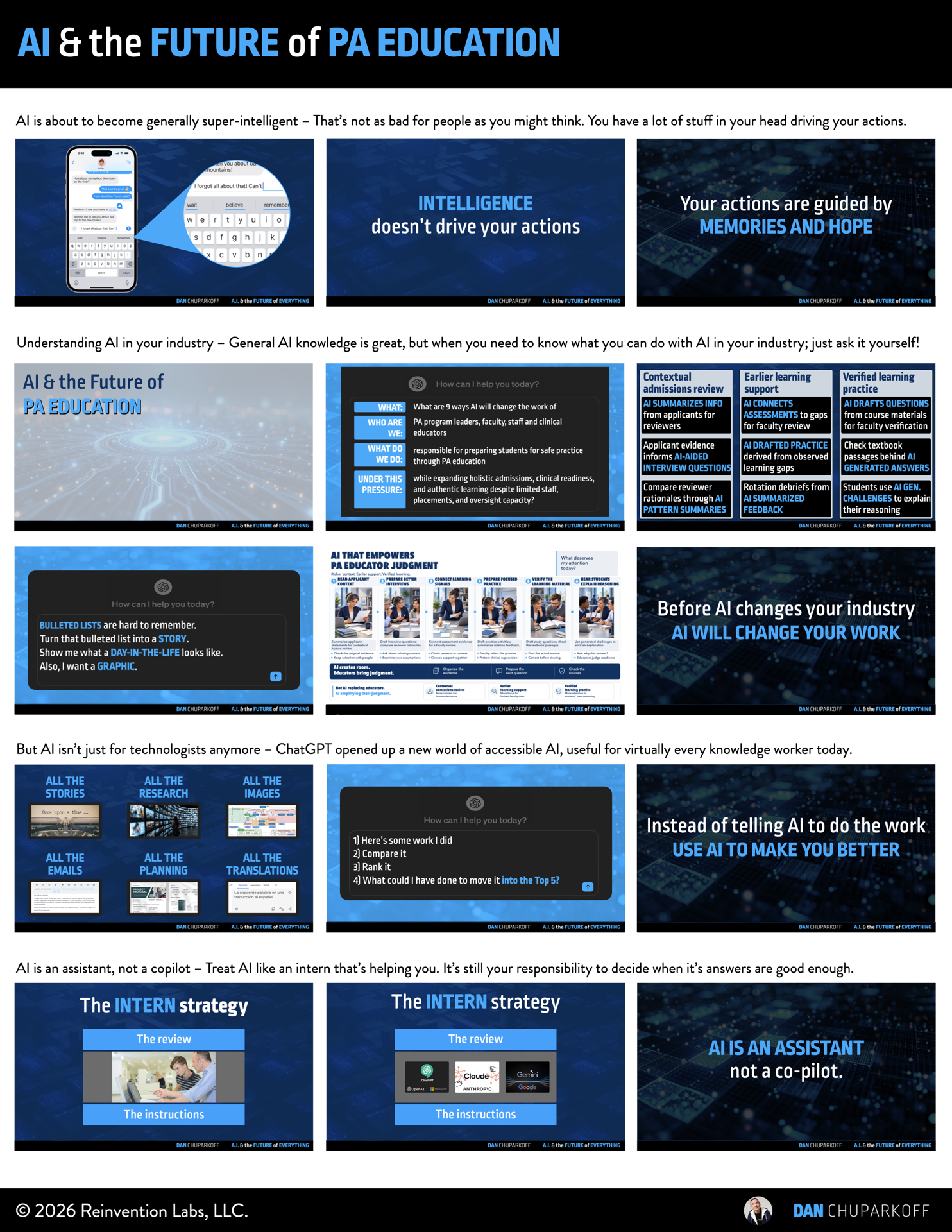
Download the 3 page
high-resolution PDF here:
Hope you find it helpful!
AI NOTES from Dan’s AI Keynote
*These notes were created using ChatGPT 5.6 pro.
Transcription errors or mistakes have not been fixed
in order to demonstrate the current state of AI notes.
Summary
AI changes what people can accomplish with assistance. Dan’s first encounter with AutoCAD made that visible: copy and paste turned days of drawing parking-lot lines into moments of computer-assisted work. The architect still guided the work. The same distinction matters for PA educators using AI: useful assistance can expand capacity while people remain responsible for the result.
The keynote connected familiar experiences—finishing a sentence, accepting or rejecting autocomplete, and supervising an intern—to a practical relationship with AI. A fluent answer needs review. Your experience, goals, and understanding of the situation shape the decisions you make with that answer. Students need to develop that judgment alongside their ability to use new tools.
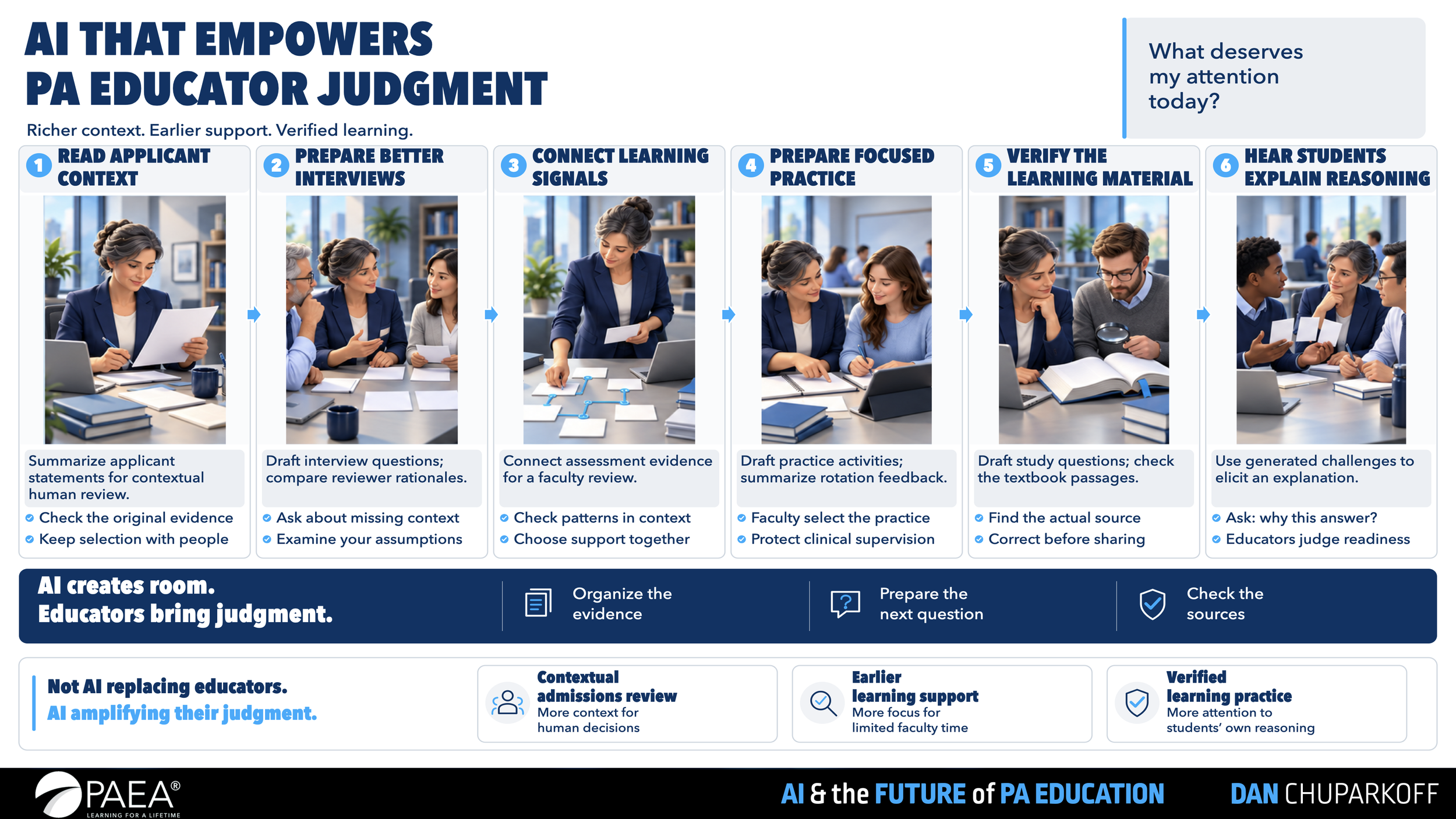
For PA education, the discussion focused on contextual admissions review, earlier learning support, and verified learning practice. It also introduced a different kind of help: use AI to critique work you have done and help you improve the next attempt. The closing framework organized work into six layers and urged attendees to make communication, processes, and finding issues more efficient, creating more room for solving problems, making decisions, and imagining a better future for PA education.
Action Items
[ ] List the work consuming your time and sort it into the six layers below. Choose one communication, process, or issue-finding task where AI assistance could free time for a problem or decision that needs your attention.
[ ] Ask an AI assistant the PA-education question below, adapting it to your role and program. Discuss the answers, identify which ideas fit your situation, and decide what you want to explore further.
[ ] Try the performance-coach loop on a piece of your own work. Ask AI to compare it with your previous work using criteria you care about, explain what was stronger in your best attempts, and suggest how to improve the next one.
[ ] Review an AI-generated answer before relying on it. Ask how sure it is and where the information came from, then open and read the source yourself. Apply that review to generated learning materials as well as your own work.
[ ] Try searchable notes for a suitable conversation using a tool appropriate for your team and its privacy requirements. Obtain permission to record, review the captured notes, and use them to retrieve details later. Keep handwritten notes too if they help you remember.
Key Ideas
Assistance expands capacity
The AutoCAD story shows how a tool can remove labor from a task while a person continues to direct the work. Look for help with the work that consumes your capacity.
Develop your expertise
Dan described AI as a “B-minus student” that can help across many subjects. The point for educators and students is to keep developing their own “A-plus” expertise while using assistance in other areas.
Useful answers still need judgment
The pizza example showed how flawed source material can produce an answer that appears useful. Autocomplete supplied the familiar response: review the suggestion, accept what helps, and do the work yourself when the suggestion misses your intent.
You bring memories & hope
Past experiences and the future you want to create influence your choices. AI can supply information for those choices; you bring the context and remain responsible for deciding what to do.
Supervise the assistant
Treat the interaction like working with an intern: give instructions, review the result, clarify what needs to change, and recognize when the work exceeds the assistant’s abilities. Teach students to take the same responsibility for their use of AI.
Use feedback to improve
The performance-coach loop begins with your own work. Comparing it with your prior attempts can help reveal what you did well, what you missed, and what to practice next.
Make room for human work
The hierarchy moves through six kinds of work: communication, processes, finding issues, solving problems, making decisions, and imagining. Use assistance in the lower layers to create more time for the upper layers. Communication remains important; the goal is to make it more efficient.
Opportunities in PA education
Contextual admissions review
Explore how AI assistance could help reviewers understand a large pool of applicants in greater detail and prepare better interviews. The opportunity is a richer understanding of applicants, with people making the admissions decisions.
Earlier learning support
Explore how learning signals and assessment information could help educators identify gaps earlier and connect students with focused practice. The keynote described a direction toward more continuous support and feedback, with faculty guiding the response.
Verified learning practice
Explore AI-assisted practice questions and explanations while checking the material students will learn from. Keep students’ own reasoning visible: ask them to explain what they think, and use assistance to help them develop that understanding.
These are starting points for a conversation about your program’s work. Decide which parts fit your needs and which do not.
A question to start the conversation
What are nine ways AI will change the work of PA program leaders, faculty, staff, and clinical educators responsible for preparing students for safe practice through PA education, while expanding holistic admissions, clinical readiness, and authentic learning despite limited staff, placements, and oversight capacity?
Adapt the question by naming who you are, what you are trying to accomplish, and what makes that work difficult. Continue the dialogue with your assistant rather than stopping at its first list of answers.
Talk Flow
1. Understand what technology assistance changes
The opening AI-generated video
Repeating a familiar prompt as models change provides a way to observe improvements and keep learning.
The journey to AutoCAD
Drawing parking-lot lines by hand and then seeing copy and paste made the value of assistance concrete.
The tool changed the effort required while the architect continued to guide the work.
The assistant realization
Seeing technology as help with work opens possibilities that fear of job replacement can obscure.
The staircase of technology
PCs, spreadsheets, the internet, mobile tools, and other changes made new forms of assistance part of ordinary work.
The AI piñata
Understanding what is inside AI helps educators identify useful assistance and guide students’ learning.
2. Review AI output & retain human judgment
Sentence completion, consensus & uncertainty
The “Once upon a…” exercise illustrated predicting a likely next word and the difference between a likely answer and the certainty a decision may require.
Ask about confidence and sources, then examine the information yourself.
Glue in the pizza
The proposed glue fix illustrated how jokes and flawed source material can enter an apparently helpful answer.
Autocomplete
You already know how to accept useful suggestions and reject ones that miss your meaning; keep that review role when using AI.
Memories & hope
Your past experiences and desired future give you context for deciding how to use the information an assistant supplies.
The intern relationship
Give instructions, review the work, and refine the request as needed.
Educators and students remain responsible for deciding whether the result is usable.
3. Explore the work of PA education
The question about your own work
Describe your role, the outcome you are responsible for, and the constraints that make it difficult.
Contextual admissions review
Look for ways to understand applicant context more fully and support better interviews.
Earlier learning support
Explore how learning signals can connect students with focused practice sooner.
Verified learning practice
Check generated learning materials and help students explain their reasoning.
The day-in-the-life picture
Connect the ideas into a recognizable workflow, then decide which parts of that picture you want to pursue.
4. Improve your work & protect your judgment
Personal uses of AI
Writing, research, software, inbox support, graphics, and translation offer places to begin using assistance in everyday work.
The performance-coach loop
Dan’s unsuccessful attempts to have AI write a LinkedIn post led to a more useful question: how did his own post compare with his previous work?
Define the criteria, compare your attempts, and use the feedback to improve.
Jobs & work
A job contains many kinds of work; removing some tasks from an overflowing workload creates capacity for others.
The hierarchy of work
Communication, processes, and finding issues form the lower layers; solving, deciding, and imagining form the upper layers.
Treat AI outputs as recommendations and keep responsibility for choosing what to do.
5. Reclaim time & share information in new ways
Communication & searchable notes
Make information easier to capture and retrieve using tools suitable for your team.
Keep the human value of communication while reducing unnecessary effort.
The notes-to-song demonstration
A different format can reinforce an important message through repetition.
Consider one curriculum idea worth hearing repeatedly; the keynote’s chorus reinforced “solve, decide, and imagine.”
Translation & collaboration
The translated-video demonstration and multilingual examples showed how AI can help people communicate across languages.
CLOSING MESSAGE: Expand collaboration & turn the pyramid over
Managing a world of more
Demands grow while the hours in your week stay fixed.
Make the lower layers more efficient so you and your students have more time to solve, decide, and imagine the future of PA education.