
WSA HEAR 2026: AI & the Future of Hearing Healthcare
Listen to the
AI KEYNOTE SONG
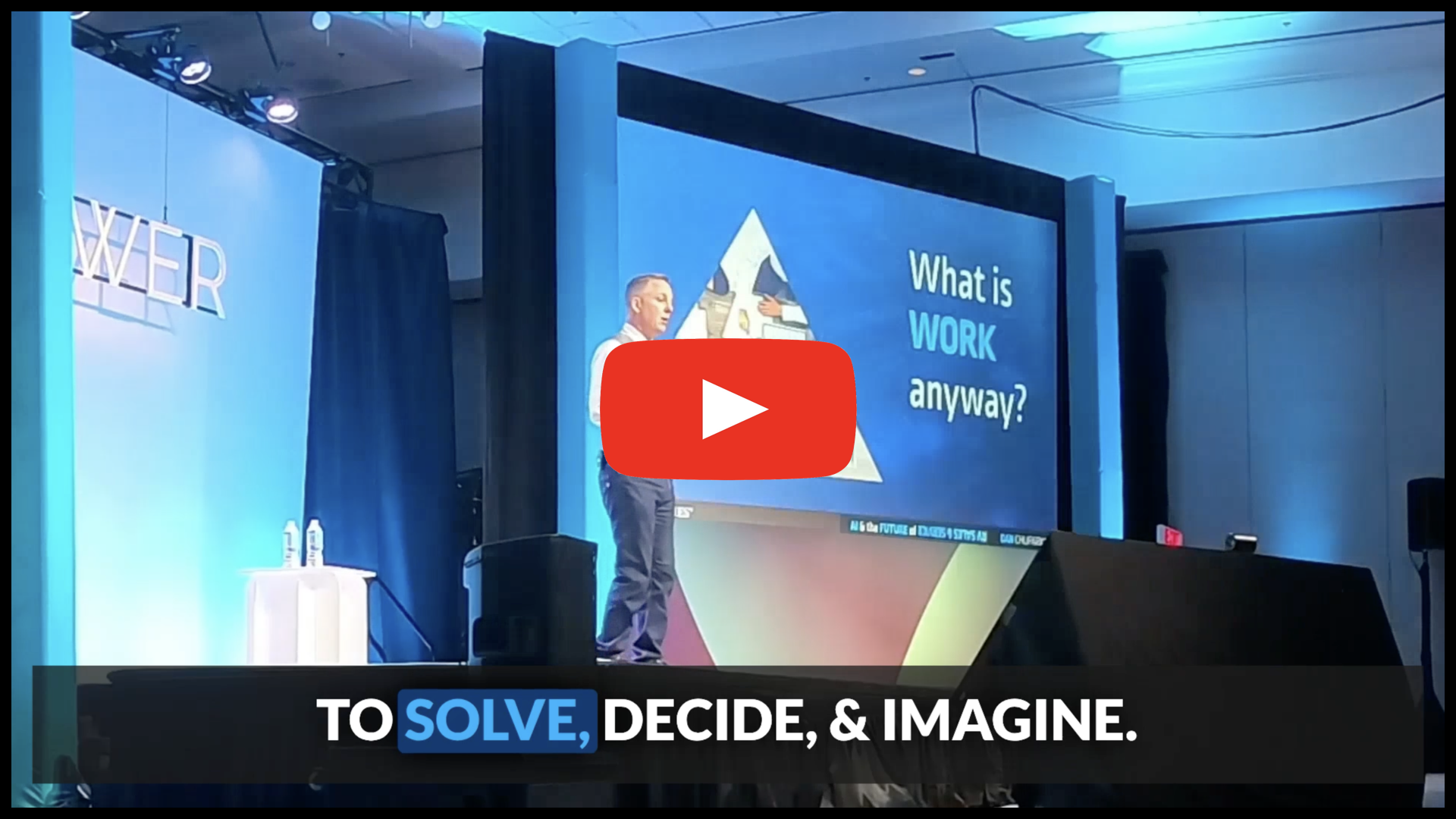
The easiest way to review or share the key points of my AI Keynote is with this song: the full keynote, matched with slides, in 4m32s!
A day in the life in YOUR AI FUTURE

PDF SUMMARY of key slides
This “Slide Cheatsheet” was customized for your specific talk. It’s designed to help audience-members like you, by wrapping my AI & the Future of Everything keynote into an easy-to-skim, easy-to-share, or easy-to-print resource for future reference.
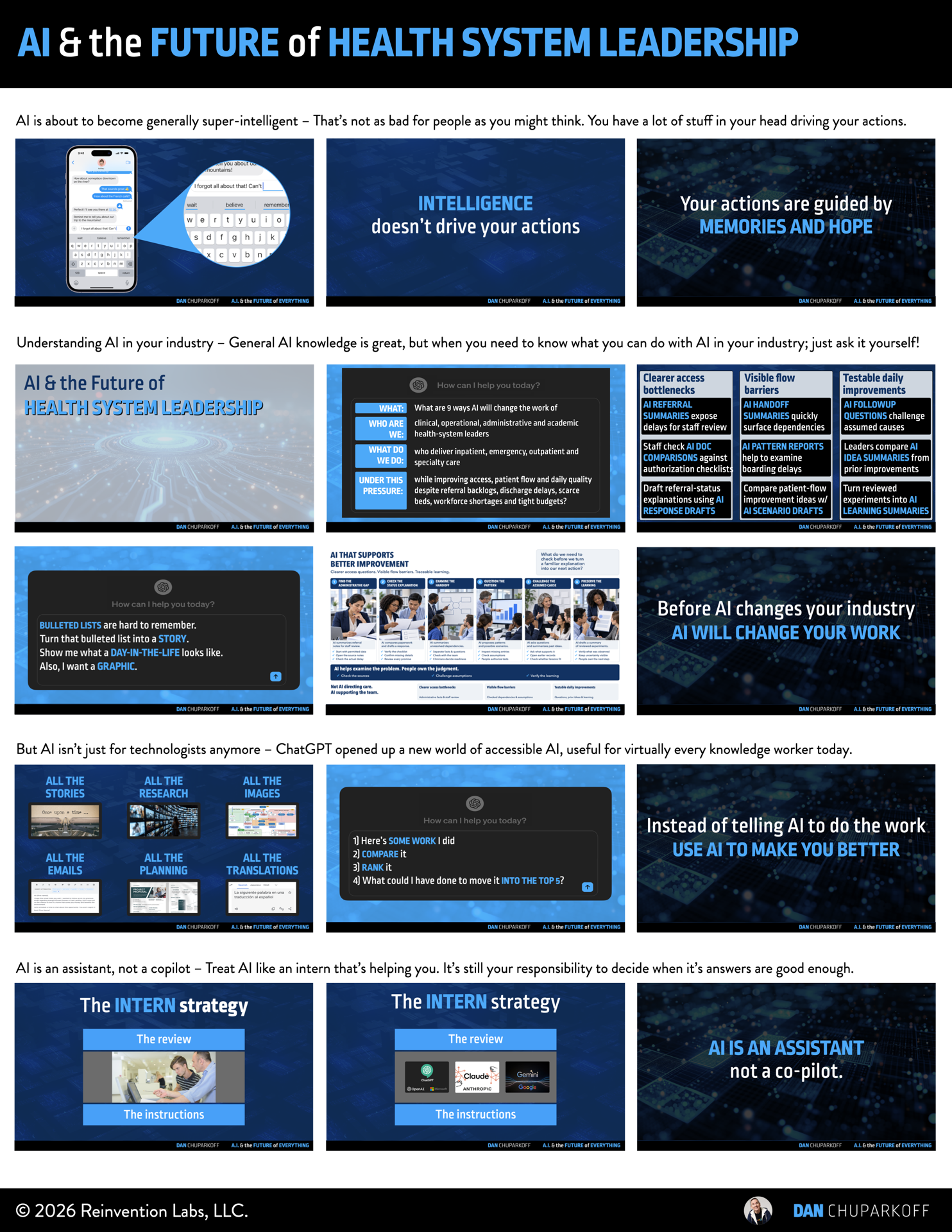
Download the 3 page
high-resolution PDF here:
Hope you find it helpful!
AI NOTES from Dan’s AI Keynote
*These notes were created using ChatGPT 5.6 pro.
Transcription errors or mistakes have not been fixed
in order to demonstrate the current state of AI notes.
Summary
AI creates another copy-and-paste moment: a way to make parts of work dramatically easier while people remain responsible for the result. Dan’s first encounter with AutoCAD turned painstaking parking-lot drafting into a fast, repeatable operation. The architect still mattered. The same distinction helps leaders use AI as an assistant while retaining judgment and ownership.
Useful assistance does not require unquestioning trust. AI can produce confident answers that need review. Autocomplete already illustrates the working relationship: accept a helpful suggestion, reject an unhelpful one, and keep doing your work. The intern metaphor extends that pattern into instructions, attempts, review, and revision. Your memories, hopes, expertise, and responsibility remain essential.
For UMass Memorial Health leaders, the opportunity is practical: understand access bottlenecks, examine patient-flow barriers, and accelerate daily improvement. Use AI to ask better questions, learn from previous work, preserve useful information, and reduce repeated communication. The goal is to redirect recovered time toward problems, decisions, and ideas that need people, including the next wave of improvements across the health system.
Action Items
[ ] Ask your AI assistant how your own work is changing. Describe your role, the service you provide, the outcome you need, and the constraints. Connect the question to your WAIT approach: ask AI to interview you and include what you have already tried.
[ ] Choose one recurring information task for assistance. Give clear instructions, review the result and its sources, then refine the instructions before using the work.
[ ] Turn AI into a performance coach. Compare a piece of your work with previous examples, ask what the strongest examples do better, and make a specific improvement yourself.
[ ] Use your organization’s available meeting-note tools to preserve a searchable record and prepare for conversations. Keep handwritten notes if they help you think.
[ ] Decide where recovered time will go: one unresolved problem, an important decision, or a new improvement idea your team has not had time to pursue.
Key Ideas
Assistance & accountability
AI can help produce the work. You remain responsible for deciding whether it is good enough to use.
Confidence needs review
A fluent answer is not a substitute for checking the information and applying your expertise.
Memories & hopes shape judgment
Your experiences and desired future help determine which recommendation to accept and which idea to pursue.
Build your skill
Ask AI how to improve your work. Repeated comparison and feedback can help you develop your capabilities.
Make room for higher-value work
Reduce time spent handling information so more attention reaches solving, deciding, and imagining.
Opportunities for health-system leaders
A prompt to reuse from the keynote:
> What are nine ways AI will change the work of clinical, operational, administrative, and academic health-system leaders who deliver inpatient, emergency, outpatient, and specialty care while improving access, patient flow, and daily quality despite delays, scarce beds, workforce shortages, and tight budgets?
Explore three groups of opportunities:
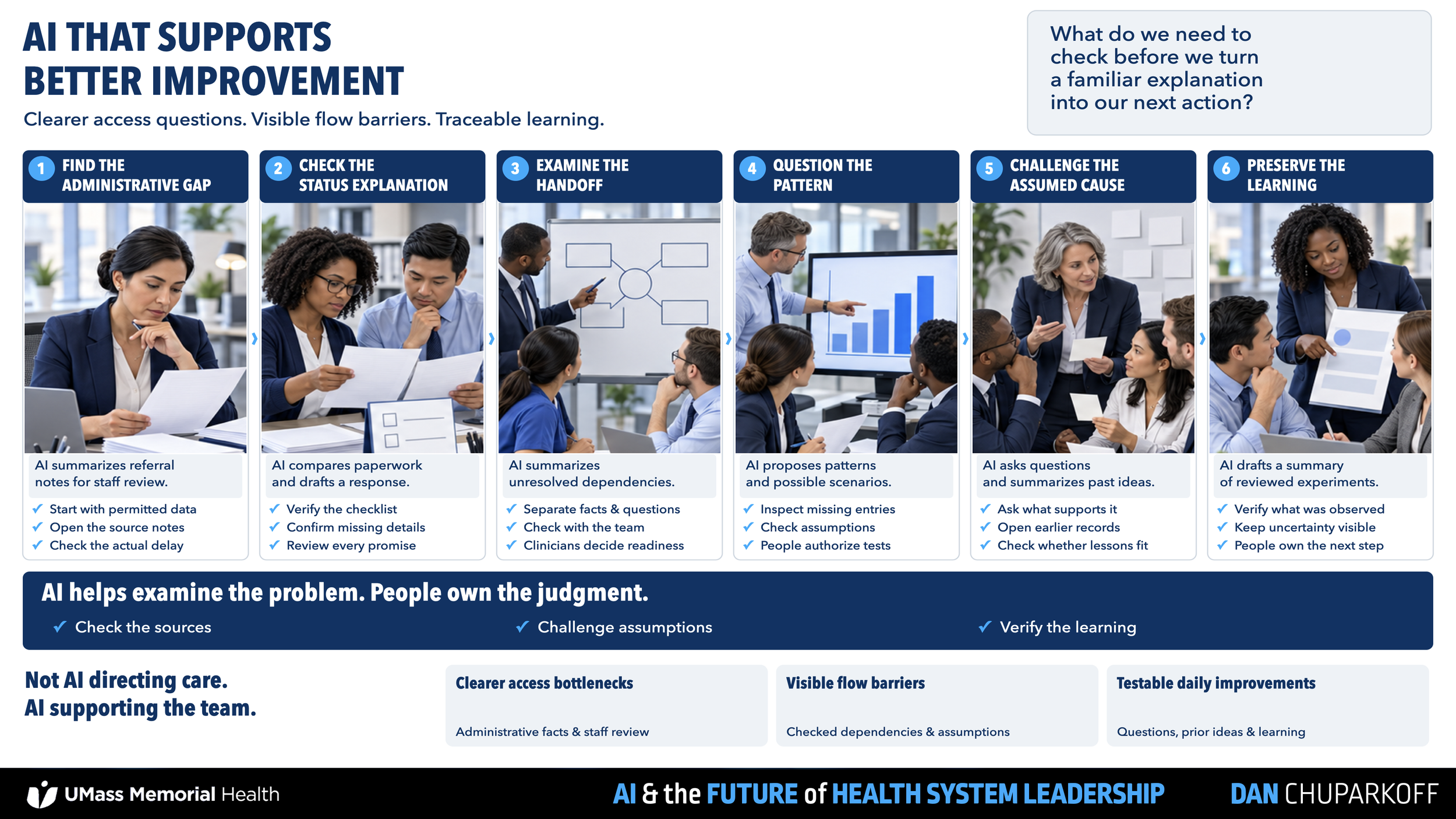
Clearer access bottlenecks: Referral summaries, document comparisons, and response drafts can help teams examine how information moves through the system.
Visible flow barriers: Handoff summaries, pattern reports, and scenario drafts can help leaders examine obstacles and compare possible improvements.
Testable daily improvements: Ask questions, challenge assumptions, compare ideas, and preserve learning so useful discoveries travel across teams.
Bring your lean experience and WAIT approach to this conversation. Add details about your actual problem and previous attempts. Treat the resulting scenarios as material to examine and shape, with leaders and teams retaining responsibility for decisions.
Talk Flow
1. Recognize the next copy-and-paste moment
From a limited starting point to technology leadership
Dan’s journey from a trailer park to Google introduced the possibility of using technology to expand your impact.
The parking-lot drawing breakthrough
AutoCAD accelerated precise, repetitive drafting while the architect remained responsible for the design.
The lesson was the distinction between an assistant and an automator.
The technology staircase & AI pinata
Familiar tools become ordinary parts of work; AI is another step in that pattern.
Leaders need to identify useful patient value inside the possibilities while attending to patient risk.
2. Understand the assistant & keep your judgment
The “once upon a time” experiment
Predicting the next word illustrated how common patterns influence an AI answer.
Use broad assistance to support the area where you bring deeper expertise.
Confidence, uncertainty & pizza glue
A leading answer can still leave substantial uncertainty.
Training material can contain sarcasm and poor advice, so evaluate the result rather than accepting its confidence.
Autocomplete, memories & hopes
You already know how to accept useful suggestions and reject unsuitable ones.
Experience and intentions add something beyond the information an assistant supplies.
The intern relationship
Give instructions, review the attempt, revise, and learn the assistant’s limits.
Check linked sources and decide whether you are willing to put your name on the work.
3. Apply AI to health-system leadership
Ask a question grounded in your work
Explain who you are, what you want to accomplish, and what makes it difficult.
Improve the prompt through WAIT, follow-up questions, and details about previous attempts.
Explore access, flow & daily improvement
Use summaries, comparisons, patterns, and scenarios to examine practical operating challenges.
Turn the list into a working picture
A day-in-the-life story can make possibilities easier to discuss than a dense list.
Continue the conversation with your assistant as you investigate, test, and learn.
4. Build capability & redirect the work
Use AI as a performance coach
Compare your own work with previous examples and ask what stronger versions do differently.
Understand the six layers
Work includes communication, process, investigation, problem solving, decision making, and imagining.
Improving the first three creates capacity for the last three.
Recover time from communication
Meeting preparation and searchable notes help useful information remain available when needed.
Reduced repetition creates time for work that was not getting done.
5. Communicate more effectively & make space for the future
Turn notes into a song
A different format can help people revisit an important message and remember it.
Reduce language barriers
The translation demonstration showed an opportunity for people to collaborate in languages comfortable to them.
CLOSING MESSAGE: Flip the pyramid of work!
Responsibilities and information keep growing while available hours remain limited.
Use assistance to reduce repeated information handling and spend more time solving, deciding, and imagining the next improvements in healthcare.