
American Gem 2026: AI & the Future of Jewelry Services
Listen to the
AI KEYNOTE SONG
The easiest way to review or share the key points of my AI Keynote is with this song: the full keynote, matched with slides, in 4m32s!
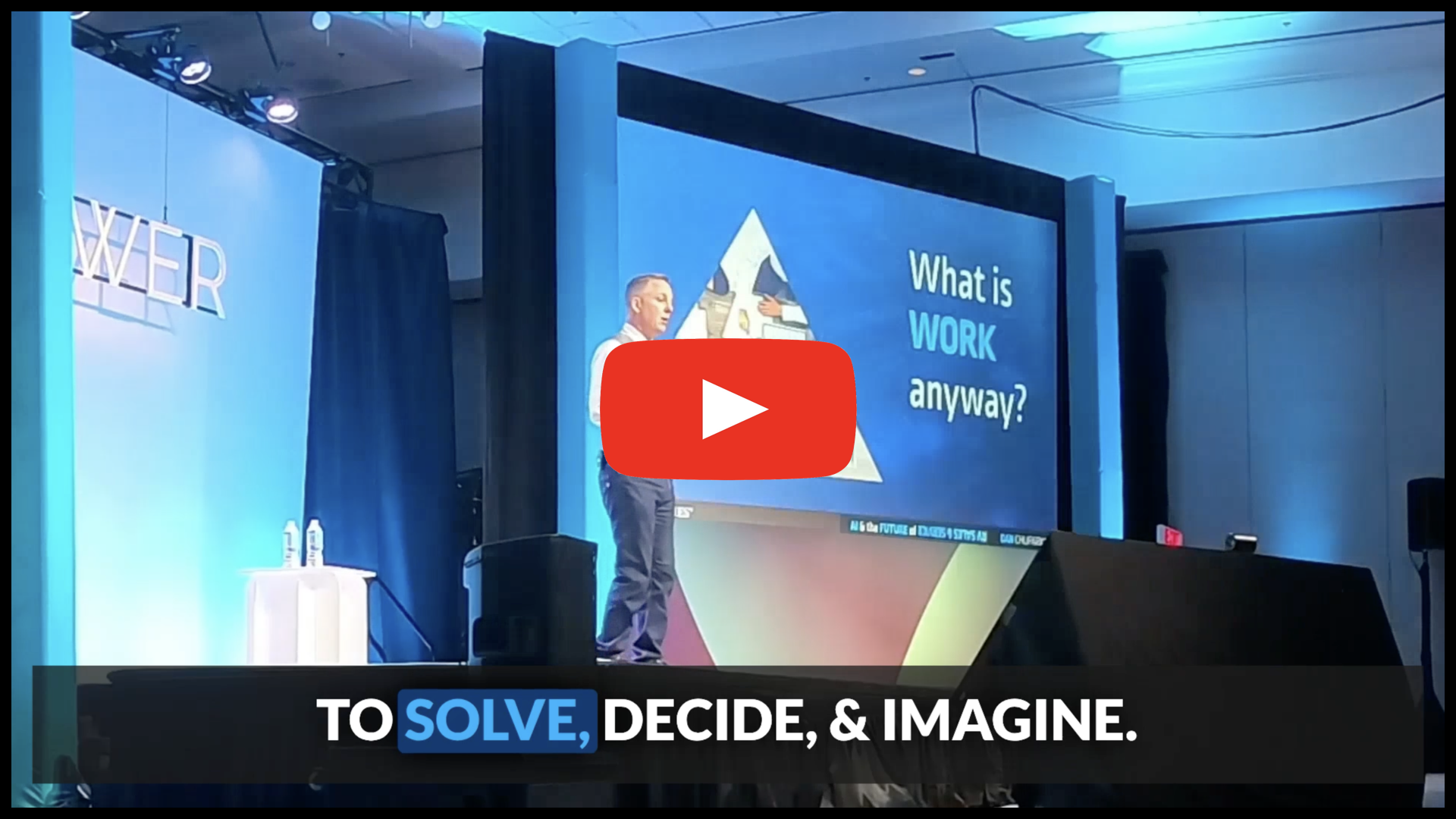
A day in the life in YOUR AI FUTURE
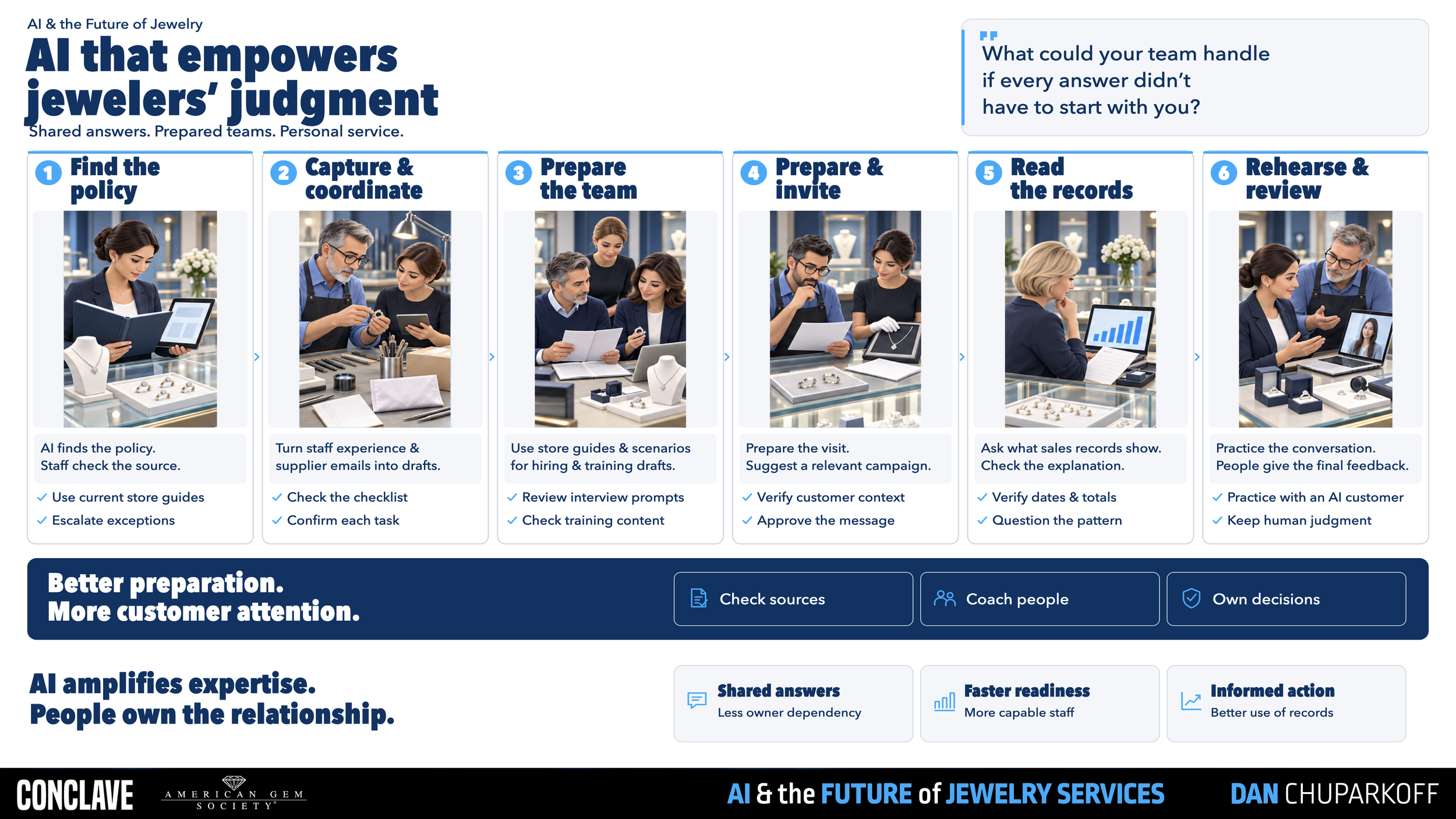

PDF SUMMARY of key slides
This “Slide Cheatsheet” was customized for your specific talk. It’s designed to help audience-members like you, by wrapping my AI & the Future of Everything keynote into an easy-to-skim, easy-to-share, or easy-to-print resource for future reference.
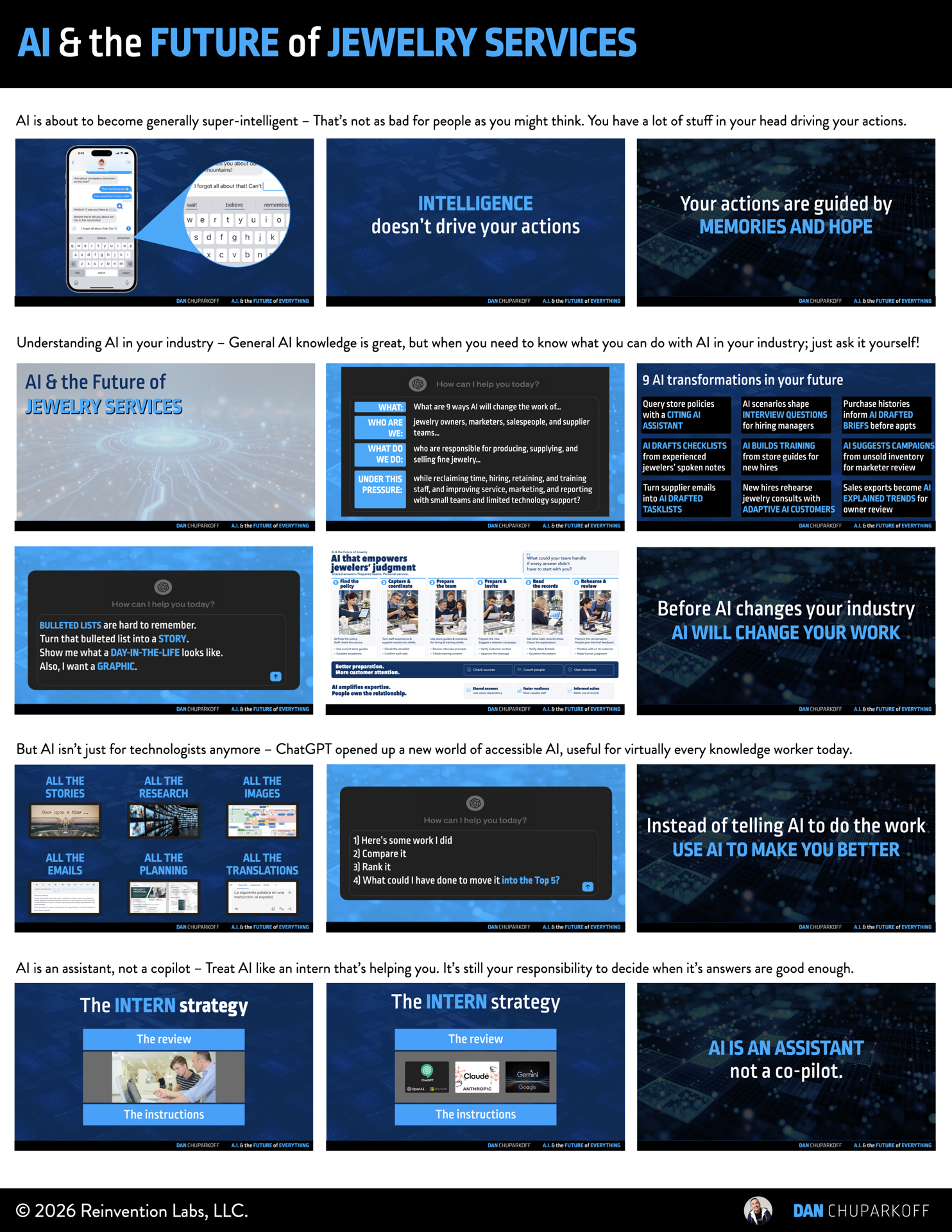
Download the 3 page
high-resolution PDF here:
Hope you find it helpful!
AI NOTES from Dan’s AI Keynote
*These notes were created using ChatGPT 5.6 pro.
Transcription errors or mistakes have not been fixed
in order to demonstrate the current state of AI notes.
One-Sentence Takeaway
Use AI to help with communication, processes, and investigation so you can spend more time solving problems, making decisions, and imagining better ways to serve your customers.
Summary
AI is a powerful assistant for people doing work. Dan illustrated that relationship through his first encounter with AutoCAD: copy and paste turned days of drawing parking-lot lines into seconds of work. The architect still guided the design. The opportunity with AI is to recognize similar moments in your own work and use the assistance to create more value.
Understanding how AI produces answers helps you decide where to use it. The “Once upon a…” experiment demonstrated prediction and consensus. The pizza example showed how an answer can reflect bad source material. Autocomplete offered a familiar model for accepting useful suggestions while keeping control. Your memories, hopes, customer knowledge, and intentions give you context that your assistant does not automatically possess.
For jewelry owners, marketers, salespeople, and supplier teams, the practical opportunity includes policies, checklists, staffing, training, service, marketing, and reporting. Start a conversation about one useful application. Then use AI as a coach: do the work, ask it to compare your attempt with your best previous work, and improve. The larger goal is to recover time from the bottom of the work pyramid and reinvest it in the human work of solving, deciding, and imagining.
Action Items
[ ] Ask an AI assistant the jewelry-work question below. Choose one useful idea, explain what does or does not fit your business, and ask how to get started.
[ ] Bring one piece of your own work to AI along with previous examples. Use the performance-coach prompt below to identify what would make your next attempt better.
[ ] Try AI-supported notes for a meeting or customer conversation, with the participants’ agreement. Use the summary to preserve information you would otherwise have to capture and retrieve manually.
[ ] Choose where recovered time should go: an unresolved customer problem, an important decision, or a new possibility for your team. Keep ownership of the decision and review the assistant’s work.
Key Ideas
Assistance expands what people can do
The AutoCAD story separates an assistant from an automator. Copy and paste changed the scale and speed of an architect’s work while the architect supplied direction. AI also needs guidance, correction, and someone deciding what matters.
Keep your expertise; expand your range
Dan described AI as a “B-minus student” across many subjects. Use that broad assistance in areas outside your specialty while continuing to develop the expertise that makes your own contribution valuable.
A likely answer still needs your judgment
The most common next word is not the same thing as the right choice for your situation. The 40% confidence example made that distinction visible. The glue-in-pizza story showed why you should also watch for flawed information behind an answer.
Memories & hope shape decisions
Your past experiences and the future you want influence how you solve problems and make choices. Give AI useful context, while recognizing that your assistant does not share everything you remember or hope to make happen.
Ask AI to coach your work
Dan’s useful shift came after an unsatisfying AI-written LinkedIn post. He wrote his own version, then asked AI to compare it with his previous work. The same approach can support customer conversations, writing, and other repeated tasks.
A reusable version of that request
Compare this work with my previous attempts. Is it my best, my worst, or somewhere in the middle? If it is not in my top five, show me the five best examples and explain what I did there that I did not do here.
Use the comparison to improve the next attempt. The goal is to become more capable with your assistant’s help.
Flip the work pyramid
Communication, processes, and investigation consume much of the working week. AI assistance in those layers can create capacity for solving problems, making decisions, and imagining a different future. Decide how to use that capacity for your customers and team.
Opportunities for Jewelry Teams
The keynote’s question connected AI to the realities of producing, supplying, and selling fine jewelry with small teams and limited technology support. Use this readable version to start your own conversation:
What are nine ways AI will change the work of jewelry owners, marketers, salespeople, and supplier teams responsible for producing, supplying, and selling fine jewelry, while reclaiming time, hiring, retaining, and training staff, and improving service, marketing, and reporting with small teams and limited technology support?
The spoken examples included:
Daily operations: Help people find store policies and draft checklists and task lists.
Staff readiness: Draft interview questions and training guides.
Service, marketing & reporting: Draft briefs, suggest campaigns, and explain trends.
Choose the ideas that fit your business. Tell the assistant where its answer is wrong, which changes seem unlikely, and what alternatives deserve attention. Ask follow-up questions about one possibility instead of stopping at a list.
Dan also demonstrated asking AI to turn a list of changes into a day-in-the-life story and graphic. A picture of how work could change can make the possibilities easier for a team to discuss.
Talk Flow
1. See AI as an assistant
The AI-generated introduction
The opening video made AI’s ability to create communication visible before the talk began.
Repeating a creative task with new generations of a tool can reveal how its output changes.
The journey to an AutoCAD moment
Dan’s path from a trailer park to leading work at Google introduced a career shaped by technology assistance.
The parking-lot story made the value concrete: copy and paste removed repetitive drawing work.
Assistant versus automator
Danny’s fear of losing architects’ jobs contrasted with Dan’s view of a tool helping architects do more.
People still supply direction, examine the work, and make decisions.
The technology staircase
PCs, the internet, mobile devices, cloud tools, and other shifts changed how people handled information and collaborated.
Looking for the next useful copy-and-paste moment makes AI easier to approach through everyday work.
Opening the AI piñata
Explore deliberately: learn what the tool can help with, where it makes mistakes, and what should remain yours to do.
2. Understand AI’s limits & your role
“Once upon a…”
The audience’s next-word response illustrated prediction and the pull of a common answer.
Use AI’s broad range while retaining the expertise you have developed in your field.
The 40% confidence problem
A leading answer can still fall short of the certainty you need for a particular decision.
Match your use of AI to the task and the judgment it requires.
Hallucinations & glue in pizza
The life-insurance analogy illustrated working from patterns in past data.
The pizza story showed how misleading source material can become an unhelpful suggestion.
Autocomplete as familiar assistance
Accept a useful suggestion or continue with your own intended message.
Watch for drift and intervene when the assistant moves away from what you mean.
Memories & hope
Experiences, aspirations, and local context shape choices that can differ even among people at the same table.
That context advantage should influence which tasks you give your assistant.
3. Apply AI to jewelry work
A question built around your work
Name the roles, responsibilities, desired outcomes, and constraints of your business.
Use the question to begin an ongoing conversation about how the work could change.
From a list to a possible working day
Policies, checklists, training, campaigns, and reporting offered concrete places to explore assistance.
Choose and challenge the ideas; use a story or graphic to help the team discuss them.
Everyday assistance
Writing, research, diagrams, inbox management, planning, and translation offer ways to begin with tools already available.
The performance-coach loop
Do the work, compare it with your strongest previous attempts, and use the feedback to improve.
Dan applied that loop to posts, customer conversations, and keynotes.
4. Create more time for human work
The hierarchy of work
Communication, processes, and investigation form the busy lower layers of the pyramid.
Solving problems, making decisions, and imagining a future need time and human direction.
The dinner-choice example and choosing one idea for a team illustrated the difference between generating options and deciding what you want.
Communication & meeting support
Notes and summaries can preserve information beyond scattered sheets of paper.
Meeting-support examples included spotting circular discussions and identifying a missing subject-matter expert.
Turning notes into a song
The short chorus reinforced “solve, decide, and imagine” in another format.
Consider how a different communication format could help people remember something important.
5. Expand collaboration & reshape the week
Translation in everyday collaboration
The video demonstration, France visit, and bilingual construction-team story showed the value of communicating across languages.
The same opportunity connects to jewelry stores, partner networks, and supply chains.
Closing Message - Managing in the world of more
Growing customer expectations, systems, and information compete for a fixed number of working hours. Use assistance to reduce work in the lower layers, then put the recovered time into harder problems, better decisions, and new possibilities. Solve problems, make better decisions, and imagine a better future for your people.