
QCS 2026: AI & the Future of Food & Beverage
Listen to the
AI KEYNOTE SONG
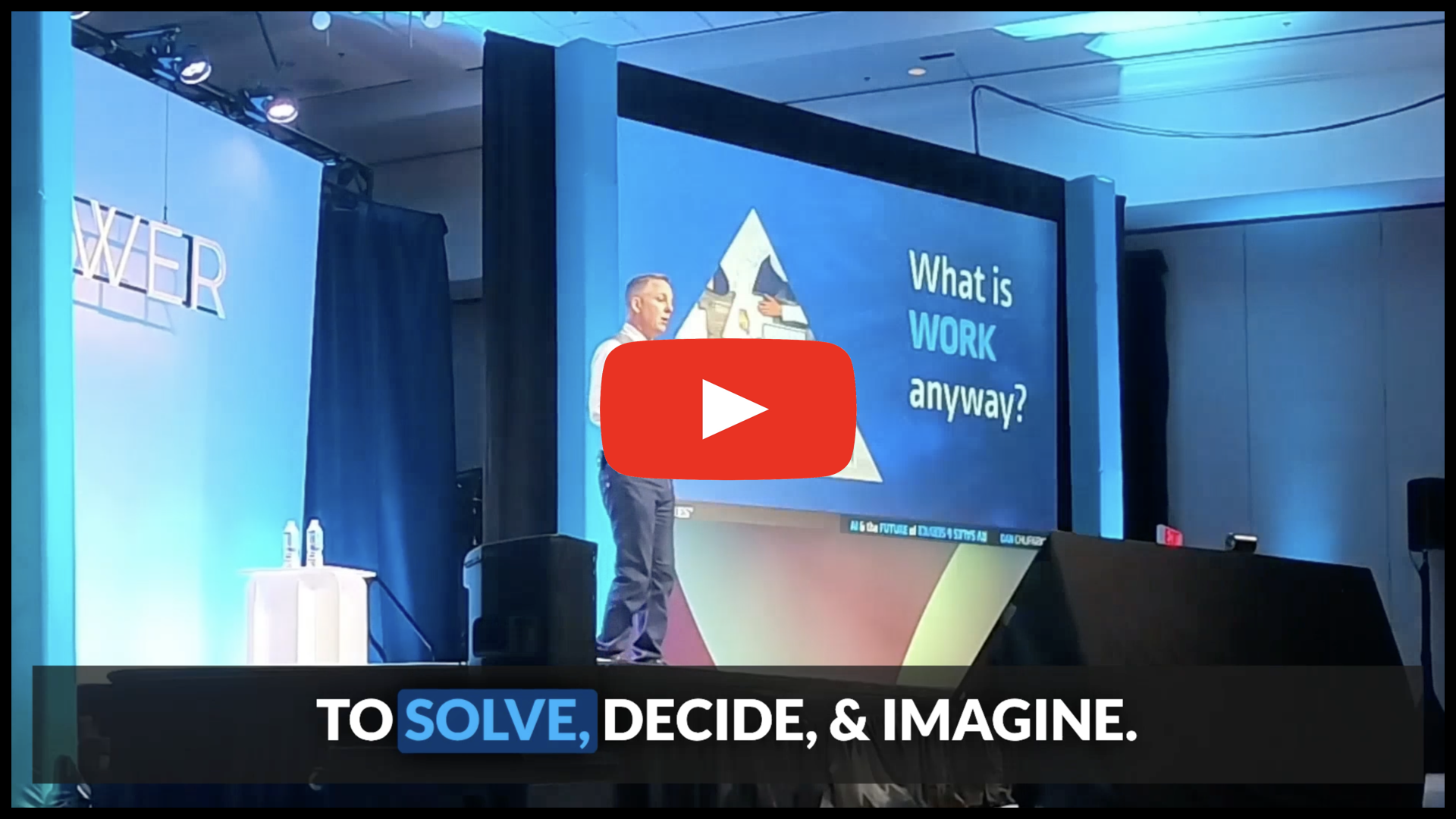
The easiest way to review or share the key points of my AI Keynote is with this song: the full keynote, matched with slides, in 4m32s!
A day in the life in YOUR AI FUTURE

PDF SUMMARY of key slides
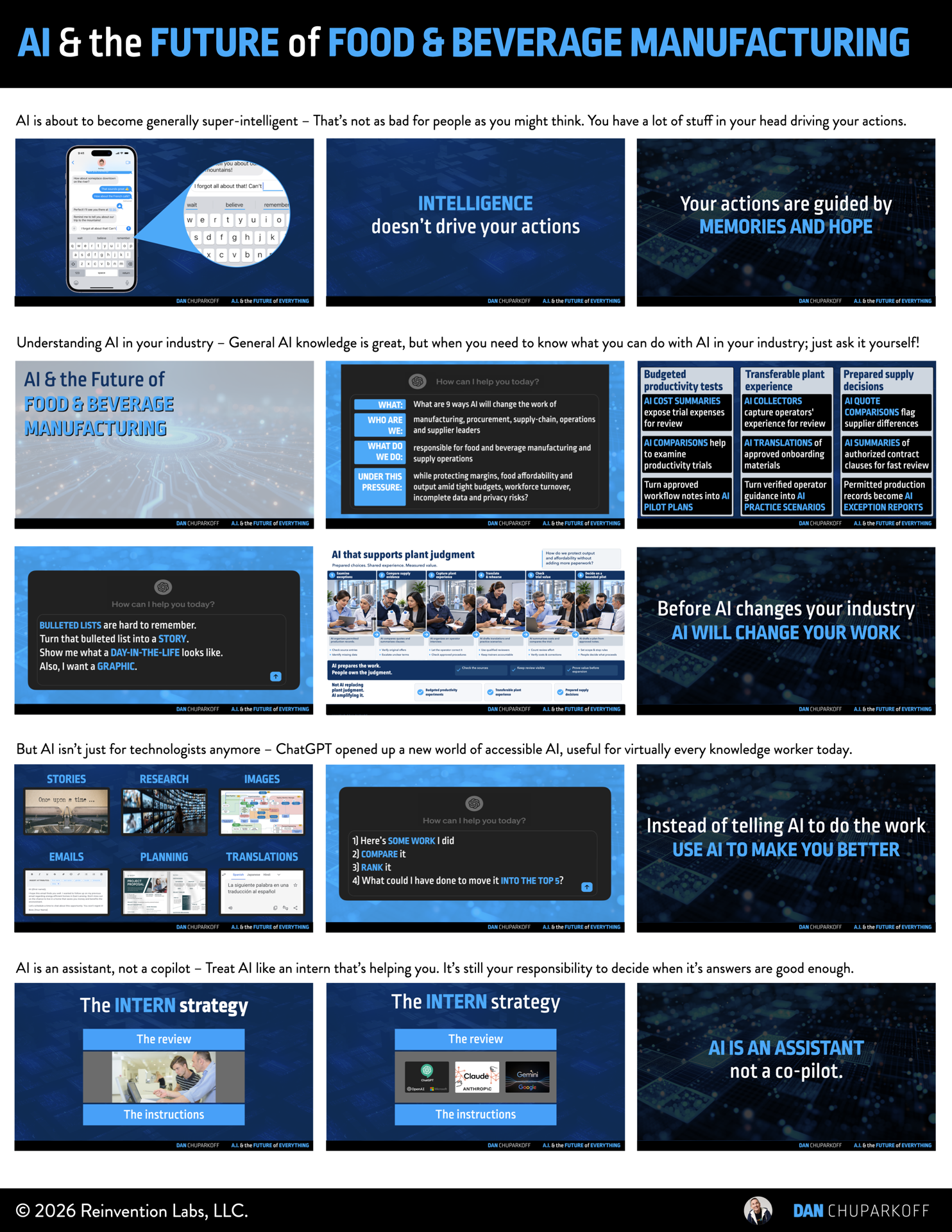
This “Slide Cheatsheet” was customized for your specific talk. It’s designed to help audience-members like you, by wrapping my AI & the Future of Everything keynote into an easy-to-skim, easy-to-share, or easy-to-print resource for future reference.
Download the 3 page
high-resolution PDF here:
Hope you find it helpful!
AI NOTES from Dan’s AI Keynote
*These notes were created using ChatGPT 5.6 pro.
Transcription errors or mistakes have not been fixed
in order to demonstrate the current state of AI notes.
Summary
AI becomes more useful when you treat it as an assistant and bring your own expertise to the work. Dan illustrated this through his first encounter with AutoCAD: copy and paste transformed the task of drawing parking lots while architects still supplied the ideas and judgment. AI creates a similar opportunity to rethink how work gets done.
A confident AI answer still needs your judgment. The sentence-completion exercise and glue-in-pizza story showed why a plausible answer can be a poor recommendation. Your memories, relationships, and hopes provide context that a prompt cannot fully capture. Ask questions, examine sources, and decide what to accept, change, or reject.
For food and beverage leaders, the opportunity includes testing productivity improvements, preserving plant experience, and preparing better supply decisions. Start with a clear description of your role, goals, and constraints. Then use AI to explore options and improve your own work. The aim is to create room for the work your customers and teams need you to do next.
Action Items
[ ] Ask an AI assistant how your work could change. Include who you serve, what you want to accomplish, and what makes the work difficult. Use the QCS prompt below as a starting point, then choose an idea to explore.
[ ] Try the performance-coach loop on one piece of work. Compare it with your previous attempts, ask what your strongest examples did better, and use that feedback to improve it.
[ ] Record an experienced leader explaining how they think about the business. Begin building a searchable record that future leaders can learn from.
[ ] Capture an important meeting with an approved AI note-taking tool. Keep a searchable record you can return to when preparing for a customer conversation or making a decision.
[ ] Choose one communication, process, or investigation task where AI can help. Decide which customer problem, business decision, or new idea you will give more attention to with the time you gain.
Key Ideas
Assistance expands what you can do
The useful question is where AI can help you produce better work and create more value. Your expertise remains part of the process.
Keep your context advantage
A past project, a conversation over breakfast, or a goal for your team can change the right decision. Treat AI's output as a recommendation and apply what you know before acting.
Confidence needs a closer look
Ask how sure AI is and request the sources behind its answer. Review those sources and consider how much certainty the decision requires.
Be the expert; use AI to improve
Dan's A-plus/B-minus comparison encourages you to identify the work where your expertise matters most. AI can help with other tasks and coach you toward stronger performance in your own work.
Better work comes from a feedback loop
Instead of accepting the first draft, compare your work with your strongest past examples. Ask what changed, what is missing, and what would make the next version better.
Flip the work pyramid
Communication, process, and investigation can fill the week. Use AI assistance in those layers to create more space for problem solving, decision making, and imagination.
Opportunities for QCS Members
Start with your work
The keynote used this question to explore the room's opportunities:
> What are nine ways AI will change the work of manufacturing, procurement, supply-chain, operations, and supplier leaders responsible for food and beverage manufacturing and supply operations, while protecting margins, food affordability, and output amid tight budgets, workforce turnover, incomplete data, and privacy risks?
This is a readable version of the delivered prompt. Adapt it to your own role and business. Ask follow-up questions about useful applications, required data, and available tools. Use your industry expertise to decide which ideas belong on your list.
Explore three areas
Budgeted productivity tests: Explore improvements in small doses before extending them across the team. Use the exercise to understand what could change the work.
Transferable plant experience: Record what experienced leaders know and how they think. Make that knowledge available to the people who will take over those responsibilities.
Prepared supply decisions: Explore how AI could help bring together information about vendors, production, and supply activity so people can make better decisions.
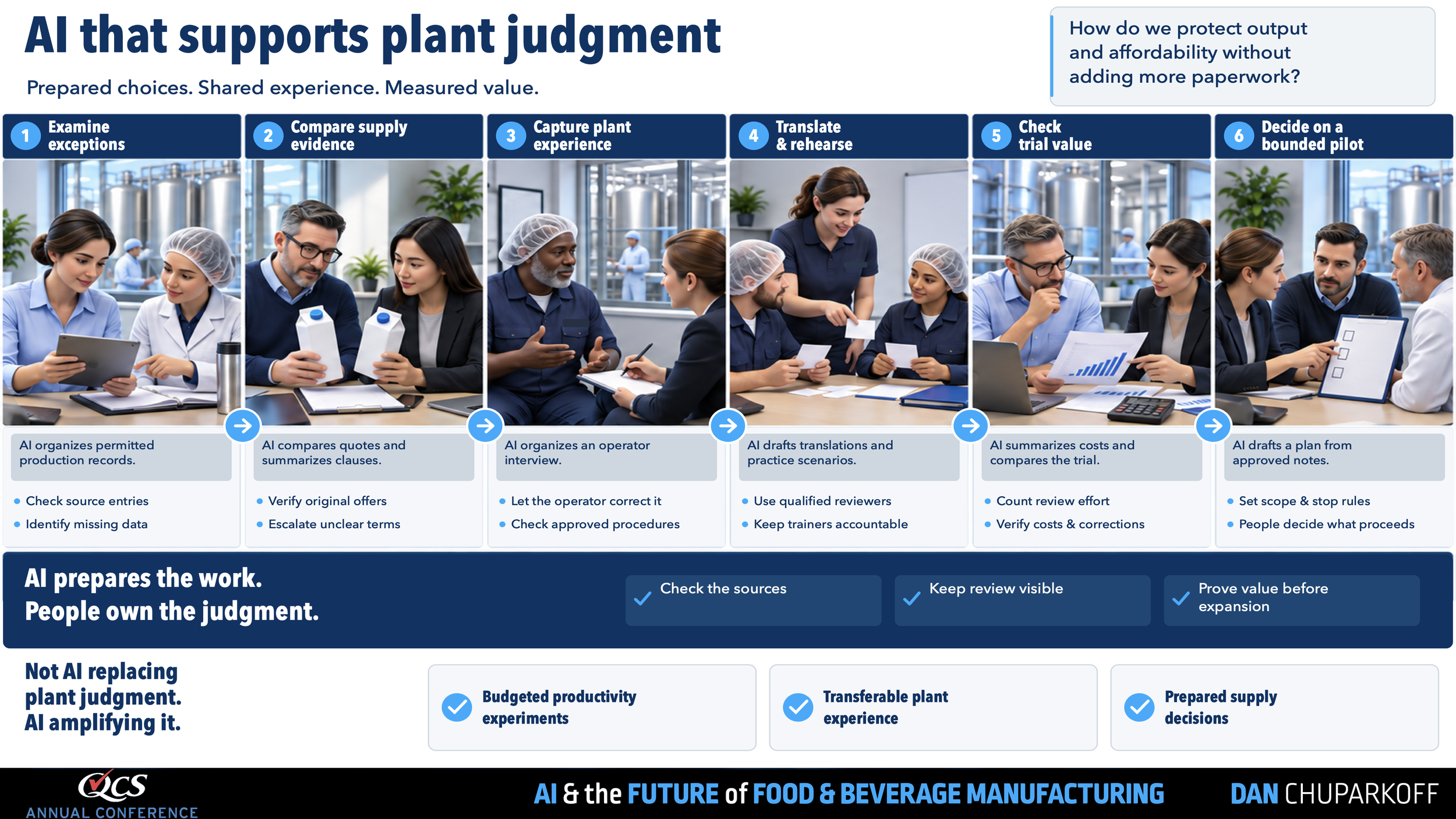
AI can also help turn a long list into a day-in-the-life story or picture. Use that format to discuss what a different workday could look like with your team.
Talk Flow
1. See technology as assistance
A career changed by copy & paste
Drawing parking lines by hand made the value of AutoCAD immediately visible.
A new tool changed what an architect could accomplish with their time.
Assistant versus automator
Danny's fear of losing jobs contrasted with Dan's view of a tool that helped people do more.
Look for the work AI can help you improve.
The next familiar tool
Spreadsheets, the internet, and cloud tools became part of ordinary work.
Open the AI “pinata” by asking what creates useful results, customer value, and a worthwhile return.
2. Understand the answer before acting
The sentence-completion experiment
“Once upon a…” illustrated prediction and the pull of a common answer.
Preserve the expertise that makes your work distinctive.
Confidence & flawed sources
The next word after “time” showed how certainty changes with the question.
The glue-in-pizza example made the risk of learning from flawed source material memorable.
Ask for sources and inspect the answer before using it.
Autocomplete, memories & hope
You already accept or reject suggestions when typing a message.
Bring the same judgment to AI recommendations, using the context and goals only you carry.
Cooperative members benefit from sharing their different experiences and aspirations.
3. Apply AI to your industry & your performance
A prompt grounded in the business
Describe your role, desired outcomes, and constraints.
Keep asking questions until the possibilities become useful to your work.
Three opportunities for QCS members
Explore productivity tests, transferable plant experience, and prepared supply decisions.
Use your expertise to build your own list of priorities.
The performance-coach loop
Dan's unsatisfying AI-written post led to a more useful request: compare his own post with his previous work.
Use comparisons to identify what your best work does well and improve the next attempt.
Customer calls, presentations, and other recurring work can benefit from the same habit.
4. Create room for higher-value work
Jobs & work
Making one task more efficient creates capacity for work you have not been reaching.
Customer and stakeholder expectations continue to grow.
The six layers of work
Communication, process, and investigation form the base of the pyramid.
Problem solving, decision making, and imagination need deliberate space in the week.
Keep ownership of decisions
Let AI prepare recommendations, then accept, change, or reject them.
Dan described reviewing overnight AI recommendations before allowing the work to continue.
5. Improve how people share information
Searchable meeting knowledge
AI notes can help preserve conversations and prepare people for later discussions.
Use a tool approved for your company's needs and keep information easy to find again.
Notes in a new form
The song demonstration turned the keynote's ideas into something people could replay and share.
Consider a new format for one important idea your team needs to remember.
Collaboration across languages
The translation demonstration and Dan's experience in Italy showed another way to connect people.
Consider what language access could mean for your employees and customers.
CLOSING MESSAGE: Managing in a world of more!
A world of more, with the same hours
Make the lower layers of work more efficient while preserving human relationships and judgment.
Use the space you create to solve, decide, and imagine a better future for food and beverage manufacturing.