
PartnerESI 2026: AI & the Future of Commercial Property Expertise
Listen to the
AI KEYNOTE SONG
The easiest way to review or share the key points of my AI Keynote is with this song: the full keynote, matched with slides, in 4m32s!
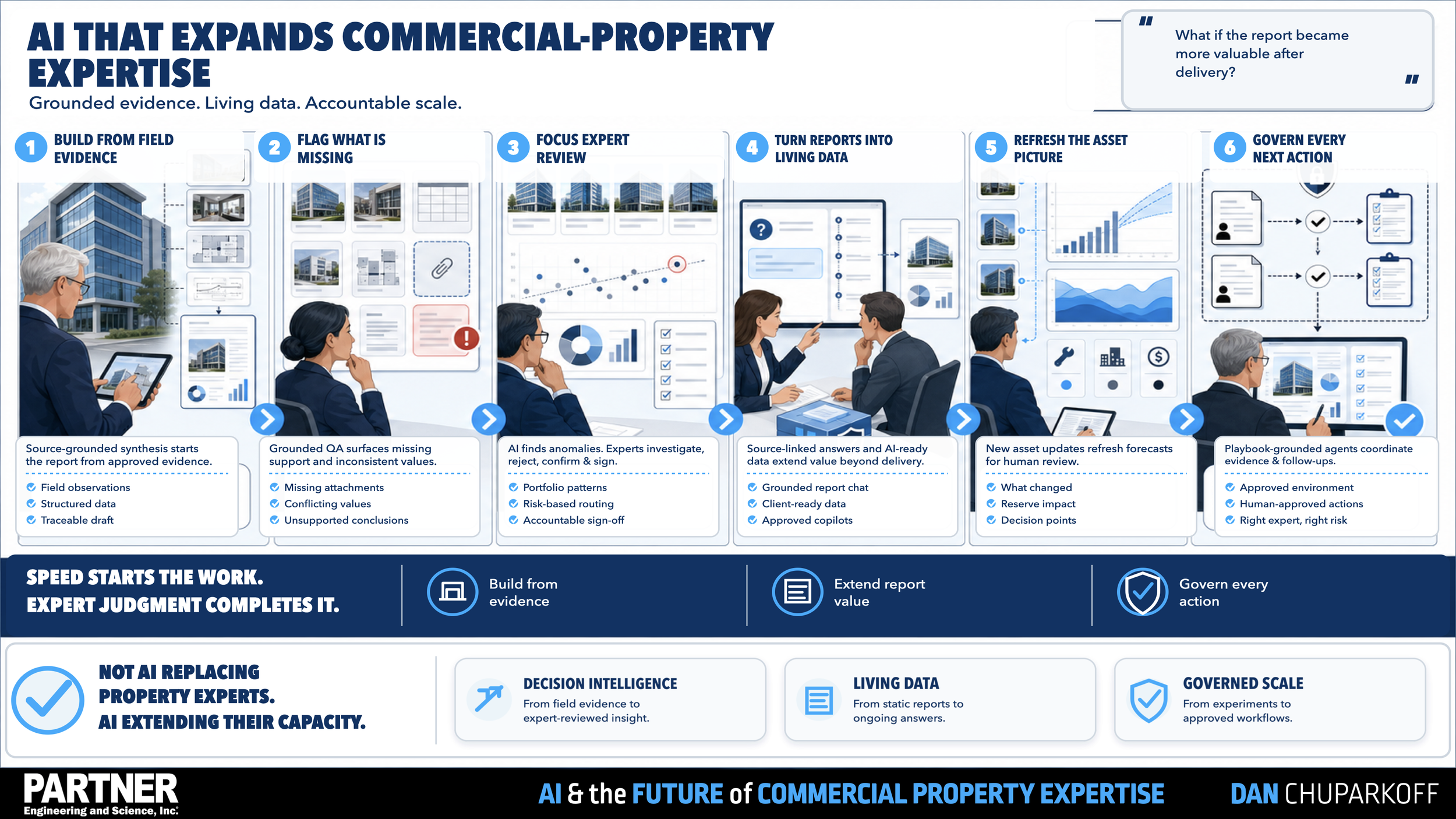
A day in the life in YOUR AI FUTURE

PDF SUMMARY of key slides
This “Slide Cheatsheet” was customized for your specific talk. It’s designed to help audience-members like you, by wrapping my AI & the Future of Everything keynote into an easy-to-skim, easy-to-share, or easy-to-print resource for future reference.
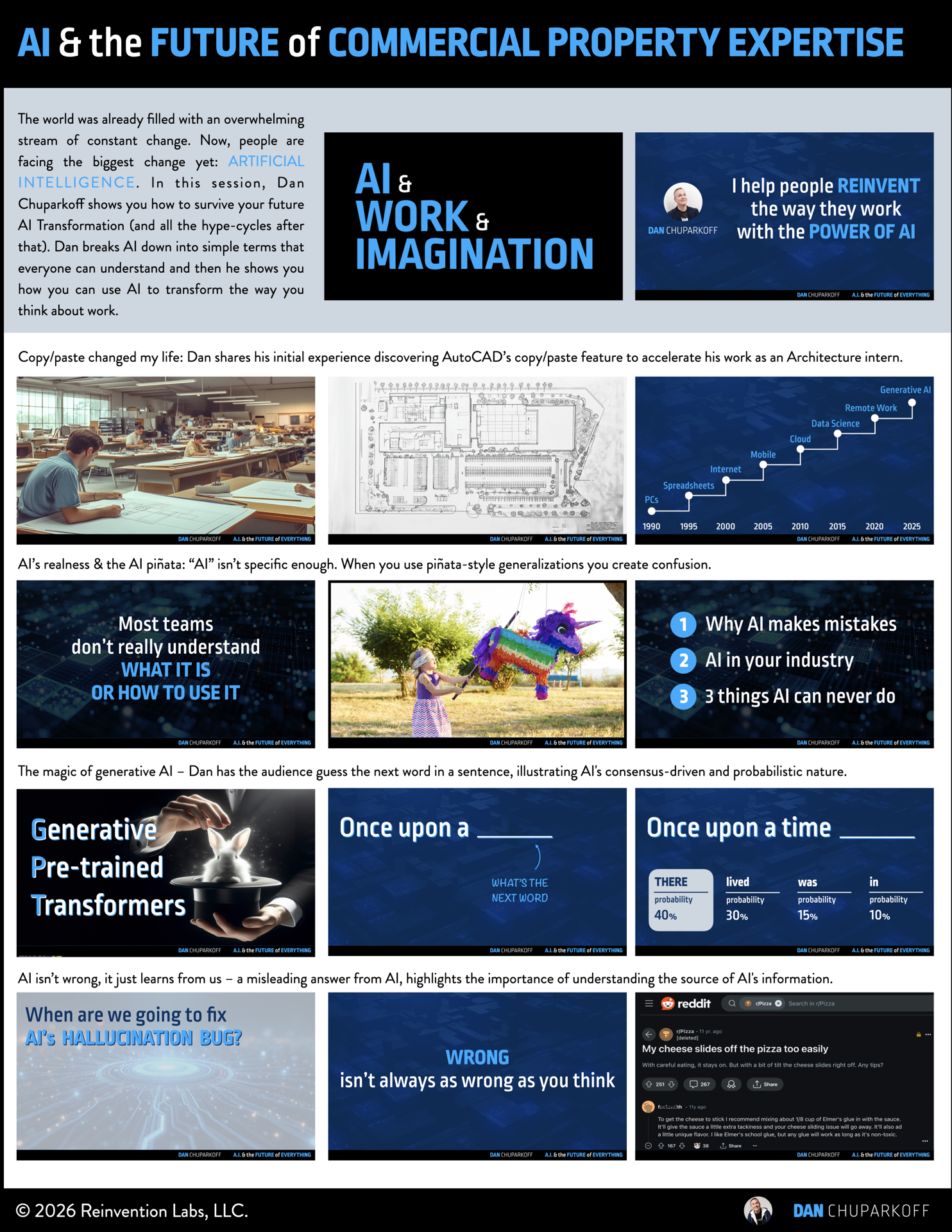
Download the 3 page
high-resolution PDF here:
Hope you find it helpful!
AI NOTES from Dan’s AI Keynote
*These notes were created using ChatGPT 5.6 pro.
Transcription errors or mistakes have not been fixed
in order to demonstrate the current state of AI notes.
One-Sentence Takeaway
Use AI as an assistant that compresses communication, process, and issue-finding work so human experts can spend more time solving difficult problems, making accountable decisions, and imagining better client outcomes.
Summary
AI is becoming another foundational work tool, much like AutoCAD, spreadsheets, the internet, mobile devices, and cloud computing. The advantage does not come from asking technology to replace expertise. It comes from pairing a powerful assistant with the judgment, context, memories, hopes, and accountability that people bring to the work.
Generative AI predicts likely next pieces of content. That makes it useful, fast, and broadly capable, but not reliably correct. Its answers reflect the information it learned from, including average thinking, outdated material, jokes, and bad advice. Treat every output as a recommendation. The person using AI must decide when its answer is useful, when the stakes require more certainty, and when expert review is nonnegotiable.
For commercial real estate consulting, the opportunity is larger than faster report writing. AI can help move the work from document production to decision intelligence, from static reports to living data, and from isolated execution to governed scale. The goal is to improve evidence handling, reporting, communication, capacity, and client value while keeping technical review and accountable sign-off human.
The practical path is to make the lower layers of the work pyramid more efficient. Let AI assist with communication, repeatable processes, and issue detection. Reinvest the recovered time in the work people remain best positioned to do: solve new problems, make decisions, and imagine what should exist next.
Action Items
[ ] Identify one recurring communication, process, or issue-detection task that could be improved with an approved AI assistant.
[ ] Ask AI how your role and service could change, then challenge its recommendations against your expertise, security requirements, and client commitments.
[ ] Treat every AI output as a recommendation to verify, not a decision or finished deliverable.
[ ] After completing important work, ask AI to compare it with your prior attempts and identify what would make the next version better.
[ ] Track whether AI assistance is recovering more time for problem solving, decision making, and imagination.
Key Ideas
AI is an assistant, not an automator.
Technology creates more value when it expands what experts can accomplish instead of trying to remove their judgment from the work.
Likely is not the same as correct.
Generative AI predicts plausible content. It does not know how much certainty your situation requires.
Average capability can still create exceptional leverage.
AI may be a broadly capable B-minus assistant while you remain the A-plus expert in your field.
Human context drives decisions.
Memories, hopes, ethics, judgment, and responsibility shape choices in ways that probability alone cannot.
The best use of AI may be improvement, not production.
AI can compare, rank, and critique completed work so each attempt becomes stronger without taking ownership away from the expert.
Recover time for higher-value work.
Use AI to compress communication, process, and issue-finding work so people can solve, decide, and imagine.
Commercial real estate consulting opportunities
From doc production to decision intelligence
Get AI synthesis to assist drafting of report sections.
Flag incomplete evidence with AI-supported quality checks.
Surface portfolio risks through AI-detected report anomalies.
From static reports to living data
Answer client questions through real-time AI chat.
Package AI-ready data for client copilots.
Refresh reserve forecasts with AI-supported asset updates.
From isolated execution to governed scale
Use governed AI environments for protected client data.
Use playbook agents to coordinate evidence collection and follow-ups.
Route AI outputs through risk-based human review.
Talk Flow
See AI as the next great work assistant
The quality threshold is moving
AI-supported work is becoming part of the baseline for communication, investigation, and process improvement.
Once a useful technology materially improves the work, returning to the fully manual method feels increasingly impractical.
The AutoCAD copy-and-paste moment
A three-day parking-lot drafting task became a roughly 90-second task with AutoCAD.
The architect still supplied the design intent, constraints, and responsibility.
Assistant versus automator
AutoCAD assisted architects rather than independently creating and approving buildings.
AI follows the same pattern: the strongest value comes from augmenting expert work, not freezing value while removing the expert.
One more step in a long progression
PCs, spreadsheets, the internet, mobile devices, cloud systems, and data science all became ordinary parts of work.
AI is moving toward the same status as a tool people use without needing to announce it.
Understand how generative AI succeeds and fails
The AI pinata
Teams need to determine which capabilities create more customer value than risk or cost.
Experimentation should be connected to real work rather than random tool use.
Once upon a time
Generative AI predicts the next likely piece of content from patterns in its training data.
Consensus-driven prediction can miss unusual, expert, or genuinely creative answers.
Confidence and uncertainty
AI may present the most likely answer even when its underlying confidence would be too low for the decision at hand.
The human user must judge whether an answer is good enough for the stakes.
Glue in the pizza and autocomplete
Training data contains expertise, mistakes, sarcasm, and deliberately bad advice.
A bad suggestion does not require abandoning the tool; it requires reviewing the suggestion before using it.
Memories and hope
People make decisions using lived experience, goals, ethics, and situational context.
AI recommendations cannot replace the human responsibility to decide.
Apply AI to commercial property expertise
Ask a role-specific transformation question
Frame the prompt around the people doing the work, the service they provide, the outcomes they need, and the constraints they must manage.
Use the response to begin a strategic conversation, not to dictate the answer.
Move from documents to decisions
AI can help organize evidence, flag missing information, and focus expert review.
Faster production matters most when it improves decision quality and client value.
Turn static reports into living data
Structured property information can support updated asset views and more responsive client conversations.
Data security, system integration, and customer readiness remain real constraints.
Build governed scale
Repeatable playbooks and governed environments can coordinate work across more projects.
Technical experts must retain review authority and accountable sign-off.
Use AI to improve expertise and reclaim capacity
AI as a performance coach
Complete the work, then ask AI to compare it with your previous attempts.
Use the comparison to improve the next customer call, proposal, presentation, or other repeated task.
The work pyramid
Communication, process, and issue detection consume much of the working week.
Those layers support the higher-value work of problem solving, decision making, and imagination.
Solve, decide, and imagine
AI can turn some familiar problems into repeatable processes, but people remain responsible for new and unusual problems.
Human experts decide what matters and imagine possibilities that do not yet exist.
Make communication more efficient
Smarter meeting support can capture information, improve follow-through, and help teams include the right expertise.
Turning notes into a song demonstrated that AI can also reshape how important information is shared and remembered.
Create more value in a world of more
Remove language barriers
AI-supported translation is already making multilingual communication more accessible.
Global teams and customers can collaborate more naturally when language becomes less of a barrier.
Compress the bottom of the pyramid
The lower layers of work do not disappear, but the time required for them can shrink.
Recovered capacity should flow toward harder problems and better decisions.
Keep the human work human
Experts should direct, validate, and govern AI-supported work.
The goal is to create more value with the same limited hours while preserving trust, responsibility, and judgment.
Closing Message - Managing in the world of more
Information, systems, expectations, and possible work keep growing while available hours remain fixed. The closing challenge was to flip the work pyramid and reinvest saved capacity in solving, deciding, and imagining the future of design, make, and engineering.