
Trane TCS 2026: AI & the Future of Residential HVAC Services
Listen to the
AI KEYNOTE SONG
The easiest way to review or share the key points of my AI Keynote is with this song: the full keynote, matched with slides, in 4m32s!
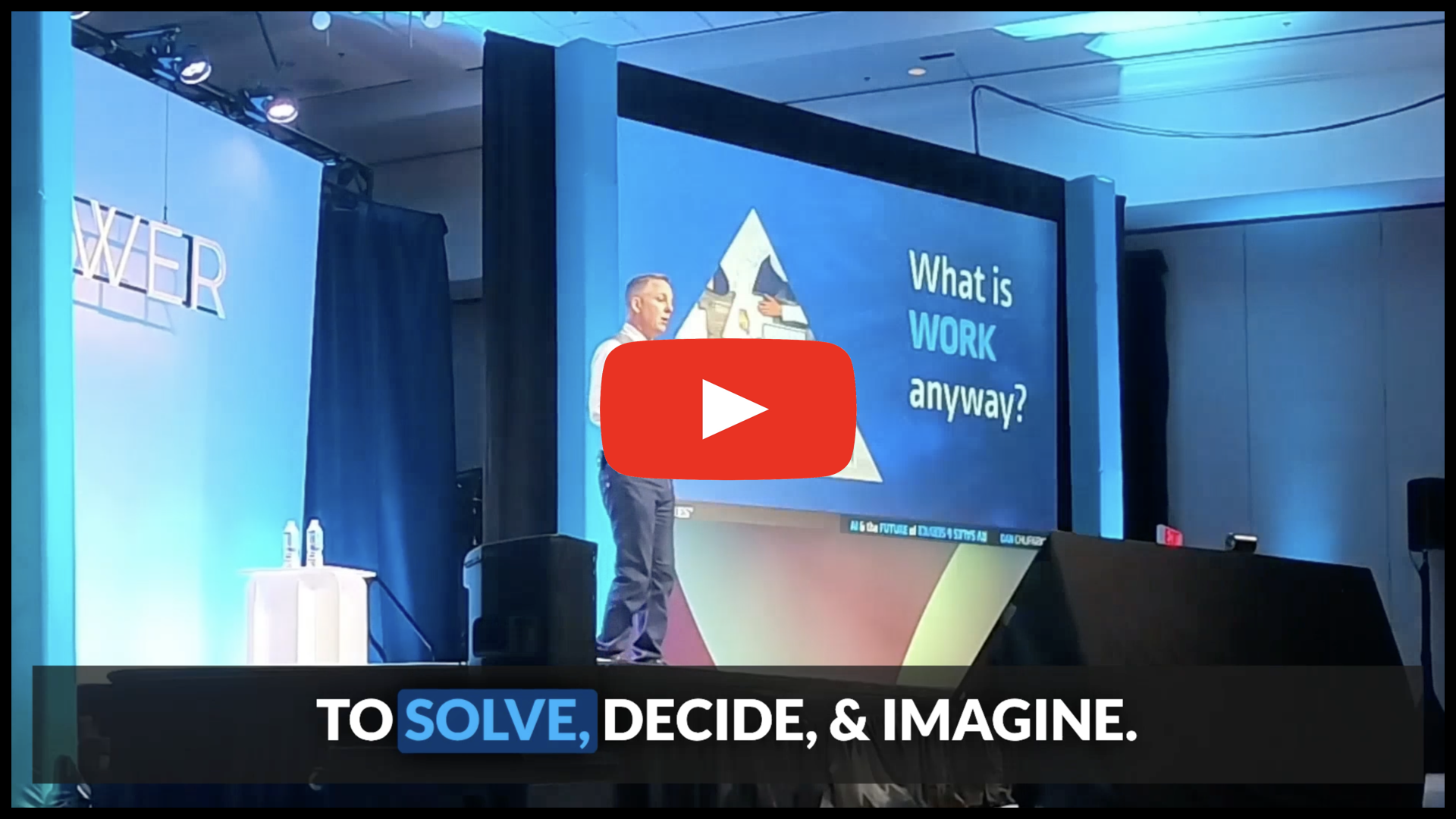
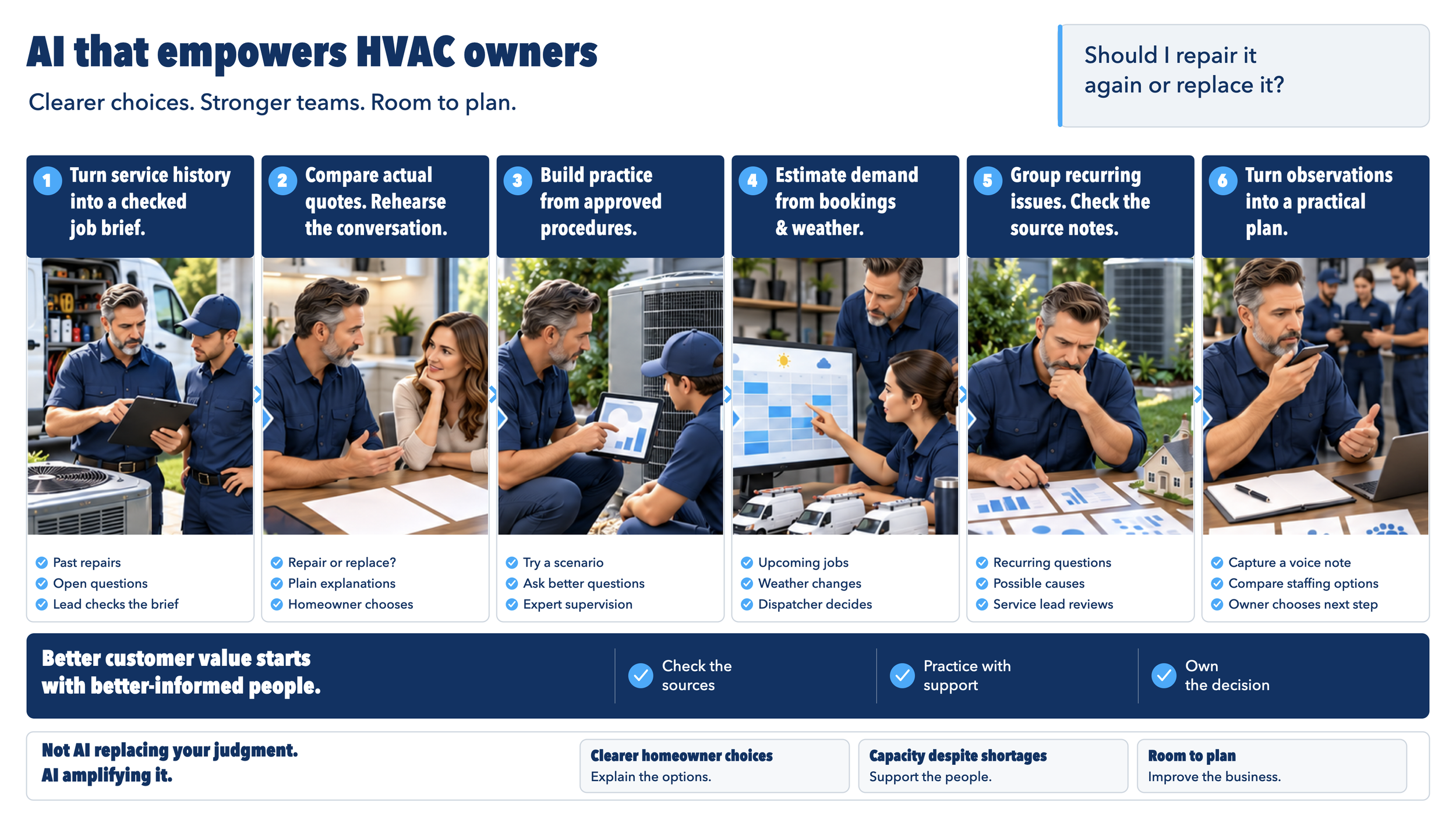
A day in the life in YOUR AI FUTURE

PDF SUMMARY of key slides
This “Slide Cheatsheet” was customized for your specific talk. It’s designed to help audience-members like you, by wrapping my AI & the Future of Everything keynote into an easy-to-skim, easy-to-share, or easy-to-print resource for future reference.
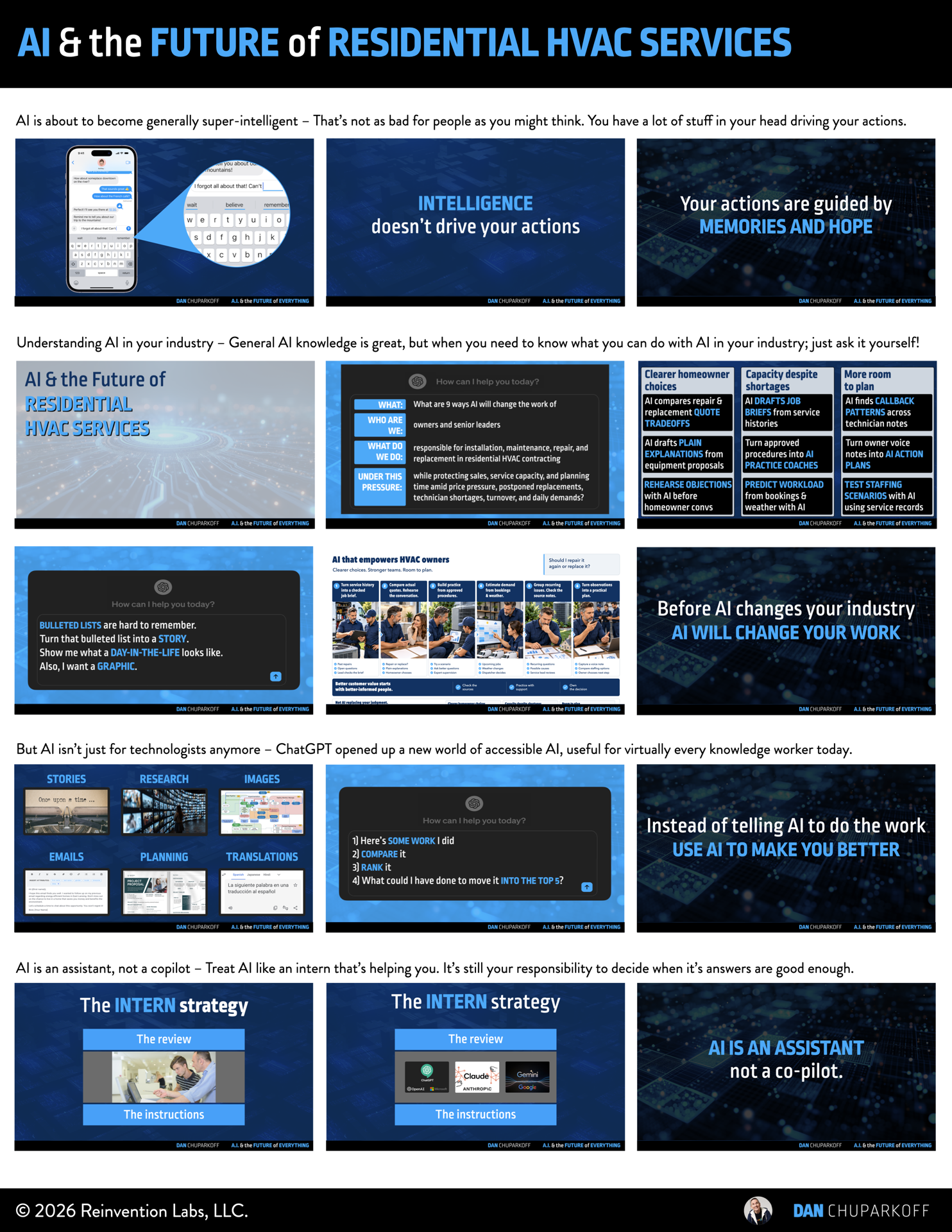
Download the 3 page
high-resolution PDF here:
Hope you find it helpful!
AI NOTES from Dan’s AI Keynote
*These notes were created using ChatGPT 5.6 pro.
Transcription errors or mistakes have not been fixed
in order to demonstrate the current state of AI notes.
Summary
AI offers another copy-and-paste moment: a new way to do work that once required much more manual effort. Dan's AutoCAD story showed how a tool could transform parking-lot drawings while architects still supplied the expertise. The same distinction matters for AI: use it as an assistant that helps you create more customer value.
AI produces useful suggestions, but a plausible answer can still be wrong. The sentence-completion experiment, pizza example, and familiar experience of autocomplete all pointed to the same habit: review the suggestion before using it. Treat AI like an intern. Give it a clear assignment, check its work, improve the instructions, and recognize when you need to finish the work yourself.
For residential HVAC owners and leaders, the opportunities include clearer homeowner choices, stronger service capacity, and more time to plan. AI can also help you improve your own performance by comparing current work with your best past work. Put that assistance to use in communication and routine workflows so you can spend more time solving problems, deciding what matters, and imagining what your business could do next.
Action Items
[ ] Run the residential HVAC prompt below in your AI assistant. Ask which opportunity best fits your business and choose one to explore first.
[ ] Use AI to draft a plain-language explanation of a homeowner's equipment proposal. Check it against the actual quote and your professional recommendation before sharing it.
[ ] Give AI a recent proposal or customer message alongside examples of your best previous work. Ask what you did better in those examples, then revise the current work yourself.
[ ] With participants' permission, capture a recurring team or customer conversation. Review the AI-generated notes and keep them somewhere searchable so useful information can be reused.
[ ] Identify one communication, process, or issue-finding task AI can assist with. Use the time it frees to work on a specific problem, decision, or improvement that has been waiting for your attention.
Key Ideas
Assistance preserves your responsibility
You remain the boss of the AI intern. Clear instructions, review, and revision are part of the work. If the output is still unsuitable, use your own expertise to complete it.
Plausible answers still need judgment
The most likely next word is not necessarily the right answer for your customer. AI can reflect mistakes in its source material. Accept useful suggestions and reject the rest, just as you already do with autocomplete.
Your context matters
Memories of past projects, relationships with customers, and hopes for your team influence your decisions. Bring that context to the work instead of expecting AI to supply it.
Improve your work through comparison
AI can compare a new piece of work with your own strongest examples and identify what made them effective. Use that feedback to build your skills and improve the next attempt.
Make room for the top of the work pyramid
Communication, processes, and finding issues form the base of the work pyramid. AI assistance there can create more time for the human work above it: solving, deciding, and imagining.
Opportunities for QCS Members
Start with a question that names who you are, what you do for customers, and what makes that difficult. The keynote's residential HVAC prompt was:
> What are 9 ways AI will change the work of owners and senior leaders responsible for installation, maintenance, repair, and replacement in residential HVAC contracting while protecting sales, service capacity, and planning time amid price pressure, postponed replacements, technician shortages, turnover, and daily demands?
The opportunities shown in the keynote fall into three groups:
Clearer homeowner choices: Compare repair and replacement quote tradeoffs, draft plain explanations of equipment proposals, and rehearse homeowner objections. Dan's own air-conditioner purchase illustrated how AI could help a homeowner understand a complicated quote.
Capacity despite shortages: Draft job briefs from service histories, turn approved procedures into practice exercises, and explore workload planning using bookings and weather. Keep your team's knowledge and review involved in applying the results.
Room to plan: Look for callback patterns in technician notes, turn owner voice notes into action plans, and explore staffing scenarios using service records.
Use these as starting points for a conversation about your own business. Ask which opportunity deserves attention first and what a day of work could look like if it were useful. Some opportunities involve new systems, cost, and implementation time; everyday assistance can begin with the work already in front of you.
Talk Flow
1. Recognize the next change in how work gets done
AI-generated media opened the keynote.
The introduction showed a practical example of using AI to create material.
The AutoCAD parking-lot story made technology assistance tangible.
Copy and paste changed the effort required to produce the drawing.
Architects still supplied the expertise and determined what to build.
The technology staircase led to the AI pinata.
Familiar tools became part of everyday work; AI can become similarly useful.
Explore what creates customer value instead of treating AI as an unknown bundle of features.
2. Understand suggestions & keep human judgment involved
The sentence-completion exercise introduced prediction.
A likely continuation can be useful without being the best answer for the situation.
Use AI to extend your capabilities while continuing to develop your own expertise.
The probability and pizza examples exposed the limits of a plausible answer.
Choosing the most likely answer does not establish that it is right for your decision.
Bad source material can produce bad advice; review the result before using it with a customer.
Autocomplete showed a familiar way to work with imperfect assistance.
Accept useful suggestions and keep your own words when they serve the situation better.
Memories and hopes explained the context people bring.
Your experience and goals help determine what a good decision means.
The intern metaphor turned that responsibility into a working method.
Assign, review, clarify, and repeat as needed.
Recognize a capability limit and take over when the task requires it.
3. Apply AI to residential HVAC & improve your performance
A specific industry prompt connected AI to owners' real work.
Name your role, customer service, desired outcomes, and operating constraints.
The HVAC examples organized opportunities into three areas.
Help homeowners understand their choices, support service capacity, and create time to plan.
Turn a list of ideas into a day-in-the-life story to make the possibilities easier to understand.
Everyday uses led into the performance-coach example.
Writing, research, diagrams, inbox management, planning, and translation offer places to start.
You can improve current work without waiting for every proposed system to be built.
Comparing work with past work offered a repeatable improvement habit.
Ask what your strongest previous examples did well.
Apply that feedback yourself so your capability grows with the output's quality.
4. Reclaim time & communicate in more useful ways
The work pyramid separated different kinds of work.
Let AI assist with communication, processes, and finding issues.
Keep ownership of solving problems, making decisions, and imagining what comes next.
Searchable conversation notes addressed repeated communication.
Capture important information so it can be found and reused.
Choose a note-taking tool whose privacy approach fits your needs.
The notes-to-song demonstration changed the format of a message.
AI can help turn an important idea into something people remember and revisit.
Choose a useful format for the message; a song is one example.
The translation demonstration showed another route to collaboration.
Helping people communicate in their preferred language can improve teamwork and customer conversations.
CLOSING MESSAGE: Put the time you gain toward a better business
Rising expectations compete with a fixed number of hours.
Use assistance at the base of the work pyramid to make room for neglected priorities.
Solving, deciding, and imagining formed the closing commitment.
Address problems before they grow and make decisions with useful information at hand.
Spend time imagining better residential HVAC services for your team and the homeowners who depend on you.