
Forvis Mazars 2026: AI & the Future of Health System Leadership
Listen to the
AI KEYNOTE SONG
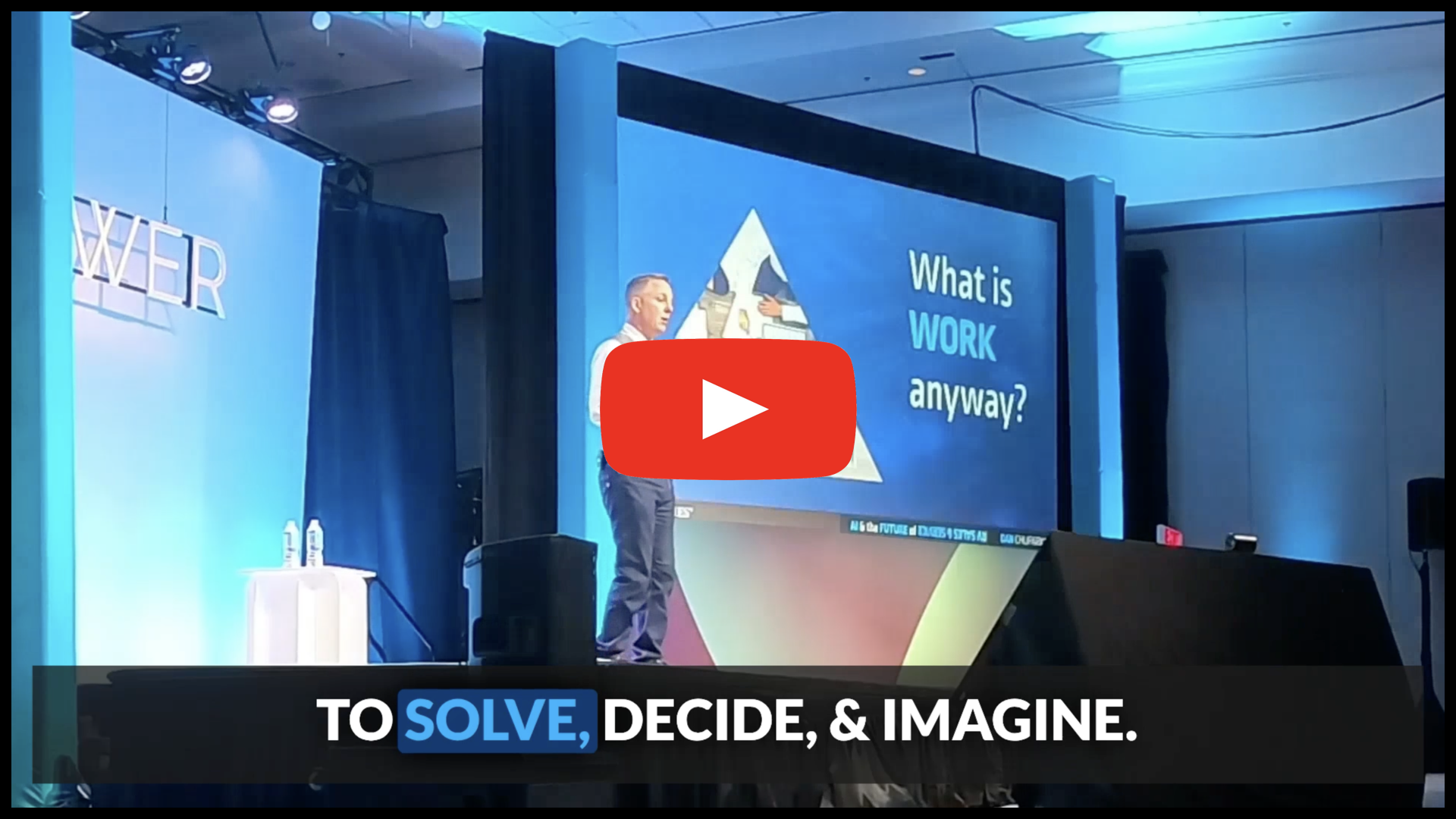
The easiest way to review or share the key points of my AI Keynote is with this song: the full keynote, matched with slides, in 4m32s!
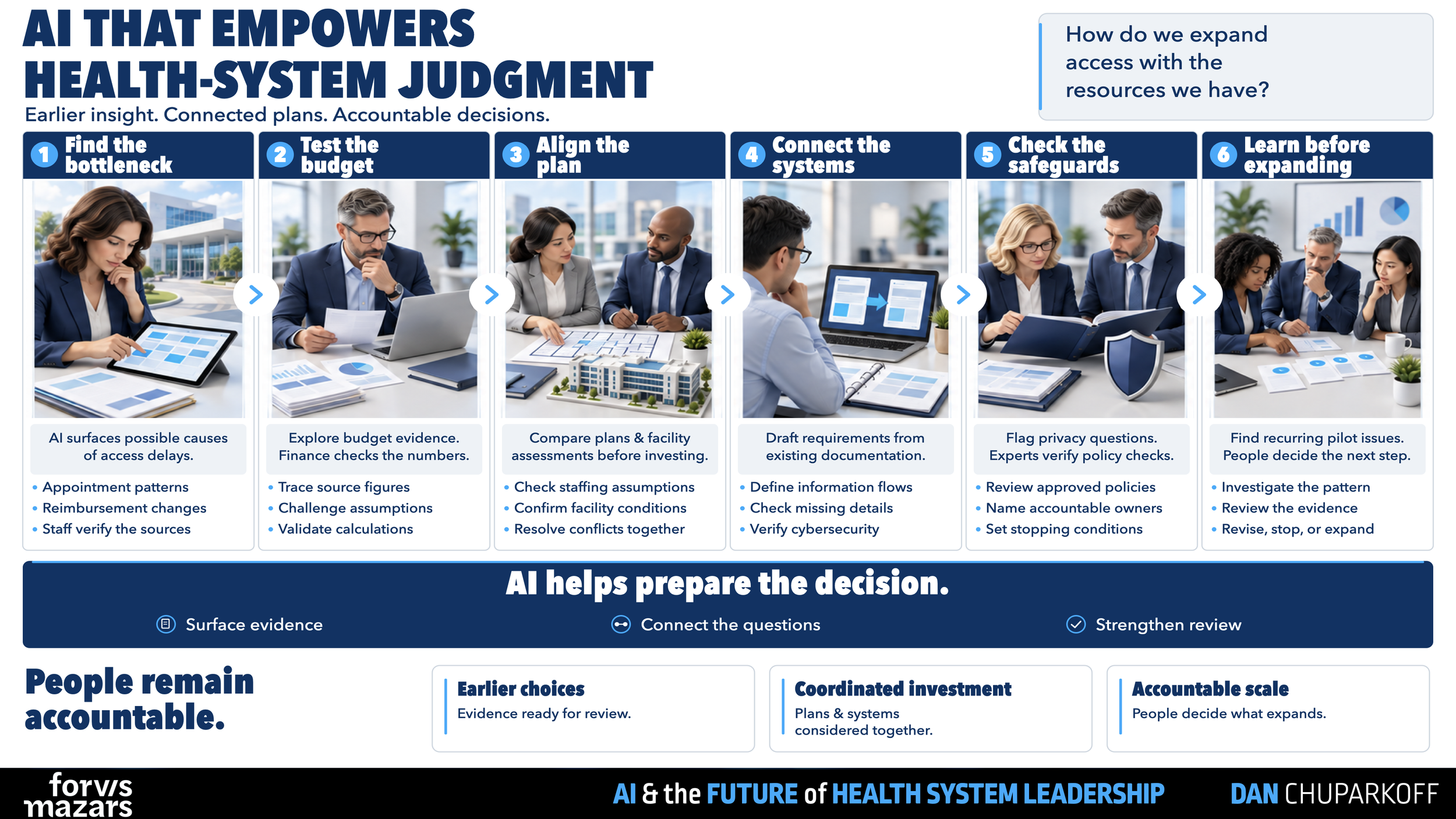
A day in the life in YOUR AI FUTURE

PDF SUMMARY of key slides
This “Slide Cheatsheet” was customized for your specific talk. It’s designed to help audience-members like you, by wrapping my AI & the Future of Everything keynote into an easy-to-skim, easy-to-share, or easy-to-print resource for future reference.
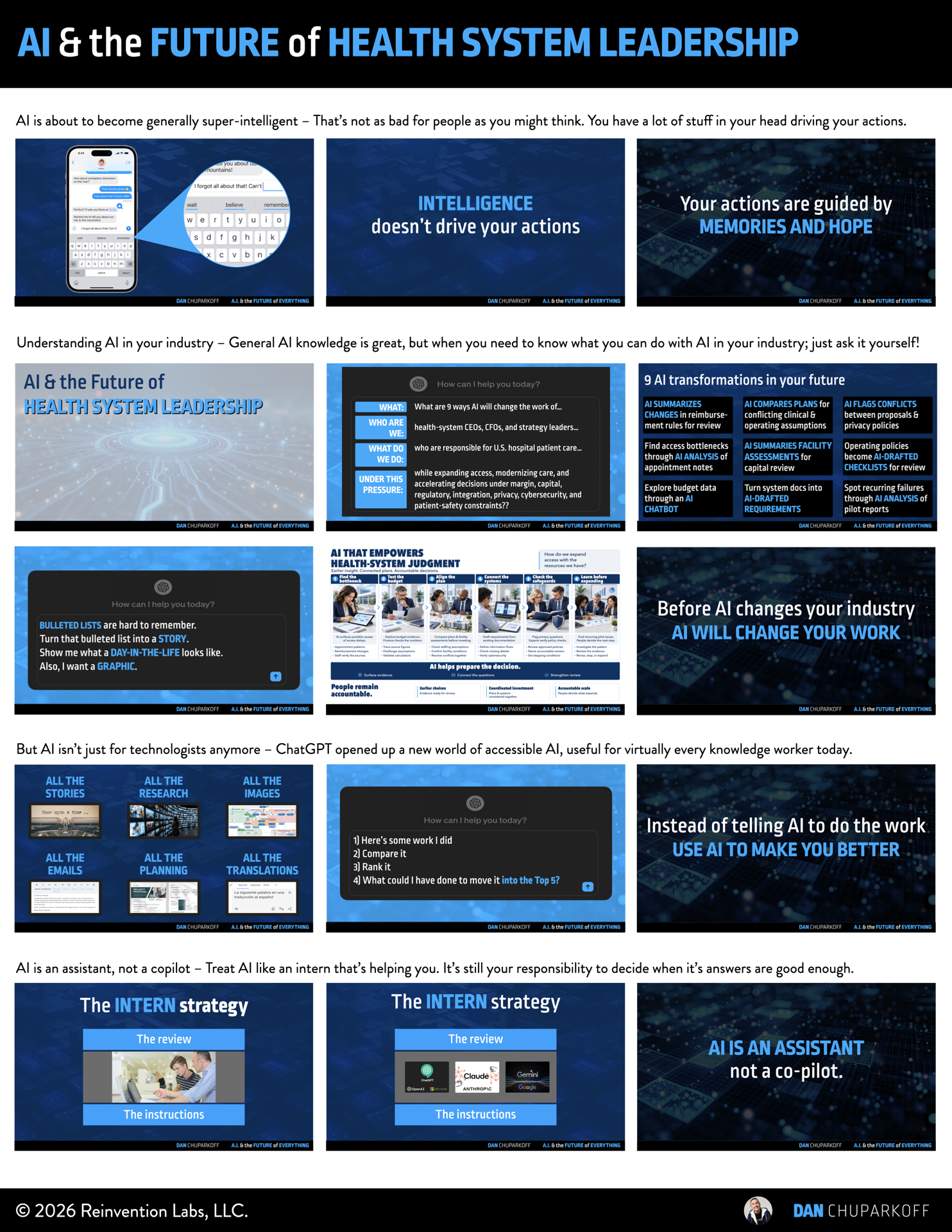
Download the 3 page
high-resolution PDF here:
Hope you find it helpful!
AI NOTES from Dan’s AI Keynote
*These notes were created using ChatGPT 5.6 pro.
Transcription errors or mistakes have not been fixed
in order to demonstrate the current state of AI notes.
One-Sentence Takeaway
Use AI to reduce the time your team spends communicating, processing information, and investigating issues so people can spend more time solving problems, making decisions, and imagining better healthcare futures.
Summary
Dan's first copy-and-paste experience in AutoCAD changed how he saw technology: a tool could remove painstaking manual work while leaving the architect responsible for the design. AI presents a similar opportunity for health-system leaders. Start by identifying the specific work it can help people do, then ask whether the value exceeds the risk and the productivity exceeds the cost.
AI's suggestions still need judgment. The “Once upon a time” exercise, the glue-in-pizza story, and the familiar experience of rejecting an autocomplete suggestion illustrated why a plausible answer is not the same as the right answer for your situation. Your experience, memories, and hopes provide context the system does not automatically have. Build human review and a way to intervene into the work you give AI.
For health systems, the discussion covered reimbursement summaries, patient-access bottlenecks, budget exploration, coordinated investment, and learning from pilots before expanding them. It also offered a personal starting point: use AI to compare your work with your own strongest examples and help you improve. The larger goal is to reshape the work pyramid—spend less time moving information around and more time solving, deciding, and imagining.
Action Items
[ ] Start an ongoing AI conversation about your leadership role. Describe your responsibilities, desired outcomes, and constraints; use the healthcare question below, then ask about the data, risks, and oversight each idea would require.
[ ] Choose one information-heavy workflow to explore with your team. Identify what AI could summarize, compare, or draft, who will review the output, and when a person should intervene. Include the privacy, security, and accuracy requirements for that workflow.
[ ] Give AI a piece of work you created and examples of your strongest previous work. Ask what the stronger examples did better, then use that feedback to improve your draft and your own skill.
[ ] Review where your team spends its time across communication, processes, investigation, problem solving, decisions, and imagining. Choose one problem, decision, or future possibility that deserves the capacity you recover through AI assistance.
Key Ideas
Assistance at the level of the task
Copy and paste helped an architect draw; it did not decide what school to build. Look for the equivalent pieces of work where AI can help your team create more value while people retain responsibility.
Open the AI piñata deliberately
Experimentation becomes useful when leaders can identify value, risk, productivity, and cost. The point is to understand what is inside the tool and where it fits your work.
A likely answer still needs your judgment
The next-word exercise showed how a prediction can win among several possibilities without being certain. The pizza example showed how flawed source material can produce an answer that misses the real purpose. Review suggestions in the context of the task.
Memories & hope create context
Your past experiences and the future you want to create influence your choices. A longer prompt can add context, but it does not transfer everything you know or care about into the system.
AI can coach the expert
Ask how to improve work you created. Comparing a new attempt with your own best examples gives you a concrete way to learn while retaining your voice, intent, and expertise.
Reinvest the time you recover
Communication, processes, and investigation support the work. Solving problems, making decisions, and imagining better futures give that work direction. Use assistance in the lower layers to make more room for the upper layers.
Opportunities for Consumer Lending
Start with the question used in the keynote:
What are 9 ways AI will change the work of health-system CEOs, CFOs, and strategy leaders responsible for U.S. hospital patient care while expanding access, modernizing care, and accelerating decisions under margin, capital, regulatory, integration, privacy, cybersecurity, and patient-safety constraints?
The nine examples below are starting points for investigation. Your team decides which fit your system, what evidence to review, and where human intervention is required.
From delayed reports to earlier choices
AI SUMMARIZES CHANGES in reimbursement rules for finance review
Find access bottlenecks through AI ANALYSIS of appointment notes
Explore budget data through an AI CHATBOT
From fragmented systems to coordinated investment
AI COMPARES PLANS for conflicting clinical & operating assumptions
Turn facility assessments into AI SUMMARIES for capital review
Turn system documentation into AI-DRAFTED REQUIREMENTS
From isolated pilots to accountable scale
AI FLAGS CONFLICTS between project proposals & privacy policies
Convert operating policies into AI-DRAFTED CHECKLISTS for review
Spot recurring failures through AI ANALYSIS of pilot reports
The day-in-the-life example connected these opportunities: find bottlenecks, test budgets, align plans, connect systems, check safeguards, and learn before expanding. Use that sequence to discuss a possible future with your team; the leaders in your organization determine which version is worth pursuing.
Talk Flow
1. Recognize the next copy-and-paste moment
Changing expectations for work
AI assistance changes how people communicate, create material, and find information; examine how it could change your team's everyday work.
The AutoCAD parking-lot story
Copy and paste removed repetitive drafting work while an architect still directed the design.
Distinguish assistance with a task from handing over the whole professional role.
A staircase of technology changes
PCs, spreadsheets, the internet, mobile, and cloud tools became ordinary parts of work. Look for how AI can become useful in the same practical way.
The AI piñata
Leaders must identify where AI creates more value than risk and more productivity than cost.
2. Work effectively with imperfect suggestions
“Once upon a time”
The audience's next-word prediction made AI's pattern-based generation tangible.
Keep developing your expertise while using AI to help with work outside your specialty.
The confidence question
The most likely answer among several options is not necessarily certain enough for the task.
Build points where a person can stop or redirect work when the output goes wrong.
Glue in the pizza
Source material can mix expertise with jokes and bad advice; an answer can miss the real purpose of the question.
Autocomplete as a familiar assistant
Accept a useful suggestion or ignore a poor one while retaining control of the message.
Apply that same review habit when AI interacts with customers or helps your organization communicate.
Memories & hope
Your experience and desired future shape decisions in ways a prediction alone cannot supply.
3. Apply AI to health-system work & personal growth
A question grounded in the role
Name the leaders, the patient-care responsibility, the desired outcomes, and the constraints when exploring AI opportunities.
Start a continuing conversation instead of treating the first answer as a finished plan.
Nine healthcare opportunities
Explore summaries, analysis, comparisons, and drafts across reimbursement, access, budgets, facilities, integration, and operating safeguards.
People determine the fit and provide the oversight.
A day in the life
Connect individual use cases into a picture of better work that your team can discuss.
Learn what works and what creates risk before expanding it.
The performance-coach method
Create your own work, compare it with your strongest previous examples, and ask what those examples did better.
Use the feedback to build expertise you can apply again.
4. Make more room for human work
The six kinds of work
Communication, processes, and investigation often consume the time needed for problem solving, decisions, and imagining.
Solving, deciding & imagining
New problems require context; decisions require ownership; imagining requires choosing a future your team wants to pursue.
Treat AI recommendations as input to your judgment.
Communication as a starting point
Capture, summarize, and recover information to reduce repeated communication work.
People still need to review transcription errors and address privacy requirements.
The “Solve, Decide, Imagine” song
The song demonstrated a different way to help people remember important information.
Reconsider how you communicate a strategy or onboarding message so people can absorb and use it.
CLOSING MESSAGE: Expand collaboration & turn the pyramid over
Collaboration across languages
The translation demonstrations showed how people could collaborate in the language most comfortable for them.
Consider how language barriers affect access to information across your teams and the people they serve.
Growing demands, fixed time
Patient and stakeholder expectations grow while the hours available to your team remain limited.
Turn the work pyramid over
Use AI assistance to reduce the time spent communicating, executing processes, and investigating issues.
Put the recovered capacity into harder problems, better decisions, and the healthcare future you want to create.