
Edwards TMTT 2026: AI & the Future of Cardiovascular R&D
Listen to the
AI KEYNOTE SONG
The easiest way to review or share the key points of my AI Keynote is with this song: the full keynote, matched with slides, in 4m32s!

PDF SUMMARY of key slides
This “Slide Cheatsheet” was customized for your specific talk. It’s designed to help audience-members like you, by wrapping my AI & the Future of Everything keynote into an easy-to-skim, easy-to-share, or easy-to-print resource for future reference.
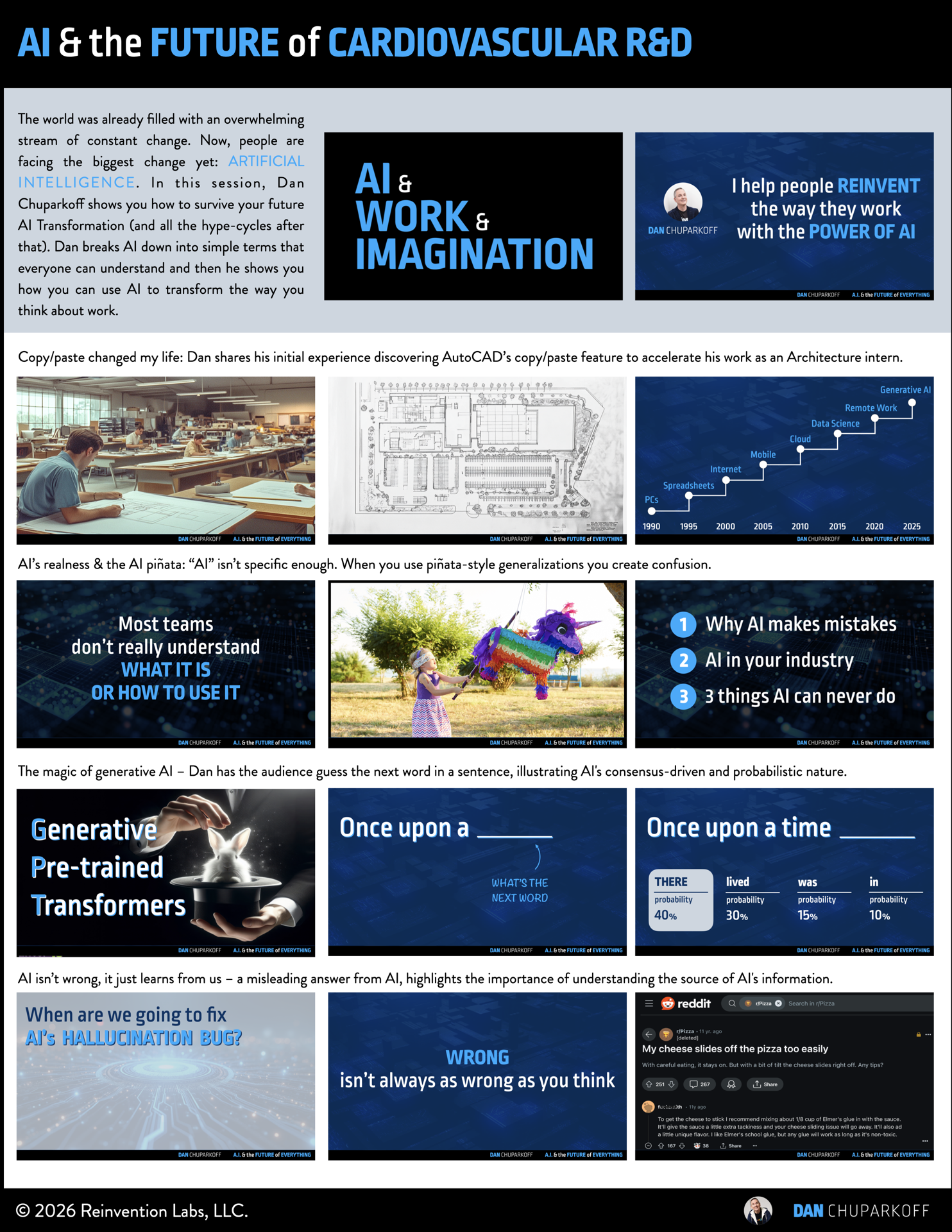
Download the 3 page
high-resolution PDF here:
Hope you find it helpful!
AI NOTES from Dan’s AI Keynote
*These notes were created using GPT 5.5 pro.
Transcription errors or mistakes have not been fixed
in order to demonstrate the current state of AI notes.
One-Sentence Takeaway
AI can help TMTT R&D teams share context, explore evidence, and improve routine work faster, but patient-safety judgment, regulated decisions, and the future of cardiovascular care must remain human.
Summary
Dan Chuparkoff opened by comparing work created manually with work improved by AI assistance. His AutoCAD story supplied the keynote's central frame: copying precise parking-lot lines in seconds did not turn the computer into an architect. It gave the architect a powerful new assistant. AI represents another shift in how work gets done, but assistance is not the same as automation.
Dan then explained why generative AI can be useful and unreliable at the same time. It predicts likely output from patterns in existing information. That makes it strong at common tasks, summarization, drafting, comparison, and translation, but weaker when a question is specialized, ambiguous, novel, or dependent on context it does not have. The pizza-glue example showed why plausible output still requires verification. TMTT experts remain responsible for catching errors, protecting patient safety, and deciding whether an AI suggestion is fit for use.
For TMTT R&D, the talk moved through three shifts: from separated teams to shared context, from slow research to guided exploration, and from fast suggestions to safe judgment. Dan connected those shifts to cross-silo memory, grounded R&D search, patent and academic evidence maps, requirements benchmarking, design-space exploration, human review loops, patient-safety checks, and simulation-based skill development. These capabilities should support expert work, not replace accountable engineers, scientists, technicians, reviewers, or leaders.
The closing message was practical. Use AI now as a coach and an intern: give it clear instructions, review what it produces, improve the instructions, and learn its capability ceiling. Let AI compress parts of communication, process, and investigation so people can spend more time solving hard problems, making thoughtful decisions, and imagining better therapies and care. The goal is not simply more output. It is more time and context for the human work that matters most.
Action Items
[ ] Ask an approved AI assistant Dan's core question, adapted to your role: "What are nine ways AI will change the work of R&D engineers, leaders, technicians, testing, imaging, evidence, and early research teams responsible for transcatheter valve therapies in cardiovascular medical devices while accelerating innovation, sharing knowledge, and preserving safety under regulated constraints?"
[ ] Choose one recurring communication, process, or investigation task that consumes time each week. Test how an approved AI assistant could summarize, compare, organize, or critique the work while keeping proprietary information within Edwards policy.
[ ] Use AI as a coach on work you already created. Ask it to compare a product requirements document, research summary, meeting brief, or communication against clear criteria and explain what would make the work stronger.
[ ] Treat AI like an intern. Give it instructions, review its output, revise the instructions, and repeat until the result is useful or you discover the tool's capability ceiling.
[ ] Before relying on an important AI output, identify the source evidence, missing context, assumptions, and expert review needed. Escalate anything that affects device design, evidence interpretation, regulatory work, or patient safety.
[ ] Identify one cross-silo information gap. Define what another therapy or R&D team should know, when they need it, and how an approved AI workflow could surface that context without exposing restricted information.
[ ] Protect time for the top of the work pyramid. Track whether AI-assisted work actually creates more time for problem solving, decision making, and imagining better patient outcomes.
Key Ideas
AI is an assistant, not an automator.
The AutoCAD story showed that a tool can remove tedious effort and improve precision without becoming the expert or owning the outcome.
AI predicts, it does not know.
Generative AI produces likely output from patterns. Its confident tone does not guarantee that an answer is complete, accurate, or appropriate for a specialized R&D context.
A B-minus assistant can still be useful.
Dan described AI as a B-minus student across many domains. It can extend an expert's reach into supporting tasks, but TMTT work still requires A-plus domain judgment where safety and efficacy are at stake.
The more specialized the question, the more review matters.
Common tasks have more examples in training data. Novel cardiovascular R&D questions have less. AI output should receive review proportional to the uniqueness and consequences of the work.
Memories and hopes shape decisions.
People bring experience, ethics, patient context, organizational history, and a desired future to decisions. AI can offer recommendations, but those human inputs still determine what should happen.
Use AI as a coach.
Instead of only asking AI to create work, ask it to rank, compare, critique, and improve work against your criteria. That can strengthen the person as well as the immediate artifact.
The review loop is part of the work.
The intern metaphor makes accountability visible: instruct, review, refine, and decide. The human remains responsible throughout the loop.
Rebalance the work pyramid.
AI is strongest at communication, process, and investigation. The opportunity is to compress those layers so TMTT teams have more capacity to solve, decide, and imagine.
Communication is an early leverage point.
AI-supported notes, summaries, retrieval, meeting support, and translation can help distributed teams share more useful context with less administrative effort.
TMTT R&D opportunities
From separated teams to shared context
Build shared context from therapy team decisions.
Surface design dependencies with cross-silo memory.
Ask prior meetings through grounded R&D search.
From slow research to guided exploration
Summarize patent landscapes before design reviews.
Compare academic evidence maps against patent gaps.
Score requirements drafts with prior PRD benchmarks.
From fast suggestions to safe judgment
Test human review loops around catheter concepts.
Flag AI outputs with patient-safety checks.
Preserve expert skill through simulation training.
These opportunities are candidates for governed exploration. Edwards experts remain responsible for approved sources, proprietary-data controls, design decisions, evidence interpretation, regulatory discipline, and patient safety.
Talk Flow
Digital emcee introduction
The introduction positioned Dan as a technology leader focused on what to hand to AI, what to keep human, and how to move faster without losing judgment.
AI-assisted work and the new threshold
Dan compared manual and AI-assisted introductions to show that the baseline for digital work is changing. AI can already add context, customization, and communication leverage.
The AutoCAD copy-paste moment
Dan told the story of drawing parking-lot lines by hand as a teenager, then watching AutoCAD create and copy precise lines in minutes. The experience changed how he understood technology-driven productivity.
Assistant vs automator
Dan contrasted AutoCAD as an architect's assistant with his manager's fear that it would replace architects. He applied the same distinction to AI: assistance can expand expert capability without transferring accountability.
Technology stair steps
PCs, spreadsheets, the internet, mobile, cloud, data science, remote work, and generative AI were presented as successive changes that eventually became normal parts of work.
Cracking open the AI pinata
Dan argued that people need a clearer understanding of what AI does and does not do before expecting useful return from it.
GPT and the next-word exercise
The "once upon a time" exercise illustrated that generative AI predicts likely next content. It is consensus-driven, which helps with common patterns but creates limits around novelty and judgment.
The B-minus student
Dan described AI as broadly capable but average across many domains. It can help cardiovascular R&D experts with supporting work, but it does not replace their specialized expertise.
Probability and hidden uncertainty
AI may present a low-confidence answer in the same polished tone as a stronger answer. The more unusual the question, the more important human review becomes.
Glue in the pizza
The internet's bad pizza advice showed how AI can reproduce information that is popular, sarcastic, misleading, or wrong. Plausible output is not the same as trustworthy output.
Autocomplete and continuous oversight
Dan used autocomplete as a familiar example of AI assistance. People accept useful suggestions, ignore bad ones, and remain responsible for the message. Higher-stakes AI workflows need the same oversight, measurement, and escalation discipline.
Memories and hopes
Dan explained that people make decisions with experience, ethics, intuition, goals, and a future they want to create. Those inputs are not reducible to probability.
The TMTT R&D question
Dan showed the audience the role-, industry-, and constraint-specific question he asked AI about the future of transcatheter valve R&D. He encouraged attendees to make the question even more specific to their own work.
Nine TMTT R&D transformations
The nine transformations grouped the opportunity into shared context, guided exploration, and safe judgment. Dan used them to make the future of R&D work more concrete without suggesting that AI should own expert decisions.
A day in the life of AI-supported R&D
Dan translated the list into a workflow: begin with a shared view of change, surface dependencies, retrieve grounded research, explore design space, and strengthen expert review and skill.
AI before the large IT project
Some capabilities will depend on future internal systems or vendor roadmaps. Dan emphasized that people can begin sooner with approved AI assistance for writing, research, images, email, planning, and translation.
Critique before drafting
Dan described using AI to compare his work against prior work and rank whether it belongs in his top five. The same coaching approach can be applied to product requirements documents and other recurring R&D artifacts.
AI as an intern
Dan rejected the copilot metaphor because it implies interchangeable control. The intern metaphor preserves the human role: instruct the tool, review the work, refine the instructions, and decide what is usable.
The hierarchy of work
Dan organized work into six layers: communicate, process, investigate, solve, decide, and imagine. AI is strongest at the first three, while people remain essential at the last three.
Solving, deciding, and imagining
New problems, consequential decisions, and futures that do not yet exist depend on human experience, judgment, values, and aspiration. Efficiency should create more capacity for this work.
AI notes and memorable communication
Dan used the recorded keynote, AI-generated notes, and an AI-generated song to show how information can be captured, packaged, remembered, and shared in new forms.
Translation and global collaboration
The translation demonstration showed how AI can reduce language barriers and help global teams communicate in the language most comfortable for each participant.
Closing Message - Managing in the world of more
Dan closed with the pressure of more projects, stakeholders, information, and expectations without more hours in the week. The response is to compress lower-level work and reinvest the time in better problems, decisions, and ideas for cardiovascular care.