
Cherry Berkaert 2026: AI & the Future of Accounting & Advisory Services
Listen to the
AI KEYNOTE SONG
The easiest way to review my keynote in 5 minutes! Share the key points of the AI Keynote with this song. It’s the full keynote, synced along with my slides!
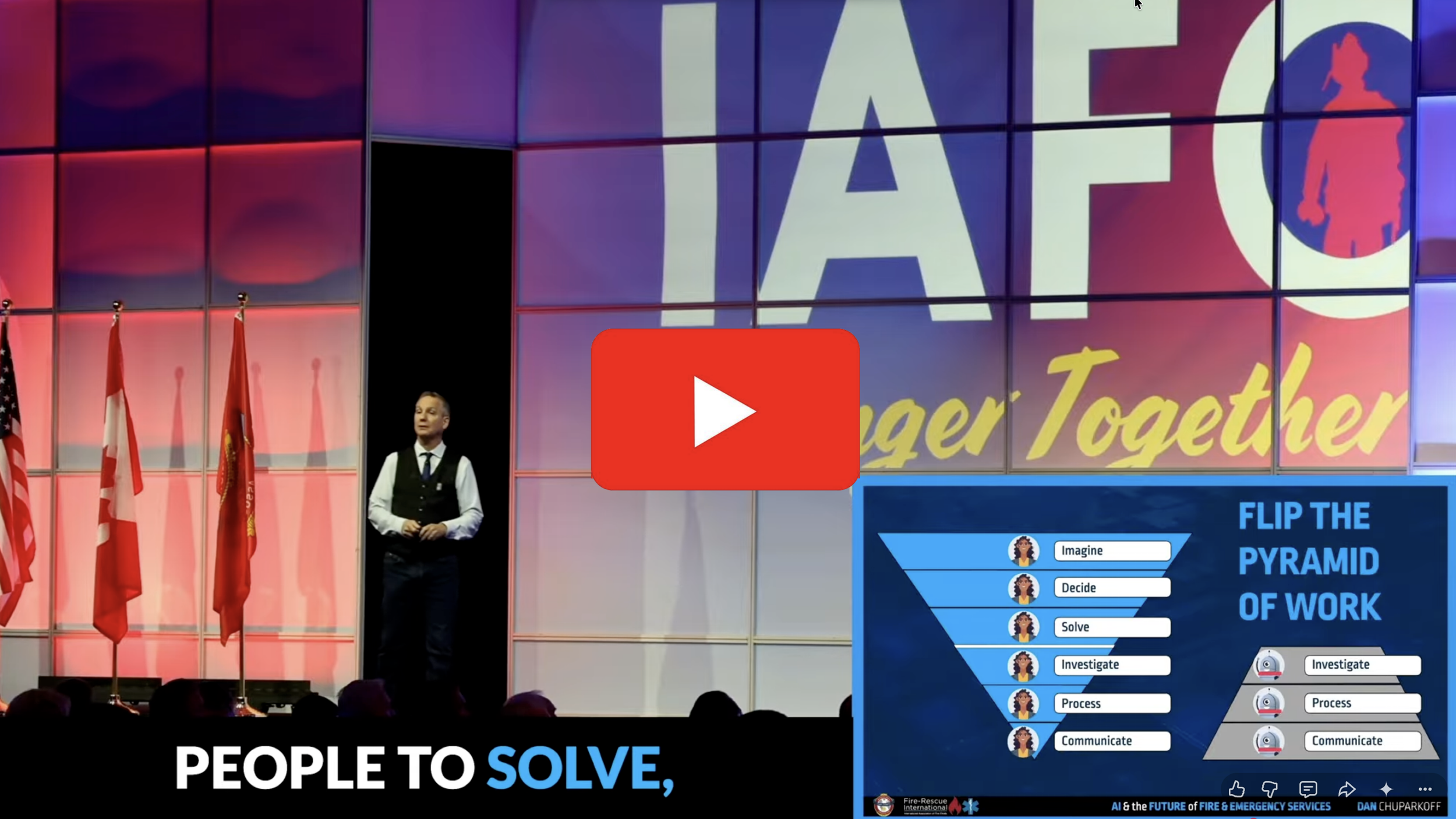
A day in the life in YOUR AI FUTURE
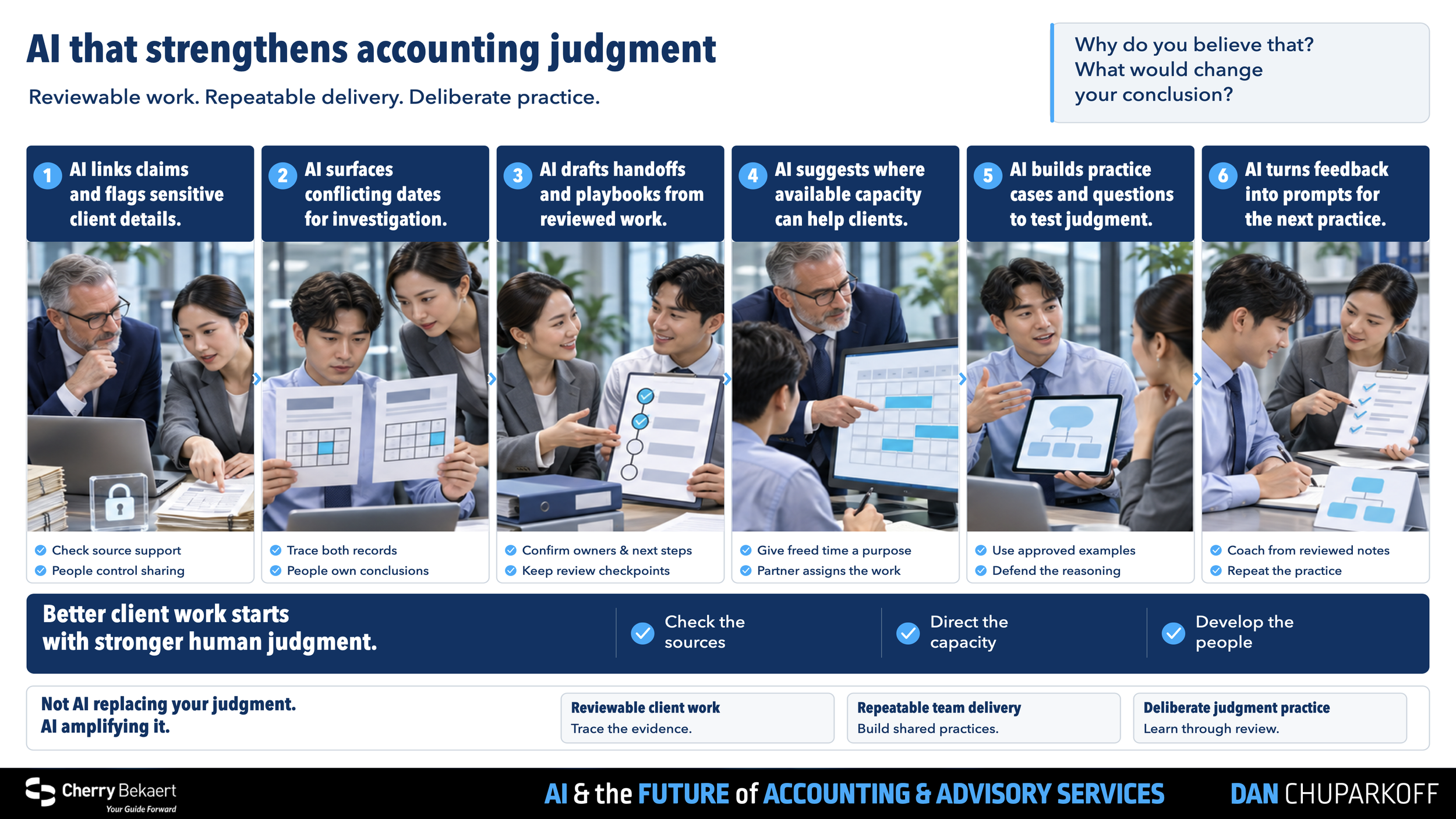

PDF SUMMARY of key slides
This “Slide Cheatsheet” was customized for your specific talk. It’s designed to help audience-members like you, by wrapping my AI & the Future of Everything keynote into an easy-to-skim, easy-to-share, or easy-to-print resource for future reference.
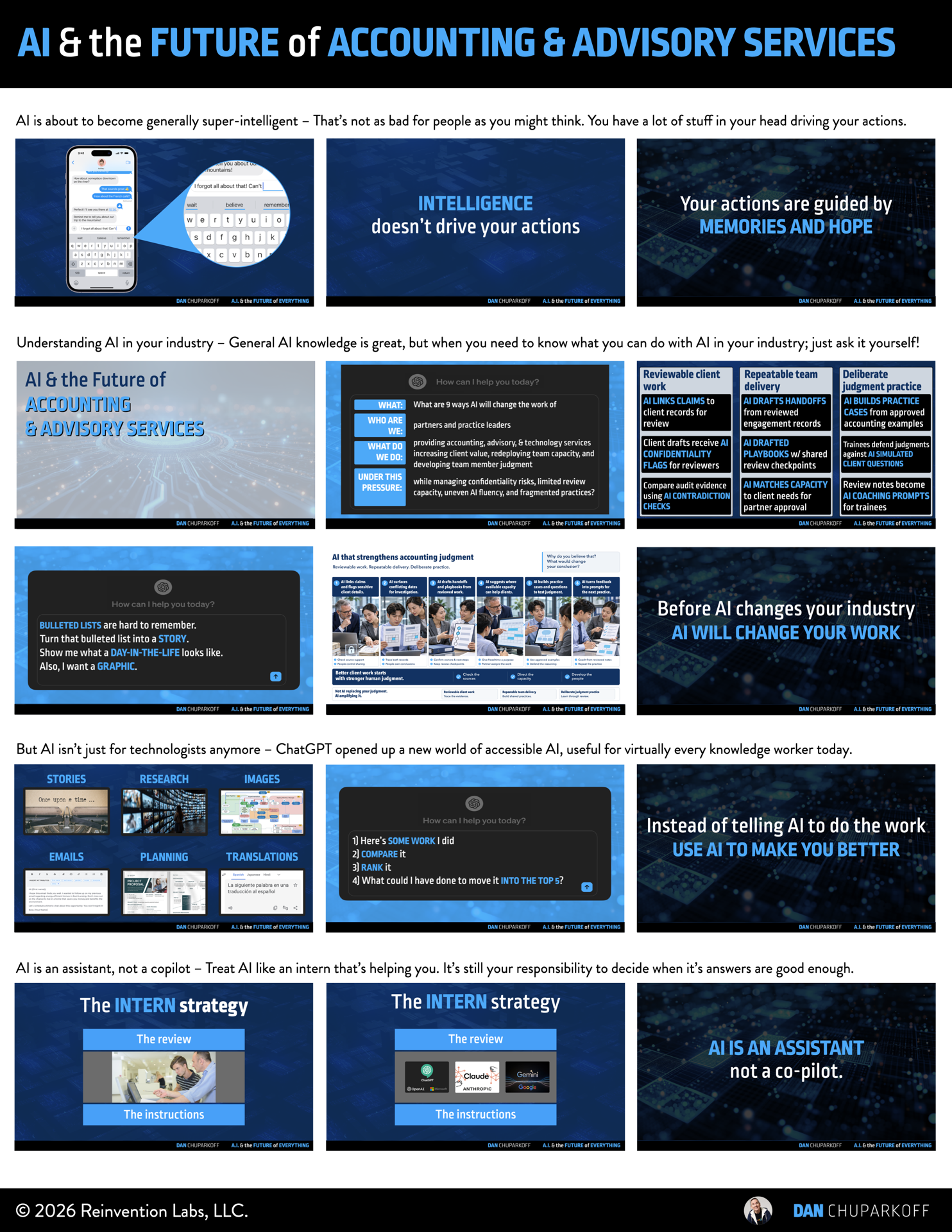
Download the 3 page
high-resolution PDF here:
Hope you find it helpful!
AI NOTES from Dan’s AI Keynote
*These notes were created using ChatGPT 5.6 pro.
Transcription errors or mistakes have not been fixed
in order to demonstrate the current state of AI notes.
Summary
AI changes how professionals work by helping them do more with their expertise. Dan’s AutoCAD story illustrated the distinction: copying and pasting a parking-lot layout transformed a painstaking drawing task without turning the software into an architect. Understanding AI as an assistant creates a more useful starting point for adoption.
Useful assistance still needs supervision. AI can produce a likely answer without knowing whether that answer offers enough certainty for your decision. The sentence-completion experiment, glue-in-the-pizza example, and autocomplete analogy all pointed toward the same habit: inspect the output, examine its sources, and apply your own context. Treat AI like an intern: give instructions, review the work, refine the instructions, and recognize capability limits. Human judgment brings memories, experience, and hopes for what should happen next.
For Cherry Bekaert’s partners and practice leaders, the keynote explored three areas: reviewable client work, repeatable team delivery, and deliberate judgment practice. It also showed how AI can coach your performance by comparing your work with your strongest previous examples. The larger opportunity is to reduce repeated effort in communication and routine workflows, then deliberately use that capacity for problems, decisions, and ideas that deserve more attention.
Action Items
[ ] Ask AI how your work is changing. Describe your role, the services you provide, the outcomes you want, and the constraints that make the work difficult. Follow up about required data, privacy considerations, and available tools.
[ ] Review an AI-assisted piece of work before relying on it. Ask where the answer came from, inspect the sources, and decide whether the answer is suitable for the stakes. Improve the instructions and review again when needed.
[ ] Use AI as a performance coach. Compare a piece of your own work with your strongest previous examples and ask what you did well before that you could apply now.
[ ] Identify repeated communication that AI-supported notes or information retrieval could reduce. Preserve the conversations that build relationships, trust, and teamwork.
[ ] Choose a neglected problem or decision that deserves the time you recover. Make room for imagining better ways to work instead of letting every saved minute disappear into more routine activity.
Key Ideas
Assistance & accountability
AI can help with the work while the professional remains responsible for its use. The difference between an assistant and an automator changes what you delegate and what you continue to oversee.
A likely answer still needs review
The most probable answer is not automatically the right choice for your situation. Checking sources and considering consequences help you decide whether an answer is useful.
Memories, hope & judgment
You bring knowledge of past experiences, current relationships, and desired outcomes to decisions. AI’s information becomes useful through that human context.
The intern loop
Give instructions, inspect the result, improve the instructions, and try again. Recognize when the task exceeds the assistant’s capability. Producing more output also increases the amount of work that needs review.
AI as a performance coach
Ask AI to help you improve at the work you do. Comparing a draft or conversation with your own strongest examples can reveal useful habits to repeat while keeping your ideas and expertise central.
Make room for the top of the pyramid
Communication, process work, and issue identification matter, but they can consume the week. Assistance in those layers can create more room for solving problems, making decisions, and imagining what comes next.
Opportunities for Cherry Bekaert
The keynote’s starting question combined the work of partners and practice leaders with three desired outcomes: increasing client value, redeploying team capacity, and developing team members’ judgment. It also named the constraints: confidentiality, limited review capacity, uneven AI fluency, and fragmented practices.
Reviewable client work: Bring relevant information together so professionals can review large amounts of material in a more prioritized way.
Repeatable team delivery: Support consistency as people join teams, change roles, receive promotions, and take on new responsibilities.
Deliberate judgment practice: Include the development of team members’ judgment in work redesign, exploring how AI can support the information and process workflows around it.
Use these as starting points for investigation. Ask what information an approach needs, what privacy considerations apply, and which tools could support it. A day-in-the-life illustration can make proposed changes easier to understand. Apply your own expertise to decide which ideas and steps fit your practice.Talk Flow
1. Technology assistance changes how work gets done
The AI-generated introduction opens a conversation about changing work.
Look at the tasks you do and consider how AI assistance changes the way you approach them.
The AutoCAD story turns painstaking parking-lot drawing into a copy-and-paste moment.
A tool can change the effort and precision of a task while the professional retains responsibility for the work.
Danny’s resistance reveals the assistant-versus-automator misunderstanding.
How you interpret a tool affects whether you see its practical value.
Familiar technologies become ordinary work habits.
Explore AI with a clear purpose: identify where useful value outweighs the risks.
2. Understand the assistance & keep human judgment
The sentence-completion experiment illustrates prediction and consensus.
Use AI to broaden your capabilities around your area of expertise while continuing to be the expert in that area.
The next-word question introduces uncertainty.
Ask about confidence and sources, then inspect the answer yourself and consider the consequences of the decision.
Glue in the pizza makes the risk of flawed sources memorable.
Plausible output can reflect misleading source material; auditing the work remains part of using AI.
Autocomplete leads into memories, hopes, and judgment.
A recommendation does not contain all your private context or know the future you want to create.
Apply your experience and desired outcomes when choosing what to do.
The intern model explains supervision.
Give instructions, review the result, refine the instructions, and recognize limits.
Keep oversight capacity in view as the amount of AI-generated work grows.
3. Explore your work & improve your performance
The industry prompt starts with who you are, what you do, and what makes it hard.
Describe both your desired outcomes and the constraints that an idea must work within.
Three opportunity groups connect the question to accounting and advisory leadership.
Explore reviewable client work, repeatable team delivery, and deliberate judgment practice.
Ask for a day-in-the-life view to make the possibilities concrete, then use your expertise to assess them.
The LinkedIn example changes the request from writing content to coaching performance.
Compare your work with your best previous examples and ask what made those examples effective.
Use the feedback to strengthen your own skills and your team’s performance.
4. Create capacity for higher-value work
The work pyramid organizes six kinds of work.
Communication, processes, and issue identification form the lower layers.
Solving, deciding, and imagining need time that those lower layers often consume.
Decisions and imagination require personal context and choices.
Treat AI output as a recommendation for your review.
Generating a list of possibilities is different from choosing where to commit your team and limited resources.
Communication offers opportunities to reduce repeated effort.
Notes and information support can help preserve and retrieve what people need.
Use that help while continuing the conversations that build relationships and trust.
5. Share ideas differently & redirect the time gained
A short song chorus reinforces the solve, decide, and imagine message.
AI can help turn an important idea into a different form that people can remember and share.
A translation demonstration expands the collaboration possibilities.
Language assistance can help people communicate in a language that is comfortable for them.
Consider a tool’s privacy terms; a capability demonstration is not an instruction to adopt that product.
The close returns to growing expectations and a limited number of hours.
Make lower-layer work more efficient while preserving oversight and participation.
Use the time gained to address neglected problems, make better-informed decisions, and bring imagination into the workday.