
Arrow 2026: AI & the Future of Investment Management
Listen to the
AI KEYNOTE SONG
The easiest way to review or share the key points of my AI Keynote is with this song: the full keynote, matched with slides, in 4m32s!
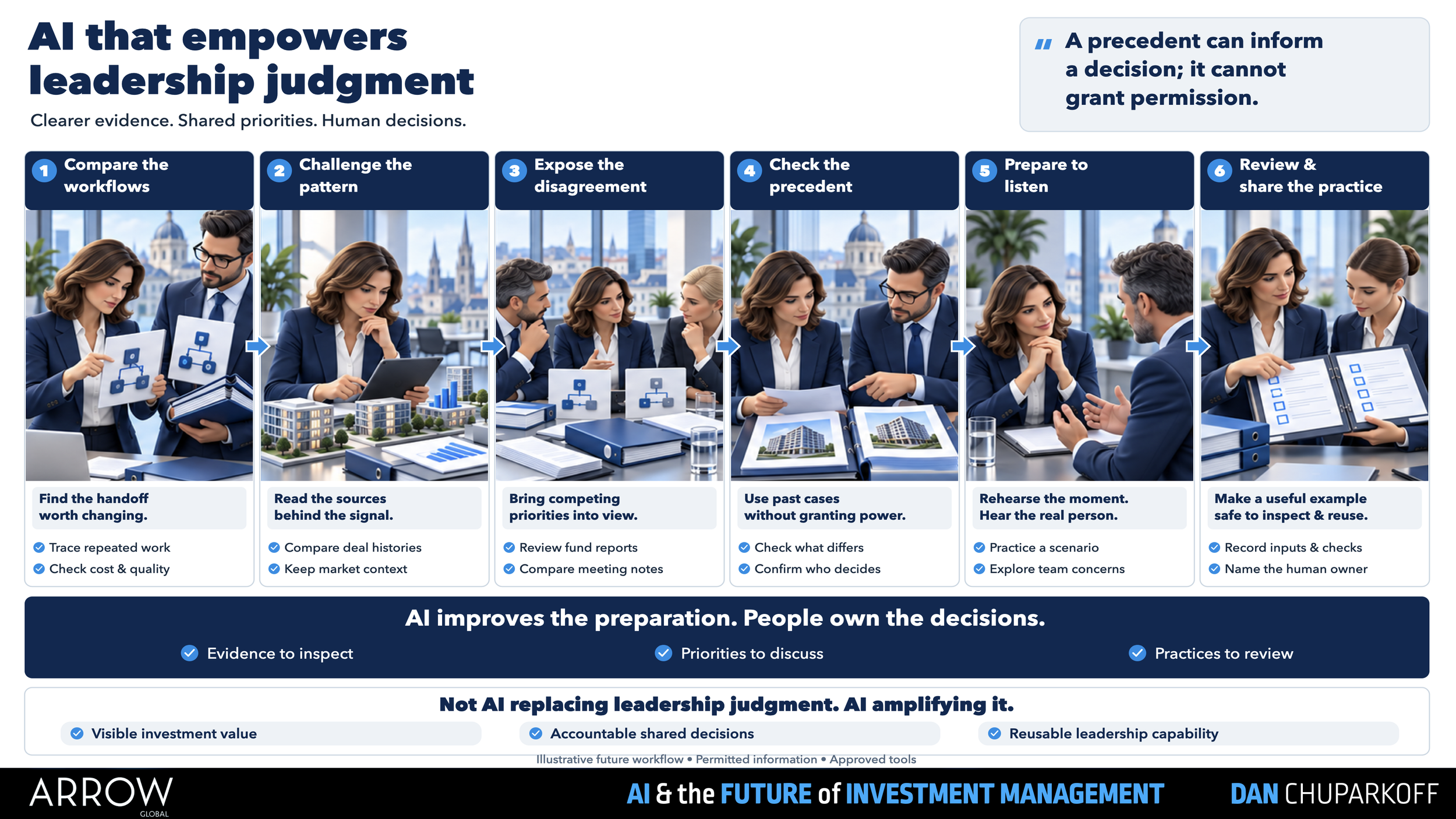
A day in the life in YOUR AI FUTURE

PDF SUMMARY of key slides
This “Slide Cheatsheet” was customized for your specific talk. It’s designed to help audience-members like you, by wrapping my AI & the Future of Everything keynote into an easy-to-skim, easy-to-share, or easy-to-print resource for future reference.
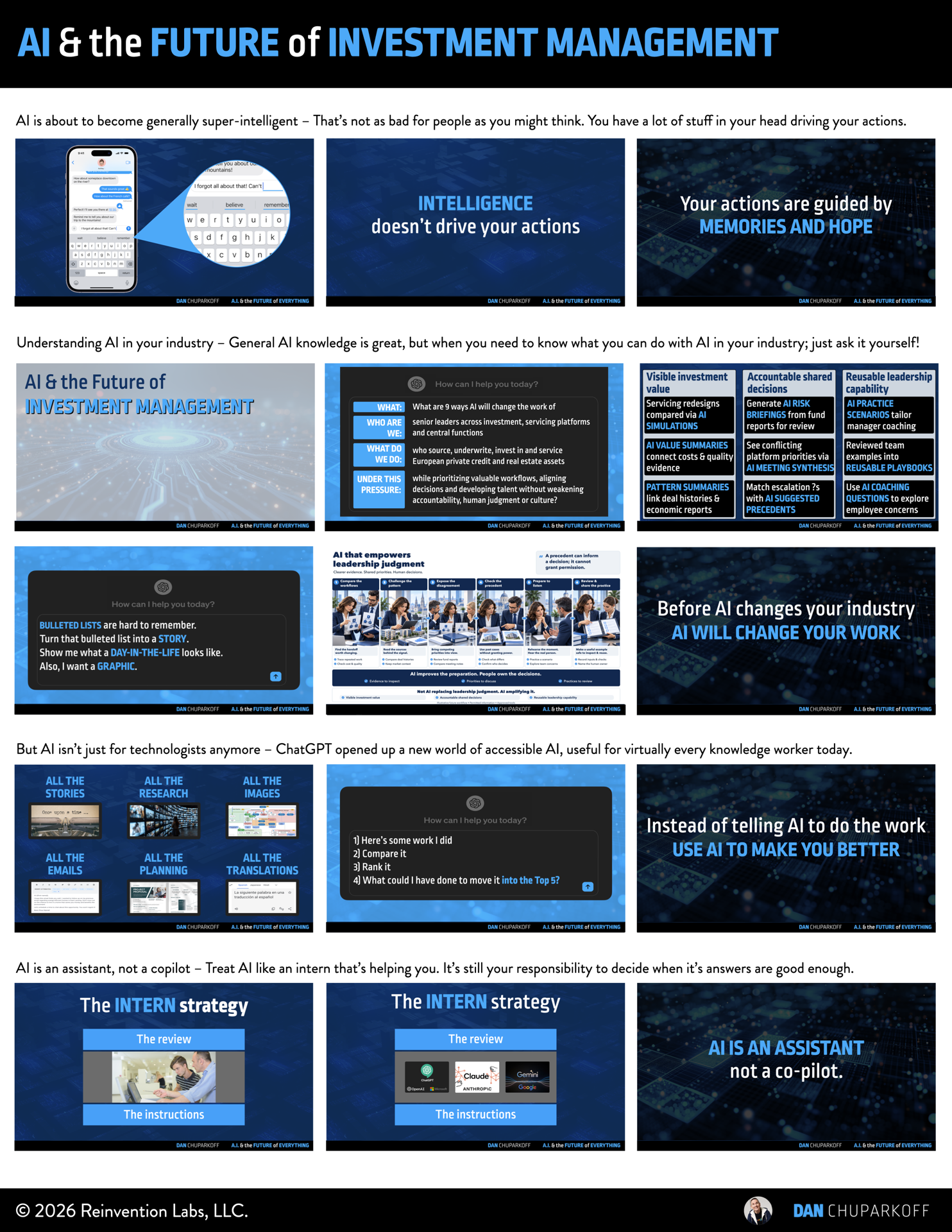
Download the 3 page
high-resolution PDF here:
Hope you find it helpful!
AI NOTES from Dan’s AI Keynote
*These notes were created using ChatGPT 5.6 pro.
Transcription errors or mistakes have not been fixed
in order to demonstrate the current state of AI notes.
Summary
The useful starting point for AI is the work in front of you. The AutoCAD parking-lot story illustrates how a repetitive task can change dramatically while the professional remains responsible for the larger result. Copy and paste gave architects a different way to draw. AI offers a similar reason to reconsider how we prepare information, explore alternatives, and communicate with one another.
That assistance needs direction. A likely answer can sound convincing without fitting your situation. The familiar-story exercise, glue-in-pizza example, and everyday experience of autocomplete all point to the same habit: inspect the suggestion before accepting it. Your experience, intentions, and knowledge of the people involved belong in the decision. Treat the assistant like an intern whose work you assign, review, and improve through feedback.
For senior leaders across investment, servicing platforms, and central functions, the nine transformations center on visible investment value, accountable shared decisions, and reusable leadership capability. AI can help compare possible workflows, bring cost and quality evidence together, prepare briefings, reveal competing priorities, and support management development. The value comes from using that material well. A summary needs checking, a suggested precedent needs context, and a difficult conversation still needs a person who listens.
The larger opportunity is to create capacity for work that gets crowded out. Better meeting recall, feedback on your own work, and communication across languages can reduce friction. Put the time and attention gained into the problems, decisions, and possibilities that need your leadership.
Action Items
[ ] Choose one recurring task in investment, servicing, or a central function. Describe your role, the outcome you need, and what makes the work difficult. Ask an AI assistant for alternative approaches, then select one small application to examine.
[ ] Use approved material to compare a current workflow with an AI-assisted alternative. Look at service quality and handoffs alongside time and cost, and have the responsible people check whether the proposed change improves the whole process.
[ ] Try the performance-coach approach on a briefing, presentation, or other piece of your own work. Compare it with your strongest previous examples, ask for specific differences under criteria you choose, and make the next revision yourself.
[ ] Improve one recurring meeting’s preparation or follow-up. Where recording and tool use are permitted, review an AI summary for disagreements, decisions, owners, and unresolved questions before sharing it.
[ ] Turn one successful, reviewed use of AI into an example a colleague can adapt. Include the permitted inputs, instructions, checks, and limits, then identify the more valuable work the improvement creates time for.
Key Ideas
A task can change before a whole job changes
The copy-and-paste lesson is useful because it starts with a specific piece of work. Examine the repeated drafting, searching, comparing, and explaining inside a role. Improving one of those activities can change how much attention is available for the rest.
A convincing answer still needs judgment
Fluent language does not establish accuracy or relevance. Check the sources and assumptions that matter to the decision. The pizza example makes the problem memorable: poor source material can become a polished recommendation.
Your experience supplies context
People bring memories of what worked, understanding of relationships, and hopes for what should happen next. Those differences can produce useful disagreement. Give the assistant relevant context, and retain responsibility for choosing the direction.
The intern needs a manager
Specify the task, inspect the result, and explain what needs to change. Repeated feedback helps you learn both how to give useful instructions and which work needs closer supervision. Delegating preparation does not delegate your accountability.
Coaching can improve your own capability
Ask AI to compare your work, identify patterns, and explain possible improvements. You choose what good looks like and decide which suggestions to practice. The goal is to become more capable with assistance.
Capacity has a purpose
The work pyramid connects communication, process, and investigation with solving problems, making decisions, and imagining possibilities. When the lower layers become easier, deliberately choose which higher-value work will receive the attention you recover.
Arrow leadership opportunities
For leaders in European private credit and real estate, these nine opportunities connect workflow value, shared decisions, and people development. Explore them using permitted information and tools, with people retaining judgment and accountability.
Visible investment value
Compare servicing redesigns using AI GENERATED WORKFLOWS
AI VALUE SUMMARIES connect workflow costs & quality evidence
AI PATTERN SUMMARIES connect deal histories & economic reports
Accountable shared decisions
Generate AI RISK BRIEFINGS from fund reports for review
Surface conflicting platform priorities through AI MEETING SYNTHESIS
Match escalation questions with AI SUGGESTED PRECEDENTS for review
Reusable leadership capability
AI PRACTICE SCENARIOS tailor manager coaching to role needs
Turn reviewed team examples into REUSABLE AI PLAYBOOKS
Use AI COACHING QUESTIONS to explore employee concerns
Choose one opportunity relevant to your team. Ask why it matters, what it could look like, and how to begin; use your expertise to judge which suggestions fit.
Talk Flow
!!!STILL NEEDS EDITS!!!
!!!STILL NEEDS EDITS!!!
!!!STILL NEEDS EDITS!!!
1. Recognize how assistance changes familiar work
The digital emcee & opening invitation
The AI-generated introduction makes the technology tangible before the discussion begins.
Look for useful changes in your own work as you consider what AI can do.
The technology journey & AutoCAD parking lot
Decades of changing tools lead to a simple example: copy and paste transforms a repetitive drawing task.
A professional can use powerful assistance while continuing to own the design and its purpose.
The realization & staircase of change
New tools invite a different way of approaching work that once seemed fixed.
Learning the next useful capability can open possibilities that were difficult to see from the previous step.
Opening the AI piñata
Move from a confusing collection of possibilities to specific uses worth trying.
Explore the value and risks in relation to a real task.
2. Understand the suggestion & keep your judgment
The familiar-story experiment & confidence
Predicting a likely continuation is different from knowing what a particular situation requires.
Confidence in the wording is a reason to examine an answer carefully, not proof that it is correct.
The glue-in-pizza example
Bad advice and misunderstood source material can find their way into an answer.
Check important recommendations against the evidence and your knowledge of the situation.
Autocomplete
You already know how to accept a useful suggestion, change it, or ignore it.
Apply that same active review habit to more substantial AI assistance.
Memories & hope
Experience and desired outcomes influence what people choose.
Bring those perspectives into decisions and make room for useful disagreement.
The intern relationship
Give direction, review the work, and provide feedback before relying on the result.
Learn where the assistant helps while keeping a person accountable for the outcome.
3. Connect AI to Arrow’s work & leadership needs
The industry question
Describe the roles, the service they provide, and the pressures they face.
For this audience, connect investment and servicing work with value, shared priorities, and developing people while preserving judgment and culture.
Visible investment value
Compare workflow alternatives and examine quality alongside cost.
Use suggested patterns to guide further investigation, with the underlying evidence available for review.
Accountable shared decisions
Arrive with clearer briefings, visible differences in priorities, and relevant previous cases to discuss.
Preserve actual authority boundaries as people decide what to resolve locally and what to escalate.
Reusable leadership capability
Practice management conversations and prepare questions that help you listen.
Capture reviewed examples so colleagues can learn from the work and adapt it to their circumstances.
The performance coach
Compare your own work with your strongest examples using criteria that matter to you.
Ask for specific feedback, apply the useful suggestions yourself, and learn through the next attempt.
4. Make room to solve, decide & imagine
The hierarchy of work
Communication, process, and investigation occupy substantial attention inside a job.
Assistance with those activities can create room for problem solving, decisions, and new possibilities.
The human contribution
People choose which problems matter and what outcomes are worth pursuing.
Use generated alternatives and analysis to support those choices while retaining responsibility for them.
Communication as a starting point
Meeting notes and summaries can make conversations easier to revisit and follow through on.
Review the record for what people actually agreed, who owns the next step, and what remains open.
The solve, decide & imagine song
Turning ideas into another format can make them easier to revisit and remember.
The refrain returns attention to the human work that better assistance should make more room for.
Translation & shared understanding
Translation can reduce friction between people who work in different languages.
Consider where clearer understanding would help colleagues collaborate across platforms and countries.
CLOSING MESSAGE: Turn the pyramid over
More information & growing expectations
More messages, systems, and demands compete for a limited amount of attention.
Choose assistance that improves how work gets done and creates capacity for something important.
The leadership choice
Start with a useful application, review its effect, and share what others can learn from it.
Put the recovered capacity into problems you need to solve, decisions you need to make, and possibilities you want to explore.