
A:Lab + Atomic Object 2026: AI & the Future of Technical Leadership
Listen to the
AI KEYNOTE SONG
The easiest way to review or share the key points of my AI Keynote is with this song: the full keynote, matched with slides, in 4m32s!

PDF SUMMARY of key slides
This “Slide Cheatsheet” was customized for your specific talk. It’s designed to help audience-members like you, by wrapping my AI & the Future of Everything keynote into an easy-to-skim, easy-to-share, or easy-to-print resource for future reference.
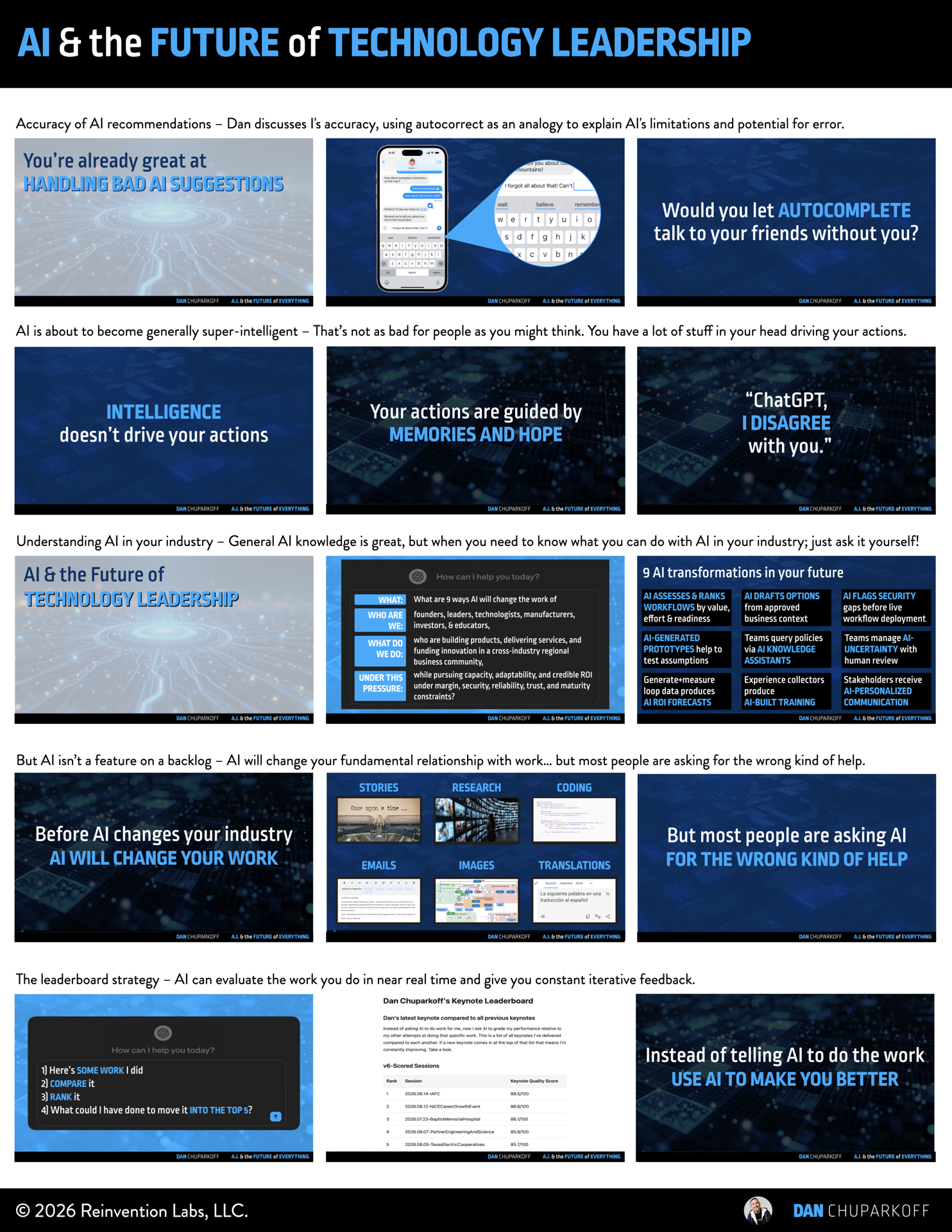
Download the 3 page
high-resolution PDF here:
Hope you find it helpful!
A day in the life in YOUR AI FUTURE
AI NOTES from Dan’s AI Keynote
*These notes were created using ChatGPT 5.6 pro.
Transcription errors or mistakes have not been fixed
in order to demonstrate the current state of AI notes.
One-Sentence Takeaway
Use AI to improve everyday work and your own performance while keeping people responsible for solving problems, making decisions, and imagining what comes next.
Summary
AI offers another opportunity to change how work gets done. Dan's AutoCAD story made that shift tangible: copying parking-lot lines transformed a slow manual task while the architect still directed the work. The opportunity for leaders is to identify where assistance creates more precision, capacity, and customer value.
Useful assistance still needs judgment. The “once upon a time” exercise introduced prediction and uncertainty; the glue-in-pizza example showed why a popular answer can be a poor answer. Treat suggestions as you already treat autocomplete: use what helps, check important claims, and bring the context, experience, and hopes that shape your decisions.
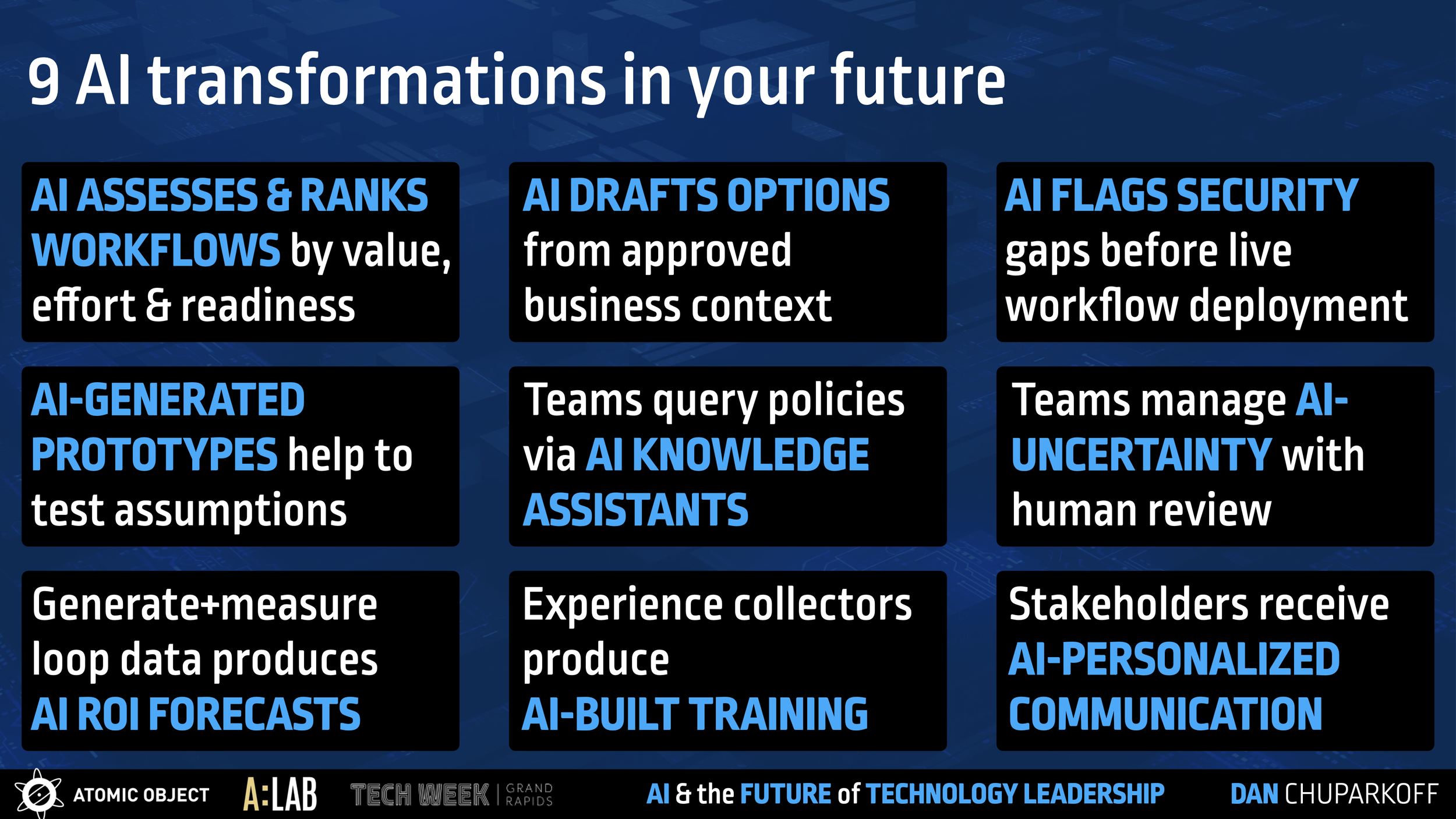
For West Michigan's technology and business community, the practical opportunities included ranking work, creating prototypes, and exploring potential returns. AI can also compare your work with your earlier efforts against criteria you define. As teams build more automation, monitoring and human intervention remain part of the job. Better communication, memorable learning materials, and translation can help recover time for the work that matters: solve, decide, and imagine.
Action Items
[ ] Choose one workflow where your team spends substantial time. Tell an AI assistant who you are, what you do, and what makes the work difficult. Ask for several improvement options, then select one worth investigating.
[ ] Use AI as a performance coach on your next document, presentation, or customer conversation. Define what good looks like, compare your work with earlier examples, and apply one specific improvement next time.
[ ] Before relying on an important AI answer, ask for its sources, uncertainty, and assumptions. Inspect the supporting information yourself and match the depth of review to the stakes.
[ ] For an AI workflow that acts on your behalf, identify who watches it, what unusual behavior should trigger an alert, and where someone can pause or intervene.
[ ] Try AI assistance in one recurring communication task, such as meeting summaries. Review the output and use any time recovered for a problem, decision, or idea that keeps getting deferred.
Key Ideas
Assistance expands capacity
A tool can change the amount and quality of work a person can accomplish while the person retains responsibility for the outcome.
A likely answer still needs context
AI suggestions reflect patterns in their sources. Your circumstances and the consequences of being wrong determine whether a suggestion is useful.
Define quality before asking for feedback
Give AI concrete criteria and examples of your earlier work. Use its comparisons to develop your skills over repeated attempts.
Reliable use requires visibility
Observability means being able to see what a system is doing. Monitoring, anomaly detection, alerts, and intervention points help people supervise AI workflows.
Make time to solve, decide & imagine
Communication, process, and investigation can fill the week. Improving those activities creates room for problems, decisions, and possibilities that deserve more attention.
Opportunities for A:LAB, Atomic Object, & West Michigan
Work ranking: Ask AI to help compare where your team spends time and which work deserves attention. Keep the final priorities with the people responsible for results.
Prototypes: Use AI-generated prototypes to explore product or engineering ideas and test assumptions before committing to a direction.
ROI exploration: Ask which possible AI improvements could offer the greatest return, then examine the assumptions behind those estimates.
Trusted workflows: Pair useful automation with monitoring and a clear route to human review, especially when customer interactions or production work are involved.
Talk Flow
1. Recognize the next change in how work gets done
The AI-generated opening
Improving tools change expectations for the quality and precision of everyday work.
The AutoCAD copy & paste discovery
A dramatic improvement in a task can change what feels possible without replacing the professional directing it.
Recognize the difference between assisting a person and taking over their responsibilities.
The AI pinata
Move from random experimentation toward identifying useful capabilities whose value exceeds their risks.
2. Use AI suggestions with judgment
“Once upon a time”
Predicting the next word illustrates how familiar patterns can produce a shared answer.
Confidence & uncertainty
Ambiguous situations need closer inspection; ask for sources and assumptions before acting.
Hallucinations & glue in pizza
A tool that sometimes gives a wrong answer needs review in use.
Popularity in source material does not establish whether advice fits the task.
Autocomplete & customer conversations
Accept helpful suggestions and supply your own answer when they miss your intent.
Customer-facing assistance needs a way for people to notice problems and step in.
Memories & hope
Past experience and the future you want influence decisions; bring that context to AI-assisted work.
3. Apply AI to your work & your development
Describe your role, work & constraints
Ask for multiple possibilities using the specifics of your job and what makes it difficult.
Rank work, prototype & explore returns
Use AI to investigate practical options, then decide which deserve further effort.
The performance coach
Do the work, compare it with your earlier efforts using clear criteria, and improve the next attempt.
4. Keep people responsible for the work
The six-layer work pyramid
Communication, process, and investigation consume time needed for problem solving, decision making, and imagination.
Use assistance to create room for those higher-value activities and review consequential actions before they proceed.
Reliability & observability
Build monitoring, alerts, and intervention points around AI workflows.
Give a responsible person visibility into unusual behavior, including when automation runs overnight.
5. Improve communication & recover time
Meeting notes & support
Summaries and meeting assistance can reduce communication effort and make information easier to share.
The solve, decide, imagine chorus
Music and repetition can help an important idea stay with people; choose the format that serves the message.
Translation & collaboration
Language assistance can help colleagues participate across language differences; consider privacy when choosing tools.
Closing Message - Managing in the world of more
Information, systems, expectations, and possible work keep growing while available hours remain fixed. As demands grow, use AI assistance to protect time to solve problems, make better decisions, and imagine a better future for your people.