
Autodesk 2026: AI & the Future of Design & Engineering Software
Listen to the
AI KEYNOTE SONG
The easiest way to review or share the key points of my AI Keynote is with this song: the full keynote, matched with slides, in 4m32s!
A day in the life in YOUR AI FUTURE

PDF SUMMARY of key slides
This “Slide Cheatsheet” was customized for your specific talk. It’s designed to help audience-members like you, by wrapping my AI & the Future of Everything keynote into an easy-to-skim, easy-to-share, or easy-to-print resource for future reference.
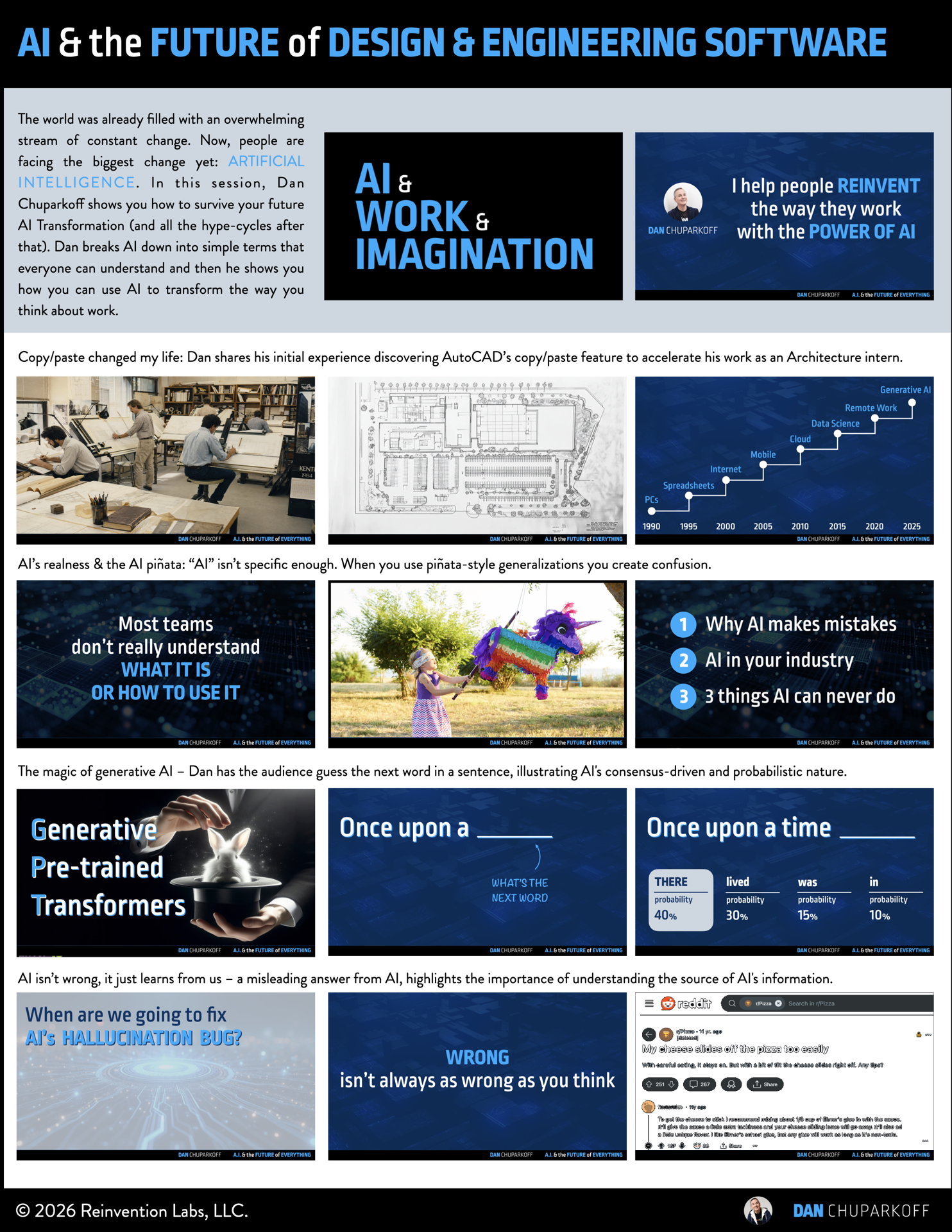
Download the 3 page
high-resolution PDF here:
Hope you find it helpful!
AI NOTES from Dan’s AI Keynote
*These notes were created using ChatGPT 5.6 pro.
Transcription errors or mistakes have not been fixed
in order to demonstrate the current state of AI notes.
One-Sentence Takeaway
Use AI as an assistant and performance coach to compress communication, process, and investigation work, while people keep ownership of problem solving, decisions, imagination, and expert judgment.
Summary
AI is becoming part of the normal fabric of work, much as PCs, spreadsheets, the internet, mobile devices, cloud tools, data science, and remote work did before it. The quality threshold is already moving: AI-supported work can become clearer and more useful, while work created without available assistance may increasingly feel unfinished.
The AutoCAD copy-and-paste story established the keynote's central distinction. Technology can be a powerful assistant without becoming an automator. Generative AI predicts likely next words or pixels from prior material, which makes it useful across unfamiliar work but also probabilistic, consensus-driven, and vulnerable to weak source material. People remain responsible for validation, context, confidence thresholds, and the consequences of acting.
For Autodesk's technology, design, product, research, and platform leaders, the opportunity is to move from producing artifacts to directing intent, from isolated experiments to repeatable execution, and from fixed roles to governed leverage. The keynote's practical recommendation was not simply to ask AI to do more work. Do important work yourself, then use AI to compare, rank, critique, and coach it so every iteration helps the person and the system improve.
Action Items
[ ] List the recurring communication, process, and investigation work that consumes the most time each week.
[ ] Choose one low-risk workflow and test how an approved AI assistant could reduce repetition while preserving human review.
[ ] Complete one PRD, customer conversation, plan, brief, or design artifact yourself, then ask AI to compare it with prior strong examples and identify improvements.
[ ] Ask how AI is already changing your role, the value you own, and the work your team should keep human.
[ ] For consequential AI-supported work, inspect sources, assumptions, missing context, uncertainty, and the appropriate review threshold before acting.
[ ] Turn meeting notes into a short digest that helps another team understand decisions, open questions, and useful context without attending the meeting.
Key Ideas
The quality baseline is moving
AI-generated material is becoming harder to identify by obvious defects. As people become AI-first, the more useful test is whether assistance improved the quality, context, and customer value of the work.
Assistant, not automator
AutoCAD did not invent schools without architects. It helped architects work faster and more precisely. AI should be framed the same way: people provide intent, judgment, review, and accountability.
AI is a probabilistic B-minus generalist
AI can raise a person's baseline across research, communication, planning, prototyping, and other supporting work. It should not replace the A-plus expertise a person deliberately develops and owns.
Probability requires consequence-scaled review
The most likely answer may still be less certain than the work requires. Treat AI output as a recommendation, verify important claims, and increase human review as the consequences rise.
People retain memories, hopes, and judgment
Past experience and the future people want to create shape decisions in ways that a model's training data does not automatically contain. Those inputs preserve human agency and responsibility.
Use AI as a performance coach
Instead of always asking AI to create the first draft, create the work and ask AI to compare it with prior work, rank it, explain gaps, and coach the next iteration.
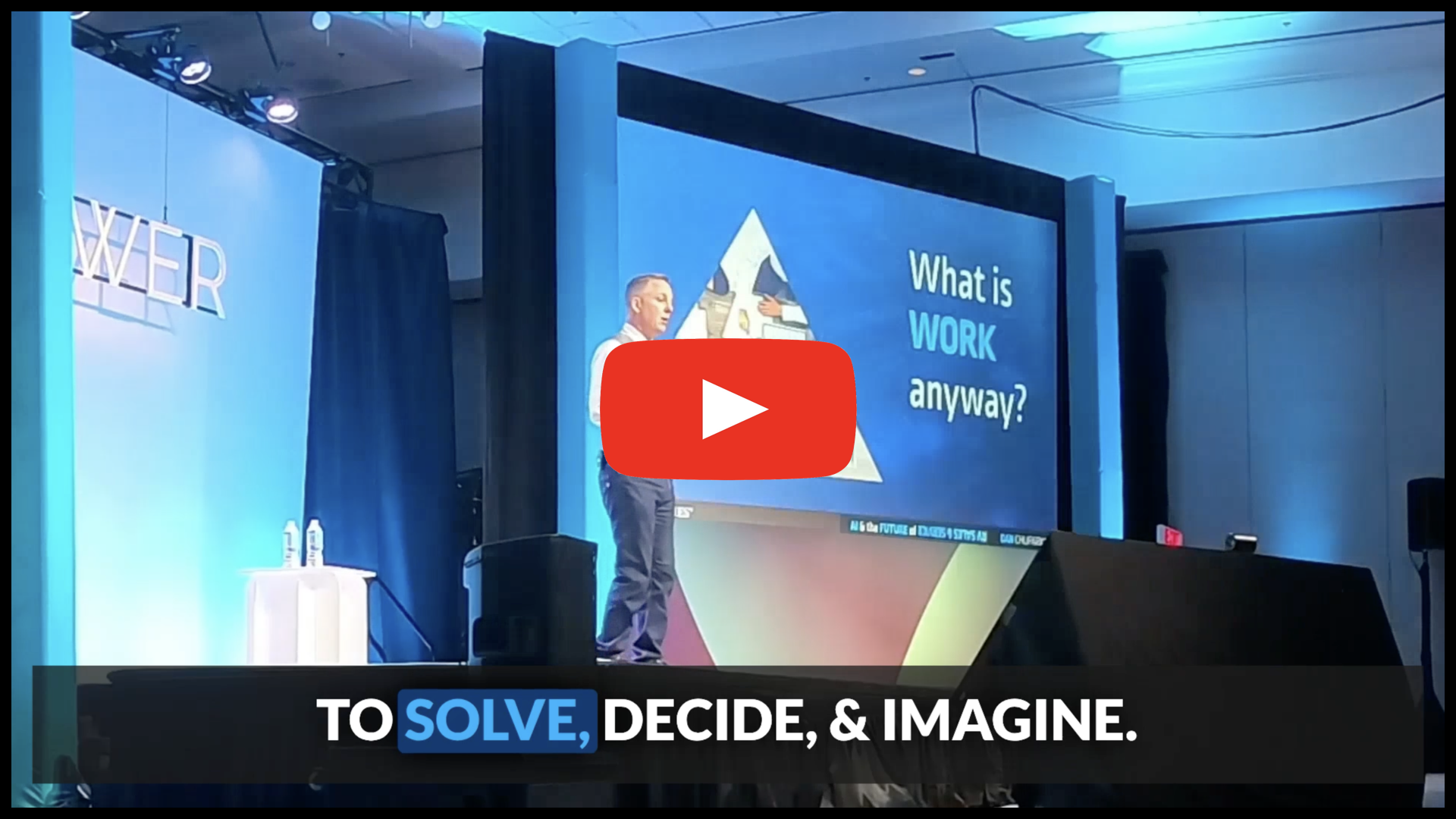
Solve, decide, and imagine
AI can help compress communication, process, and investigation. The capacity created should be reinvested in solving harder problems, making thoughtful decisions, and imagining better products, platforms, workflows, and customer outcomes.
Autodesk Opportunities
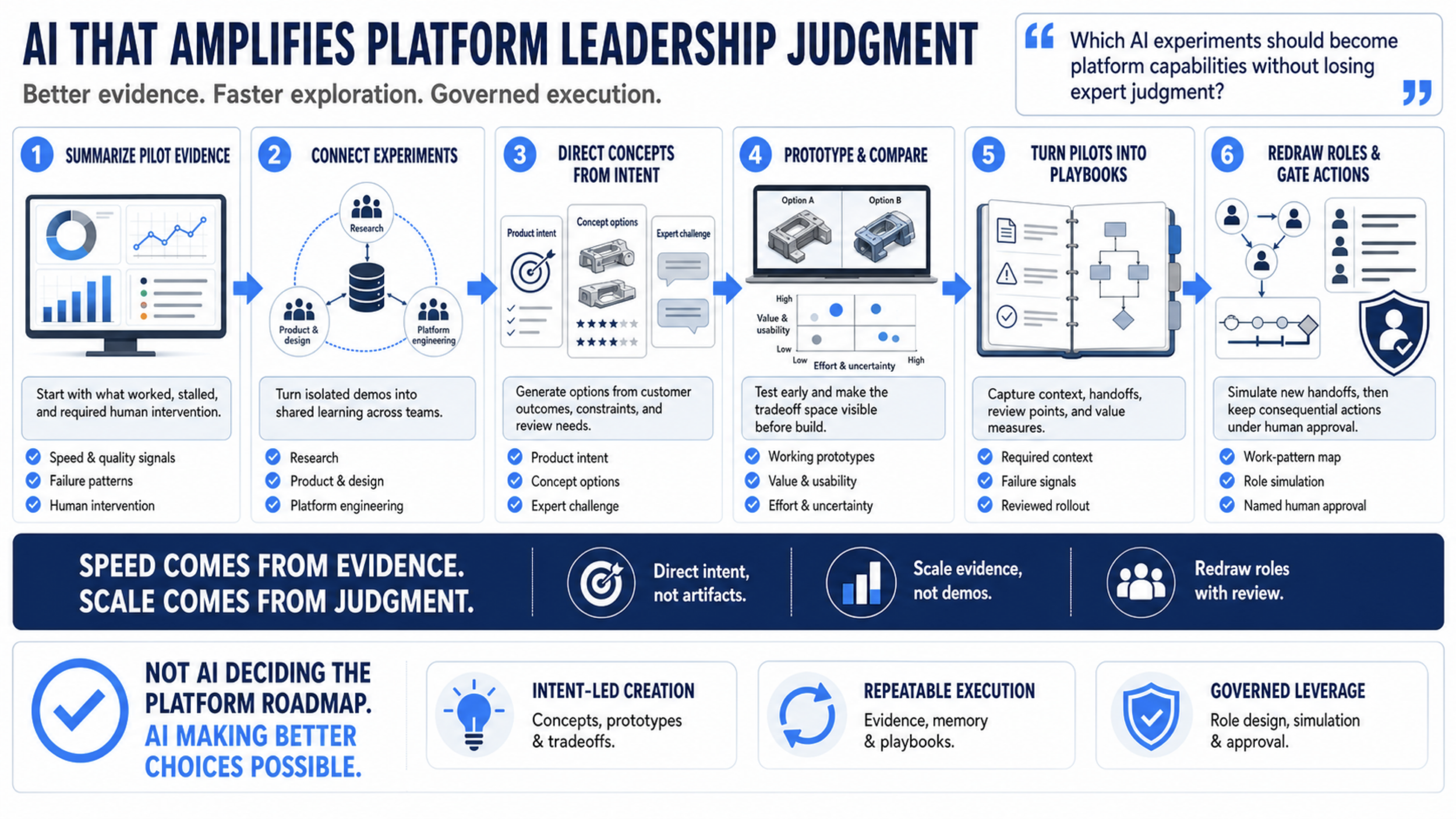
From producing artifacts to directing intent
Start product exploration with AI-generated concept options.
Turn specifications into AI-generated prototypes before build.
Compare alternatives through AI-generated tradeoff models.
From isolated experiments to repeatable execution
Use AI-summarized pilot evidence to guide platform priorities.
Connect experiments through shared AI memory.
Scale proven workflows with AI-generated implementation playbooks.
From fixed roles to governed leverage
Use AI-mapped work patterns to redraw role boundaries.
Test evolving responsibilities through AI-guided work simulations.
Gate AI agent actions through human review.
Talk Flow
The AI-generated opening
The opening video demonstrated how quickly the quality threshold is moving and framed AI-supported work as a present operating reality rather than a distant possibility.
The AutoCAD copy-and-paste moment
A parking-lot task that took days on paper took seconds in AutoCAD. The story established the keynote's core distinction between assistance that creates leverage and automation imagined as replacing professional judgment.
The technology staircase and AI piñata
PCs, spreadsheets, the internet, mobile, cloud, data science, and remote work each changed the baseline of work. AI is the next copy-and-paste moment, but leaders still need to crack open the vague promise and identify practical value, cost, and risk.
Prediction, consensus, and confidence
The `Once upon a time` exercise demonstrated next-word prediction and consensus behavior. The ambiguous follow-up showed why a probable answer is not automatically certain enough for the decision at hand.
Hallucinations, glue in pizza, and autocomplete
The pizza story showed how sarcasm, jokes, trolls, experts, and novices can become mixed source material. Autocomplete supplied the familiar operating model: accept useful suggestions, reject bad ones, and continue with the human in control.
Memories, hopes, and accountable review
People make choices using experience, aspirations, expertise, judgment, and ethics that AI does not automatically possess. AI recommendations therefore remain subject to human review and appropriate reliability controls.
AI and the future of Autodesk platform work
The room-specific prompt connected AI to experimentation, execution, role evolution, shared context, and expert oversight. The three shifts moved from individual artifact production toward directed systems, repeatable learning, and governed leverage.
AI as a performance coach
The keynote shifted from AI-generated work to AI-evaluated work. Comparing new work with prior strong examples can create a continuous improvement loop for PRDs, presentations, customer conversations, research, and other important work.
The intern model
AI was framed as an intern rather than a copilot: give it instructions, review the result, improve the instructions, and learn its capability ceiling while retaining accountability.
The hierarchy of work
Communication, process, and investigation occupy the broad base of the work pyramid. AI can help compress those layers, while people continue to solve novel problems, make judgment-rich decisions, and choose which ideas deserve resources.
Notes, music, and translation
Meeting notes can become searchable shared context, and a song can make important ideas easier to revisit. Near-real-time translation illustrated how AI may reduce language barriers and expand collaboration.
Closing Message - Managing in the world of more
Information, systems, expectations, and possible work keep growing while available hours remain fixed. The closing challenge was to flip the work pyramid and reinvest saved capacity in solving, deciding, and imagining the future of design, make, and engineering.