
Alegeus Partner Summit 2026: AI & the Future of Benefits Administration
Listen to the
AI KEYNOTE SONG
The easiest way to review or share the key points of my AI Keynote is with this song: the full keynote, matched with slides, in 4m32s!

PDF SUMMARY of key slides
This “Slide Cheatsheet” was customized for your specific talk. It’s designed to help audience-members like you, by wrapping my AI & the Future of Everything keynote into an easy-to-skim, easy-to-share, or easy-to-print resource for future reference.
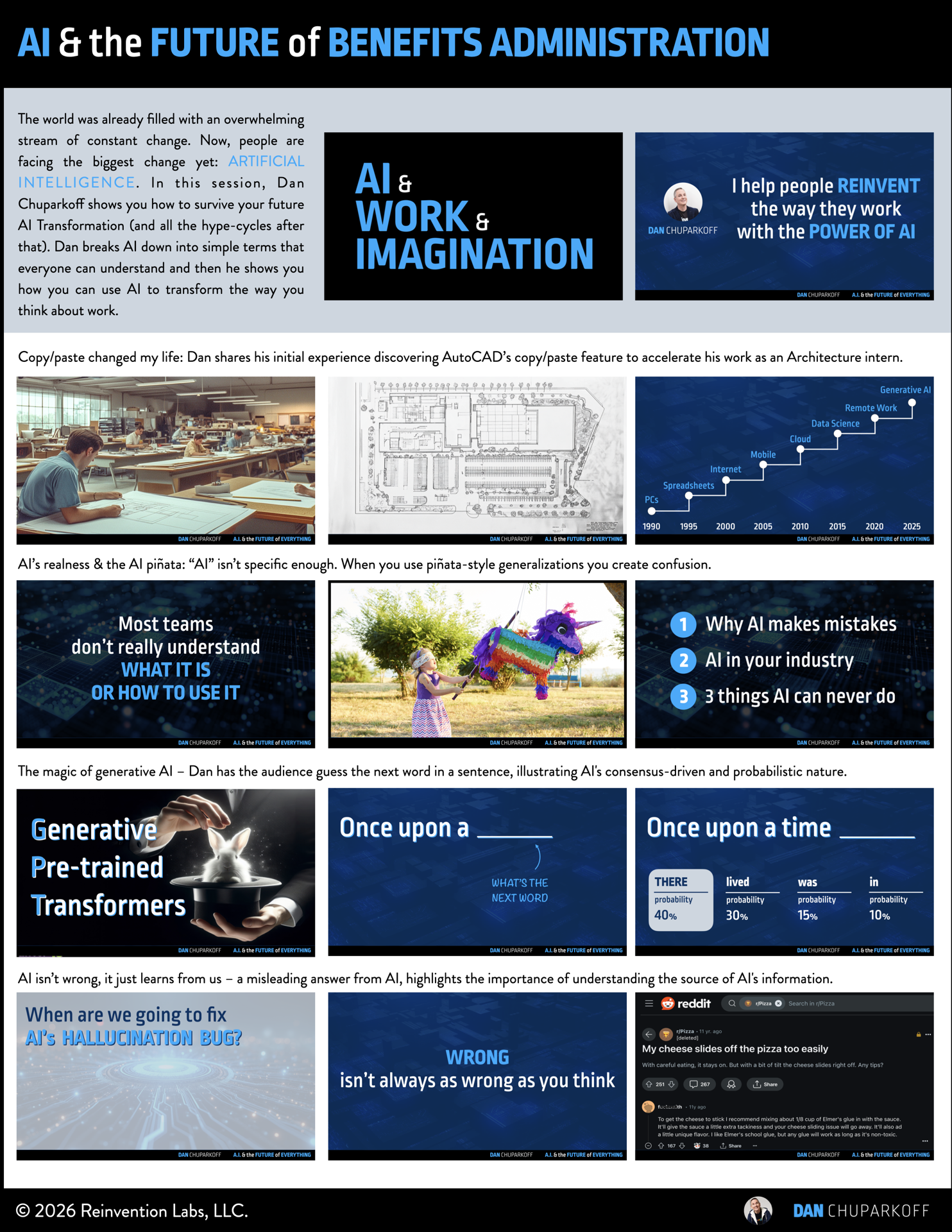
Download the 3 page
high-resolution PDF here:
Hope you find it helpful!
Check out the
Benefits Adminstration
AI FIELD GUIDE
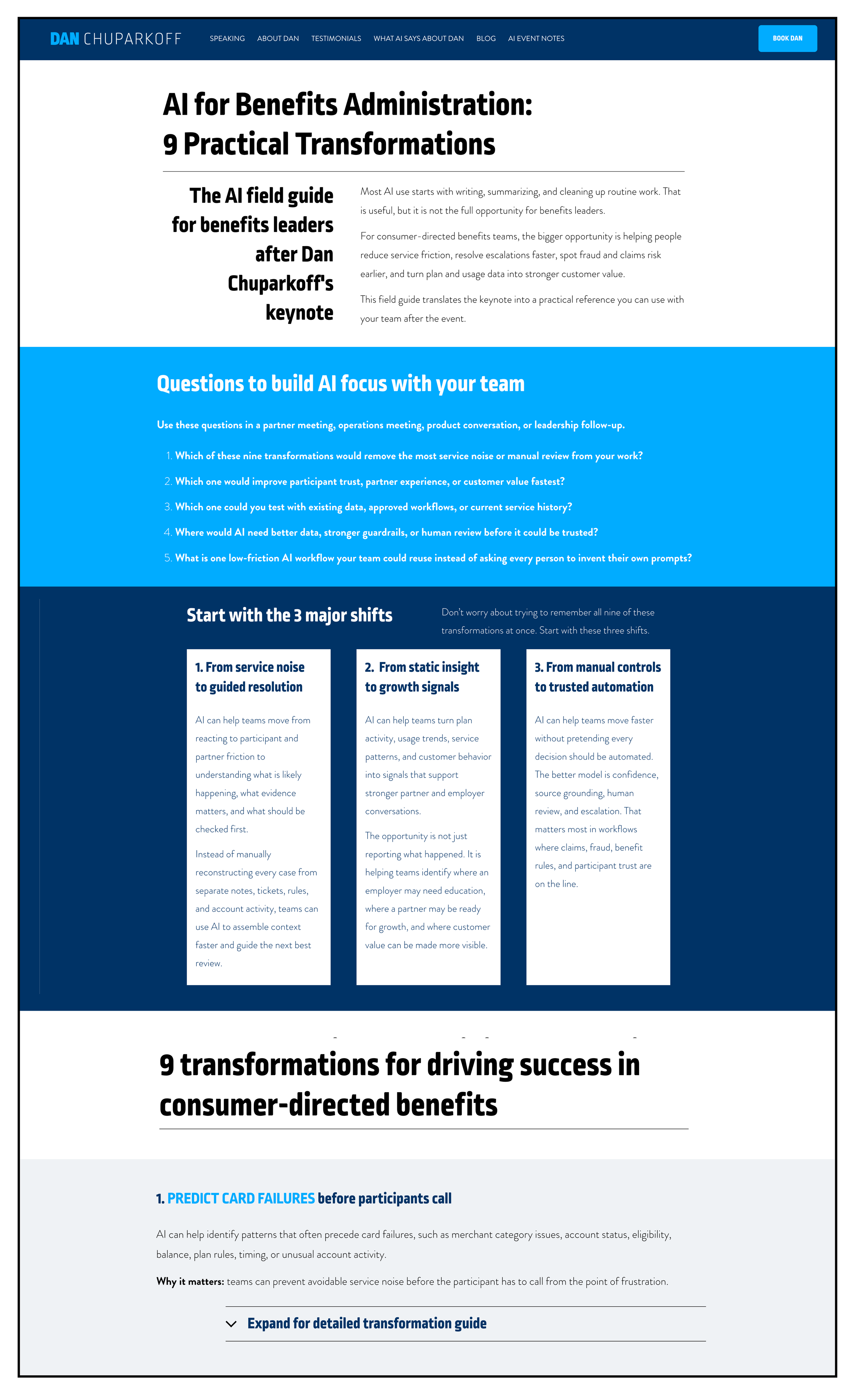
In my keynote, we didn’t have time to go into all the detail on the AI transformations. But here, you can see all of the amazing detail.
AI NOTES from Dan’s AI Keynote
*These notes were created using GPT 5.5 pro.
Transcription errors or mistakes have not been fixed
in order to demonstrate the current state of AI notes.
One-Sentence Takeaway
AI should reduce repeatable communication, process, and investigation work so benefits leaders can spend more time solving hard problems, making trusted decisions, and imagining better participant and partner experiences.
Summary
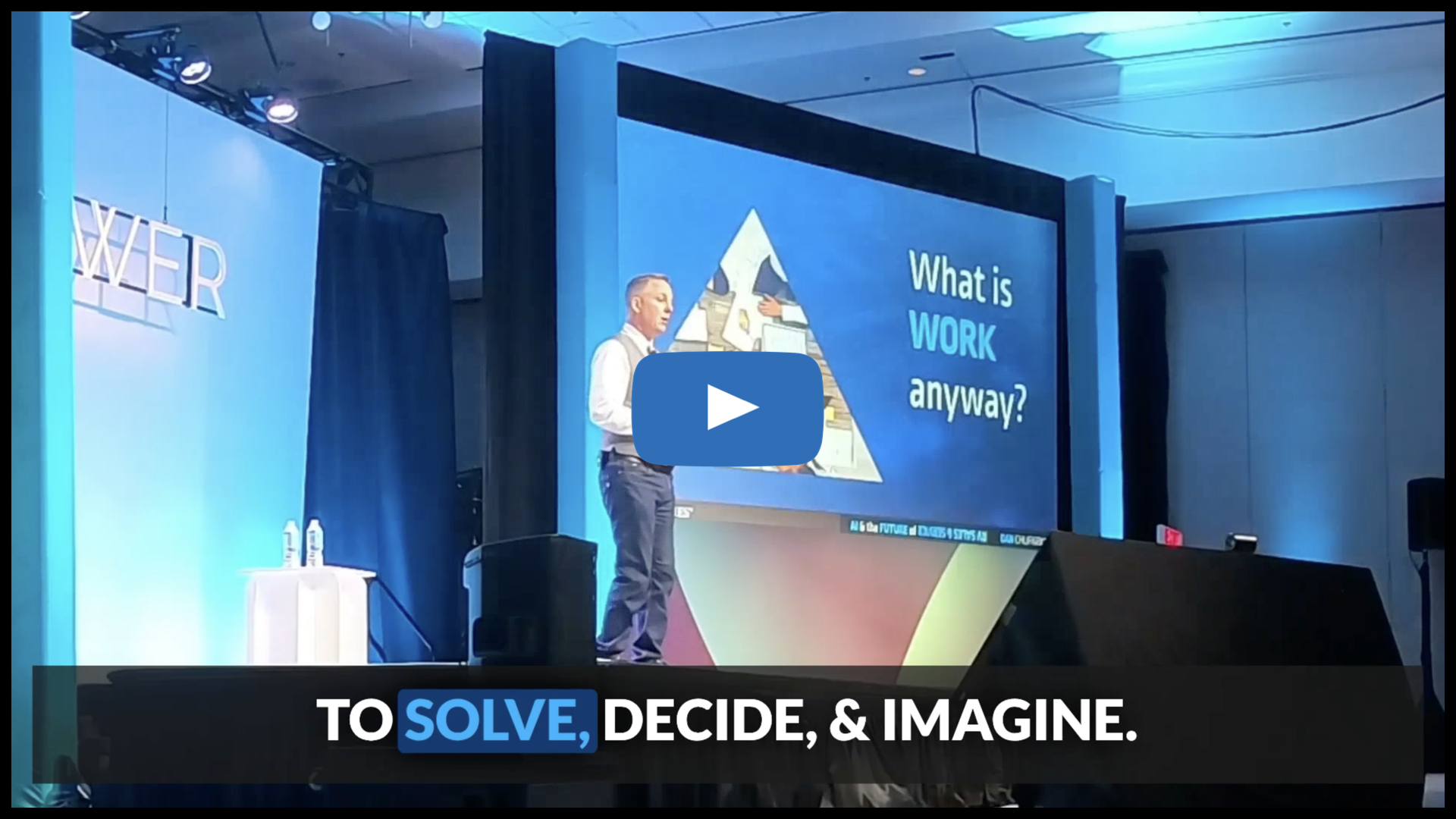
Dan opened by showing an AI-generated video and naming the threshold many teams are starting to cross: work without AI support may soon look less complete, less polished, or less informed than work created with AI assistance.
He framed AI as the next copy-paste moment, using the story of seeing AutoCAD copy parking lot lines in seconds after months of drawing them by hand. The lesson was that breakthrough tools are usually assistants before they are automators. They remove repetitive load and expand what people can do, but they still depend on human expertise and judgment.
Dan explained that AI generates likely answers from prior patterns. That makes it powerful for drafting, summarizing, comparing, finding patterns, and creating a better first pass, but it also means uncertainty will always be part of the system. The practical response is to ask about confidence, assumptions, sources, and escalation, especially in sensitive benefits, claims, fraud, and service workflows.
For Alegeus and its partners, the industry-specific middle of the talk focused on using AI to move from service noise to guided resolution, from static insight to growth signals, and from manual effort to trusted automation. The closing message was that AI can compress lower-value repeat work so people have more time for the work they should continue to own: solving, deciding, and imagining.
Action Items
[ ] Ask your preferred AI tool Dan's benefits-administration question: what are 9 ways AI will change the work of executive sellers, operators, product, and technology teams delivering consumer-directed benefits administration while reducing friction, turning insight into growth, and using AI responsibly?
[ ] Pick one recurring piece of work, such as an escalation summary, customer story, internal update, or meeting agenda, and ask AI to critique it instead of writing it from scratch.
[ ] For any AI output that could affect a participant, partner, claim, payment, or trust decision, ask what confidence level, assumptions, and escalation path belong with it.
[ ] Identify one communication-heavy workflow where AI notes, summaries, translations, or reusable follow-ups could reduce repeat work without weakening human relationship-building.
[ ] Keep the highest-judgment work with people: solving new problems, making important decisions, and imagining better future experiences for partners and participants.`
Key Ideas
AI is an assistant, not an automator.
The AutoCAD story showed that powerful tools can change the economics of work without eliminating the expert. AI should help people work faster and better, while people remain responsible for judgment and quality.
AI is a B-minus student in many subjects.
AI can raise your baseline in areas where you are not already an expert, but it should not replace the niche expertise that makes your team valuable. Use it to improve the work around your expertise.
Probability is not the same as truth.
AI predicts likely answers, which means wrong answers are not just a temporary bug. Confidence checks, source review, and human approval matter, especially in regulated or trust-sensitive workflows.
People have context AI does not.
Memories, hopes, recent conversations, risk tolerance, customer commitments, and company priorities shape decisions. AI can add intelligence to the process, but it does not own that context.
The work pyramid has been upside down.
Teams spend huge amounts of time communicating, processing, and investigating, while problem solving, decision making, and imagining get squeezed. AI creates leverage when it helps rebalance that pyramid.
Alegeus-Specific AI Opportunities
Move from service noise to guided resolution by predicting card failures before participants call, resolving escalations with AI-grounded case history, and answering partners from verified benefit rules.
Move from static insight to growth signals by surfacing employer needs from plan and usage data, prioritizing partners by growth risk signals, and drafting renewal stories from customer value signals.
Move from manual controls to trusted automation by flagging claim risks before automated decisions ship, monitoring fraud patterns with human review queues, and building workflows around confidence and escalation.
Use AI as a business transformation coach before treating it only as an IT backlog item. Everyday behavior change can start with better stories, sharper questions, clearer visuals, smarter email, stronger meeting prep, and faster translation.
Treat trust as a design requirement. In benefits administration, AI workflows should be built around confidence, review, escalation, and clear human ownership.
Talk Flow
Digital emcee introduction
The introduction positioned Dan as a technology leader who helps people turn complex technology into practical action.
AI-generated video and the new threshold
Dan used an AI-generated video to show how quickly AI content is improving. He described a coming threshold where work created without AI help may start to look less complete than AI-assisted work.
AutoCAD and the copy-paste moment
The story of drawing parking lot lines by hand introduced the keynote's central metaphor. Once Dan saw AutoCAD copy and paste perfect lines, manual drafting felt absurd. The lesson was that AI is another major assistance breakthrough.
Technology stair steps
Dan connected PCs, spreadsheets, the internet, mobile, cloud, data science, remote work, and generative AI as a continuing sequence of tools that first seem disruptive and later become normal.
The AI pinata
Dan described the current AI conversation as people swinging at a pinata without knowing what is inside. Leaders have to identify what creates real value without unnecessary risk.
What GPT is doing
He unpacked GPT as generative, pre-trained, and transformer-based, then focused on the practical point: AI generates likely answers from old patterns rather than simply searching for truth.
Once upon a time
The audience exercise showed that AI predicts the most likely next word and tends toward consensus. That makes it broadly useful, but not automatically expert, creative, or correct in every context.
Confidence and hallucination
Dan explained that hallucination is a symptom of probability, not just a bug waiting to be fixed. The right operating habit is to ask for confidence, assumptions, sources, and review points.
Glue in your pizza
The pizza example showed how internet data can include jokes, sarcasm, and bad advice. AI can filter some of this, but organizations still need review layers.
Autocomplete as the first AI assistant
Autocomplete gave a familiar model for accepting or rejecting suggestions. People already know how to use AI help without letting it act independently on their behalf.
Memories and hopes
Dan argued that decisions are shaped by experience, goals, context, and aspiration. AI can support the decision, but people should remain the decision makers.
Nine benefits-administration transformations
Dan asked AI what would change for executive sellers, operators, product, and technology teams delivering consumer-directed benefits administration. He summarized the answer as three shifts: guided resolution, growth signals, and trusted automation.
AI before the IT project
Dan emphasized that AI should change everyday work before it becomes a formal systems project. Writing, answering questions, creating workflow diagrams, handling email, preparing meetings, and translating across languages can all improve now.
Critique before drafting
Rather than asking AI to create everything from scratch, Dan recommended asking it to rank or critique work people have already created. That turns AI into a coach for improving human work.
AI as intern
Dan rejected the copilot metaphor and described AI as an intern. You give instructions, review the work, improve the instructions, and learn the tool's capability ceiling.
The hierarchy of work
Dan introduced six kinds of work: communication, process, investigation, problem solving, decision making, and imagining. AI can help with the lower layers, while people should keep ownership of the higher-judgment layers.
Communication as a major opportunity
Dan cited the large share of work time spent in communication and argued that AI can help teams summarize, redistribute, translate, and retrieve information more effectively.
AI notes and AI song
Dan showed how AI notes and a generated song can make key ideas easier to review and share. The broader point was that AI can change how teams preserve and reuse important information.
Real-time translation
Dan demonstrated AI translation and connected it to global collaboration, customer access, and broader workforce participation.
Closing Message - Managing in a world of more
Dan closed by naming the pressure leaders face: more information, more systems, more demands, and no more hours. The answer is to let AI compress repeat work so people can spend more time solving, deciding, and imagining.