
FedEx Midwest 2026: AI & the Future of Delivery Operations
Listen to the
AI KEYNOTE SONG
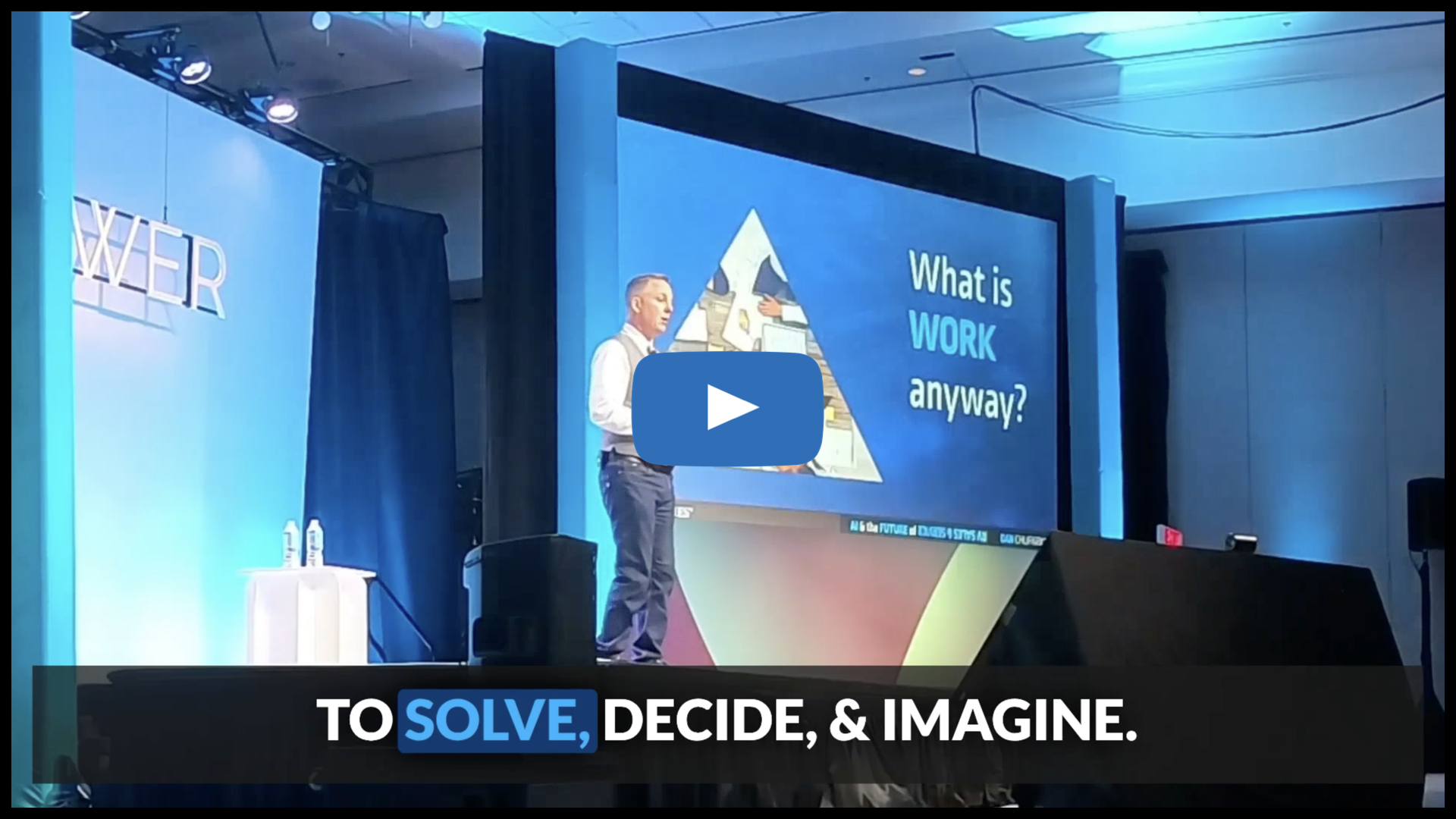
The easiest way to review or share the key points of my AI Keynote is with this song: the full keynote, matched with slides, in 4m32s!

PDF SUMMARY of key slides
This “Slide Cheatsheet” was customized for your specific talk. It’s designed to help audience-members like you, by wrapping my AI & the Future of Everything keynote into an easy-to-skim, easy-to-share, or easy-to-print resource for future reference.
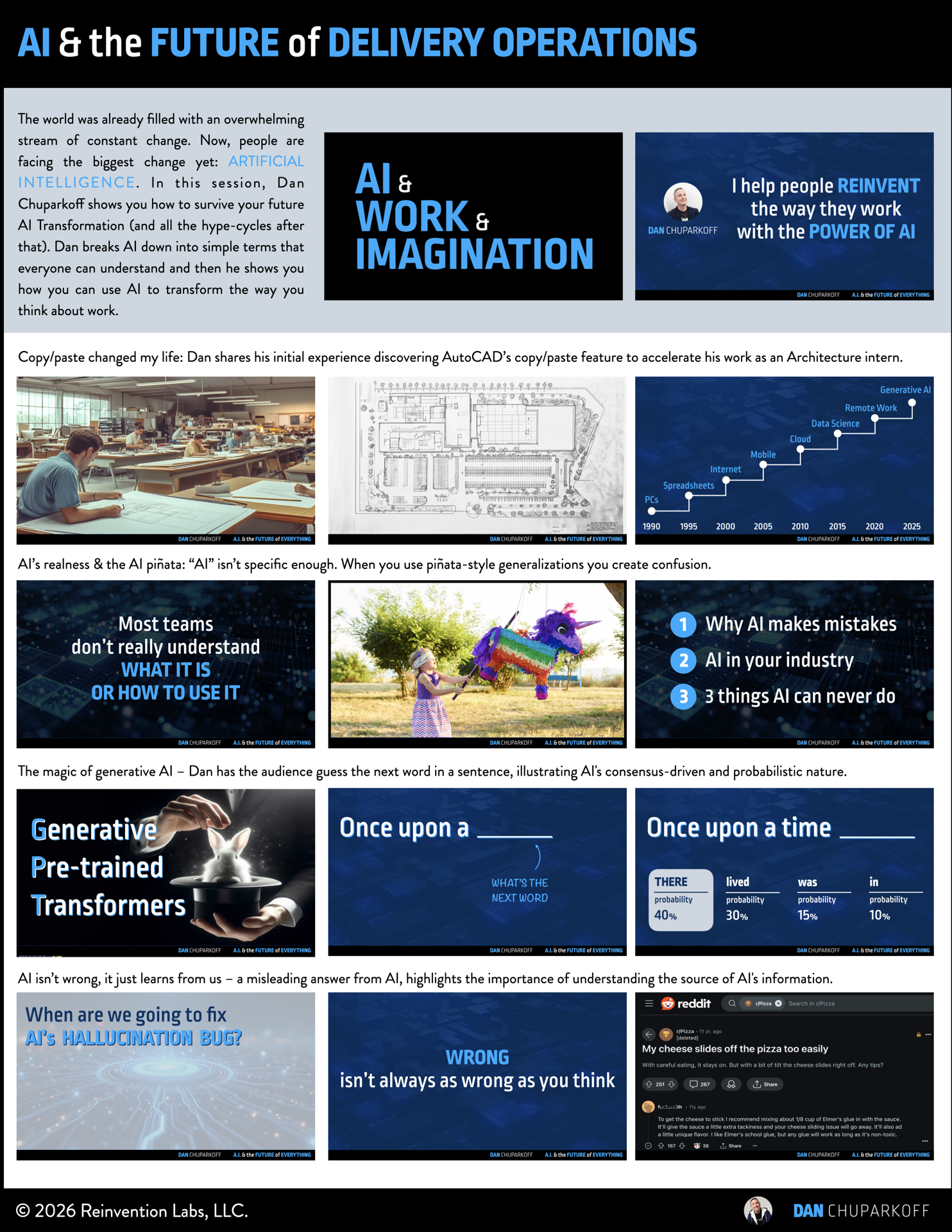
Download the 3 page
high-resolution PDF here:
Hope you find it helpful!
Check out the
Delivery Operations
FIELD GUIDE
In my keynote, we didn’t have time to go into all the detail on the AI transformations. But here, you can see all of the amazing detail.
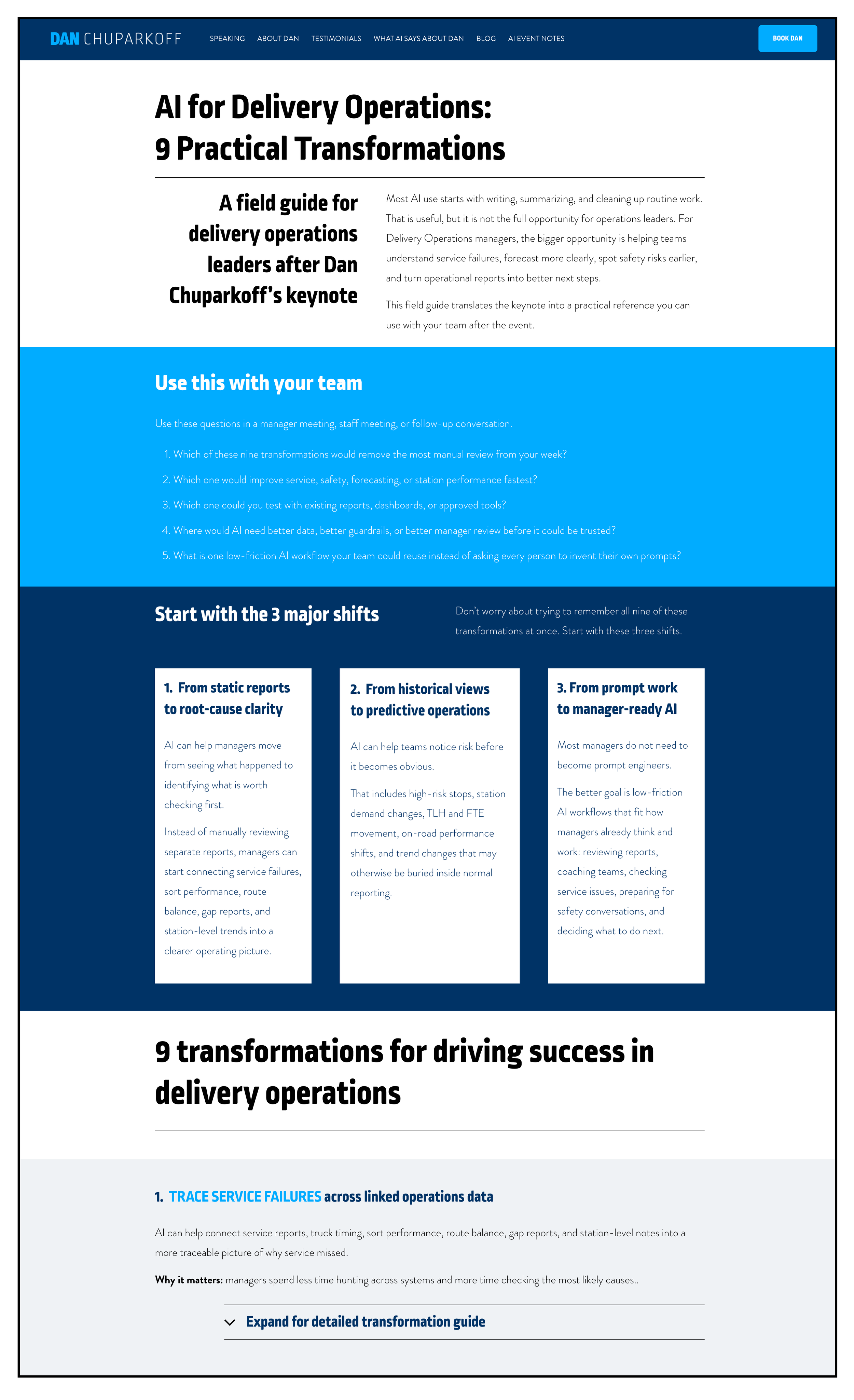
AI NOTES from Dan’s AI Keynote
*These notes were created using GPT 5.5 pro.
Transcription errors or mistakes have not been fixed
in order to demonstrate the current state of AI notes.
One-Sentence Takeaway
AI is most useful when leaders treat it as a practical assistant for communication, process, investigation, and preparation while keeping people responsible for solving problems, making decisions, and imagining what comes next.
Summary
Dan opened by showing how quickly AI-generated content is improving and argued that the threshold is shifting: work that is done without AI assistance may soon look slower, rougher, or less complete. He used his AutoCAD story from 1987 to show that the most important technology shifts are not usually about replacing experts. They are about giving people a new assistant that changes the baseline for how work gets done.
He then explained AI in practical terms. Generative AI predicts likely next words, images, and answers based on patterns from past data. That makes it useful, fast, and broad, but not perfectly reliable. The session emphasized that hallucinations are not a temporary bug. They are a natural result of probability-based systems, which is why leaders need to ask AI how confident it is, what assumptions it made, and what source material supports its answer.
For delivery operations, Dan translated AI into the daily work of station and frontline leaders. AI can help leaders move from metric overload to grounded answers, from reactive exceptions to earlier risk detection, and from workforce churn to more guided ramp-up. The most practical opportunities include faster manager briefs, chat-based SOP support, shipment exception prioritization, service recovery drafts, safety trend coaching, and volume-spike staffing forecasts.
The keynote closed by reframing work itself. AI can help reduce some of the time spent communicating, processing, and investigating, but people remain essential for problem solving, decision making, and imagining better ways to run the operation. The goal is not to remove managers from the work. The goal is to give them more time and better context for the work only people can do.
Action Items
[ ] Ask AI one practical delivery-operations question this week, then ask how confident it is and what assumptions it made.
[ ] Identify one recurring manager communication task, such as a daily brief, follow-up note, or performance summary, and test AI as a first-draft assistant.
[ ] Pick one SOP or policy area where frontline leaders ask repeated questions and consider what a controlled, source-grounded assistant would need before it could be trusted.
[ ] Choose one dashboard or report that creates overload and rewrite it as a short list of questions managers actually need answered.
[ ] Use AI as a coach on one piece of your own work by asking, "How could this be clearer, more useful, or more actionable?"
Key Ideas
AI is an assistant, not an automator.
The AutoCAD story showed that technology can create massive productivity gains without eliminating the need for skilled judgment. AI should be treated the same way: useful support for people who still own the work.
Probability is powerful, but it is not certainty.
AI gives the best answer it can based on patterns, but the best available answer may still be uncertain. Leaders should ask for confidence, sources, assumptions, and alternatives before relying on important outputs.
You have a context advantage.
AI does not have your memories, hopes, operating history, team knowledge, or local judgment. Those human inputs shape better decisions than probability alone.
AI can raise your baseline in many skills.
You may still be the expert in your core role, but AI can make you better at adjacent work: writing, planning, summarizing, analyzing, coaching, and communicating.
Use AI as a performance coach.
Instead of only asking AI to do work for you, ask it to compare your work to your goals and suggest how to make it stronger next time.
Managers still solve, decide, and imagine.
AI can help with communication, process, and investigation, but new problems, judgment calls, and future possibilities still require people.
Delivery Operations-specific AI Opportunities
GROUNDED OPS COPILOTS answer station metrics questions.
Summarize building performance with MANAGER BRIEF GENERATORS.
Use CHAT-BASED DECISION SUPPORT for frontline SOPs.
AI-PRIORITIZED SHIPMENT ALERTS escalate critical exceptions.
Draft service recovery from SHIPMENT EXCEPTION DATA.
Prioritize station actions with LIVE RISK DETECTION.
Personalize onboarding with ROLE-SPECIFIC LEARNING PATHS.
Coach managers through AI-ANALYZED SAFETY TRENDS.
Spot staffing gaps from VOLUME-SPIKE FORECASTS.
Talk Flow
AI-generated content is crossing a threshold
Dan began with an AI-generated video to show that AI content is becoming harder to dismiss as obviously artificial. The point was not the video itself, but the larger shift: AI assistance is becoming part of normal work quality.
The AutoCAD copy-and-paste moment
Dan told the story of drawing parking lot lines manually as a teenager and then seeing AutoCAD copy and paste those lines in minutes. That moment showed how a tool can become an assistant that changes the economics and expectations of a profession.
AI is the next step in a long technology staircase
PCs, spreadsheets, the internet, mobile, cloud, data science, and remote work all changed how people collaborate with information and with each other. AI is the next step, and it will eventually become invisible inside normal tools.
Crack open the AI pinata
Dan framed AI as something many people talk about without understanding. Leaders need to figure out which AI uses create more value than risk, especially in serious operational environments.
What GPTs are really doing
Through the "once upon a time" exercise, Dan explained that AI predicts likely next words. That makes AI useful for language and content, but it also means AI is consensus-driven and often strongest at the middle of the bell curve.
Confidence matters
The "40% confidence" example showed that AI may present an answer clearly even when its underlying certainty is limited. Dan encouraged attendees to ask AI how sure it is, where the answer came from, and what decisions it made along the way.
Hallucination is not a bug
Dan compared AI mistakes to actuarial predictions and internet-sourced answers. AI can be useful while still being wrong sometimes, just like autocomplete can help without being trusted to send messages on its own.
Memories and hopes give people the advantage
AI has intelligence-like pattern matching, but people bring lived experience, judgment, values, and desired futures. Those human inputs matter most when solving real problems and making decisions.
AI for delivery operations
Dan translated AI into delivery operations by asking how it could change the work of senior managers running pickup, sorting, and last-mile delivery while balancing service, safety, overload, and workforce continuity. He highlighted grounded ops copilots, manager briefs, SOP support, prioritized shipment alerts, exception recovery, live risk detection, role-specific learning paths, safety trend coaching, and volume-spike forecasting.
AI changes individual work before it becomes a major IT project
Dan emphasized that leaders do not have to wait for every enterprise system to change. AI can already help with stories, questions, images, inboxes, planning, translation, and work quality when used carefully.
Use AI as a coach
Instead of asking AI to write everything from scratch, Dan recommended asking AI to evaluate work, compare it to prior examples, and suggest how to improve. This keeps the human improving instead of becoming dependent.
Intern, not copilot
Dan argued that AI is better understood as an intern than as a copilot. You give instructions, review the work, improve the instructions, learn the capability ceiling, and remain responsible for the result.
The work pyramid
Dan broke work into communication, process, investigation, problem solving, decision making, and imagining. AI can help most with the lower layers, freeing more time for the higher-value human work.
Meeting notes, songs, and translation
Dan showed how AI can change communication through better notes, more memorable summaries, and real-time translation. These examples illustrated how AI can reduce friction in how teams capture, share, and understand information.
Closing Message - Managing in a world of more
The close returned to the pressure leaders feel every day: more goals, more information, more tools, and the same number of hours. AI can help leaders shrink some of the overloaded work so they can solve harder problems, decide with better context, and imagine better delivery operations.