
IAT 2026: AI & the Future of Insurance Leadership
Listen to the
AI KEYNOTE SONG
The easiest way to review or share the key points of my AI Keynote is with this song: the full keynote, matched with slides, in 4m32s!
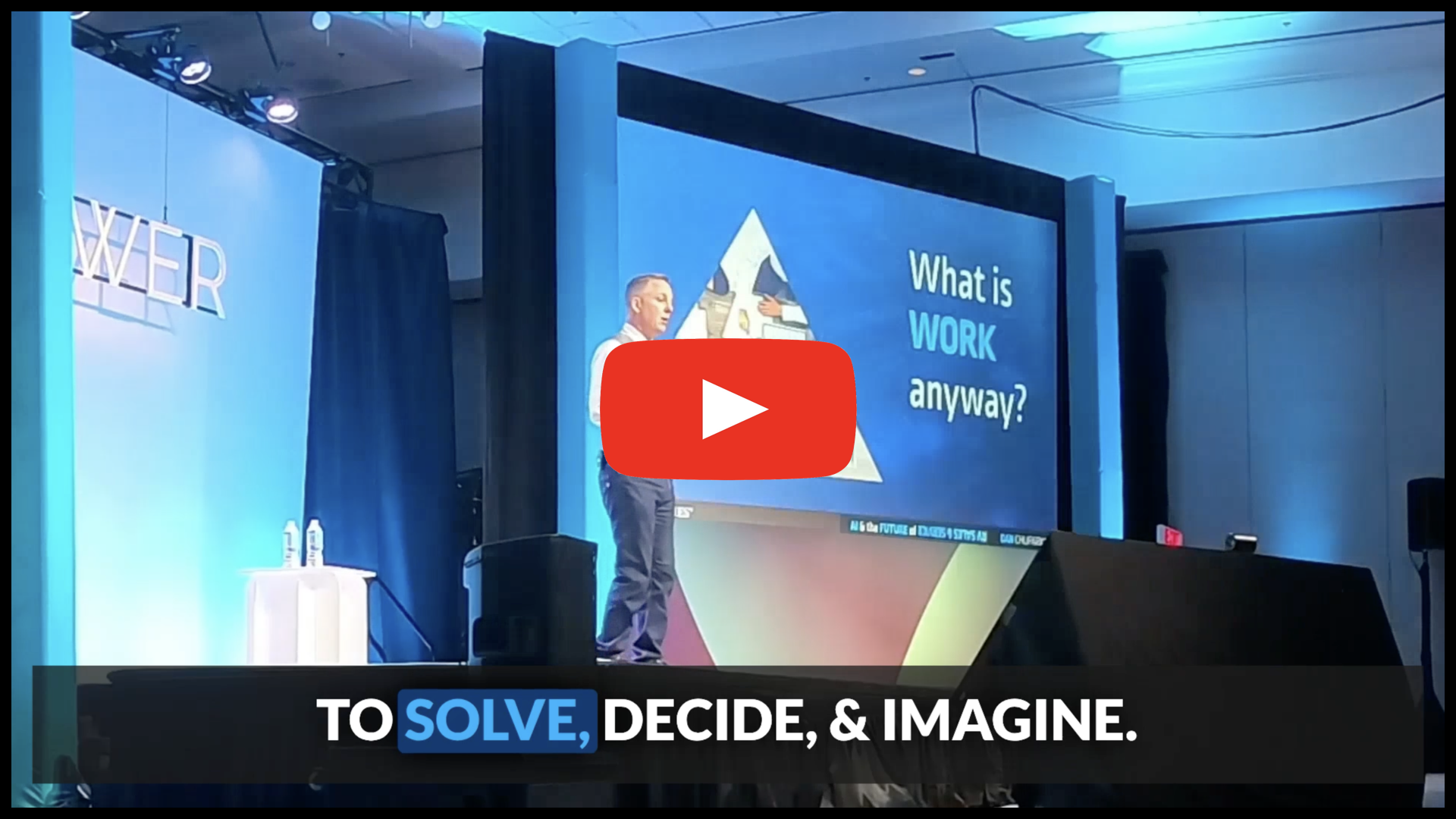
A day in the life in YOUR AI FUTURE

PDF SUMMARY of key slides
This “Slide Cheatsheet” was customized for your specific talk. It’s designed to help audience-members like you, by wrapping my AI & the Future of Everything keynote into an easy-to-skim, easy-to-share, or easy-to-print resource for future reference.
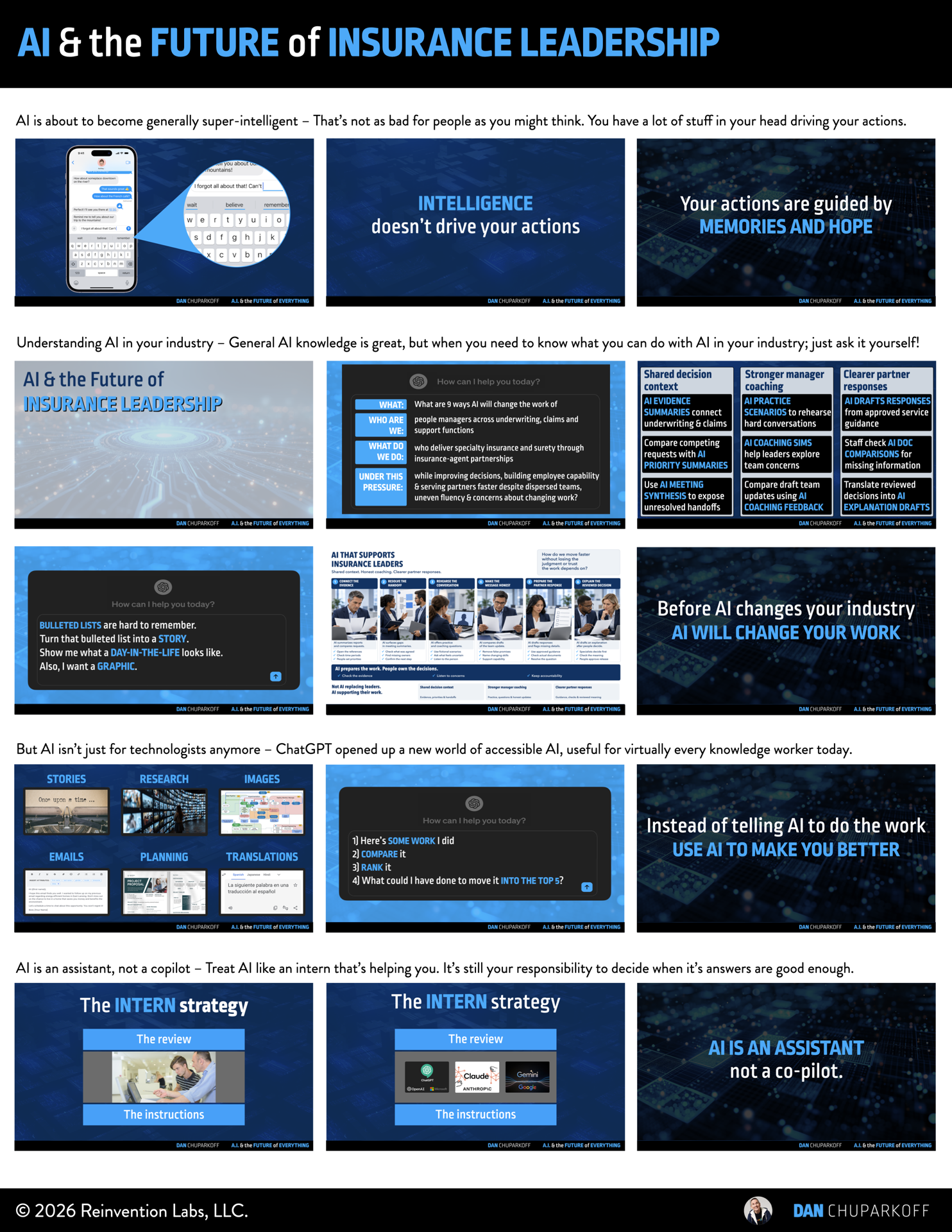
Download the 3 page
high-resolution PDF here:
Hope you find it helpful!
AI NOTES from Dan’s AI Keynote
*These notes were created using ChatGPT 5.6 pro.
Transcription errors or mistakes have not been fixed
in order to demonstrate the current state of AI notes.
Summary
AI changes how work gets done by giving people more powerful assistance. Dan's first copy-and-paste moment, watching AutoCAD replace painstaking manual parking-lot drawing, illustrated the distinction between an assistant and an automator. The opportunity was to help an architect work faster and create more value while the architect remained responsible for the work. Generative AI is another step in that continuing change.
Using that assistance well requires judgment. AI generates answers from patterns and probabilities; the most likely answer can still be unsuitable or wrong. Your experience, relationships, memories, and hopes supply context that an AI assistant does not fully share. Treat it like an intern: give instructions, review the result, improve the instructions, and learn which work it can handle. You remain responsible for deciding what to use.
For insurance leaders, the opportunities discussed centered on shared decision context, stronger manager coaching, and clearer partner responses. AI can also coach your own performance by comparing your work with prior examples and identifying ways to improve. The larger goal is to compress communication, processing, and investigation work so you have more capacity for solving problems, making better decisions, and imagining the future of insurance leadership.
Action Items
[ ] Ask your AI assistant the insurance-leadership question below. Discuss the answers, identify the most relevant near-term opportunity, and explore what it would change in your team's work.
[ ] Try the intern loop on one suitable task: give clear instructions, inspect the output, check its sources and facts, refine your instructions, and decide whether the result is usable.
[ ] Coach one piece of your own work. Define what good looks like, ask AI to compare your draft or permitted call record with prior examples, and apply one specific improvement.
[ ] Review where your week goes across the six layers of work. Choose one communication, process, or investigation task where AI assistance could create more time for a problem or decision you have been postponing.
[ ] Make one recurring meeting's information easier to reuse with an approved AI notetaker. Keep useful notes searchable so the discussion can inform later preparation and decisions.
Key Ideas
Assistance & accountability
An assistant increases what you can accomplish. It does not remove your responsibility for the result. Look for work AI can help you perform with greater speed, clarity, or precision while you retain judgment.
Probability & verification
A highest-probability answer is not the same as an answer that meets your needs. Ask how sure AI is, request its sources, open those sources, and check the information. The actuary analogy and glue-in-pizza example illustrated both uncertainty and flawed source material.
Expertise, memories & hopes
AI can raise your baseline in areas outside your specialty. Continue developing the expertise that makes you valuable. Your past experiences and desired future influence decisions in ways that a general answer cannot capture; different experiences also make team discussion valuable.
The intern loop
Give instructions, review the work, provide better direction, and review again. Over time, learn whether the output is usable and where the assistant's capability ceiling lies. You are the responsible manager of the work.
Your performance coach
After doing the work, ask AI to compare it with your earlier work using criteria you choose. What did your strongest examples do that this one misses? Use that feedback to improve the next attempt and help your team build the same habit.
The hierarchy of work
The six layers are communicate, process, investigate, solve problems, make decisions, and imagine. The first three are important, but they can consume the week. Use assistance there to create more capacity for the last three. A repeating issue with a known response may be a process opportunity; new, unusual problems require your attention.
Opportunities for IAT insurance leaders
Start a conversation with AI using the question from the keynote materials:
What are 9 ways AI will change the work of people managers across underwriting, claims and support functions who deliver specialty insurance and surety through insurance-agent partnerships while improving decisions, building employee capability and serving partners faster despite dispersed teams, uneven fluency and concerns about changing work?
The keynote presented three groups of opportunities. These examples from the accompanying transformation list provide ways to explore each group:
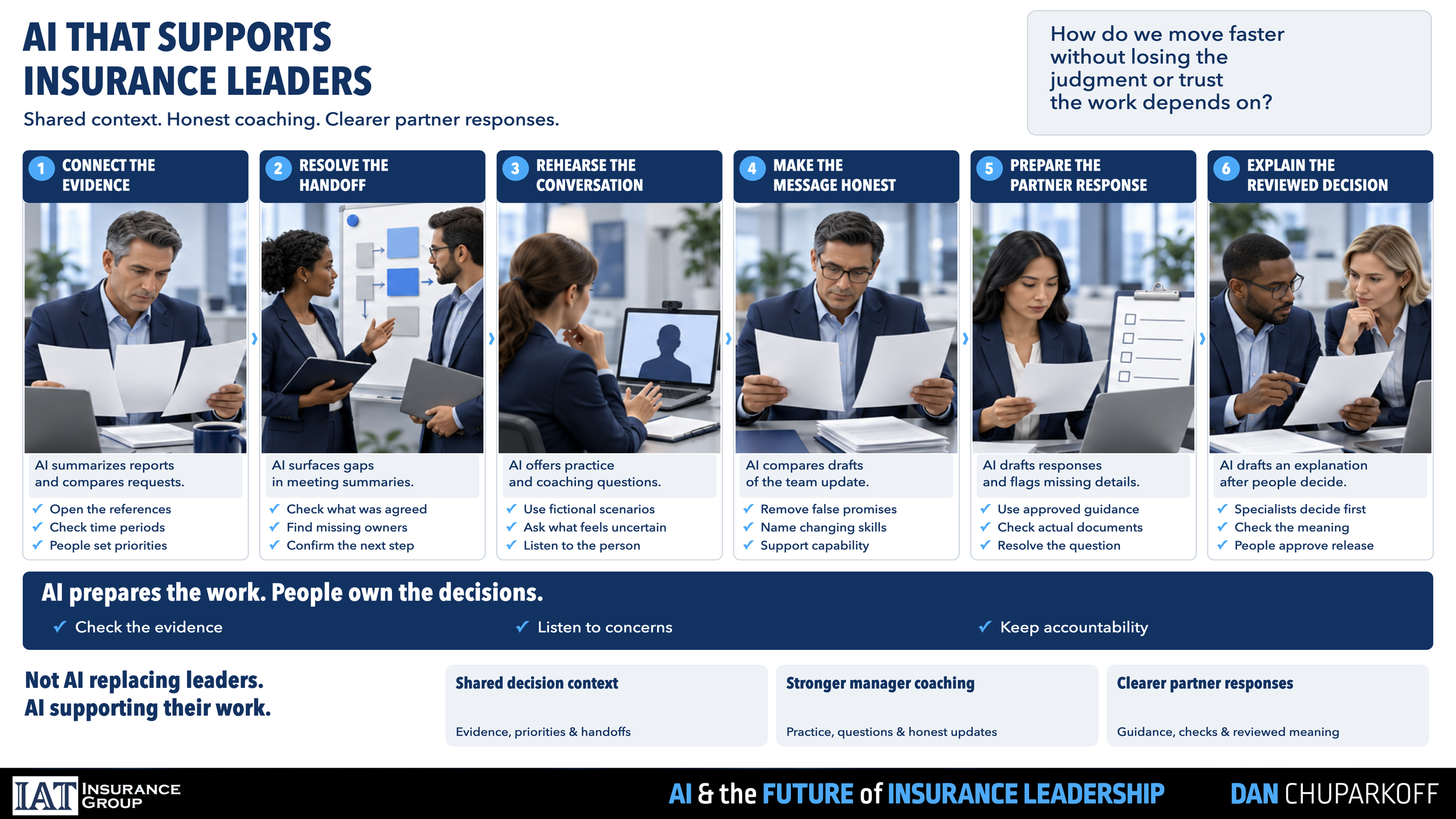
Shared decision context: Use AI summaries to connect underwriting, claims, and finance information, compare competing priorities, and expose unresolved handoffs in meeting discussions.
Stronger manager coaching: Explore practice scenarios for conversations about changing work, questions that help employees explain their concerns, and feedback on draft team updates.
Clearer partner responses: Explore drafts based on approved insurance-agent service guidance, document comparisons that flag missing submission information, and explanations of decisions that people have reviewed.
The day-in-the-life example connected those possibilities into a workflow: connect evidence, resolve handoffs, prepare for conversations, check that the message is accurate, refine responses, and improve how decisions are explained. AI can help prepare you to say the right thing before a conversation as well as capture what was said afterward.
Choose the opportunity that matters most to your work. Some larger applications will depend on IT priorities, service providers, cost, and privacy readiness. Personal learning and coaching can begin within the tools and information you are approved to use. Managers and other accountable professionals retain decisions and source review.
Talk Flow
1. Recognize the next change in work
AI-generated introduction & technology journey
AI-generated material and Dan's career illustrated how technology expands the work people can do.
Examine your own work for tasks that assistance could change.
The parking-lot copy-and-paste moment
AutoCAD turned repetitive manual drawing into work that could be completed much faster.
The architect still supplied the purpose and expertise.
Danny's resistance & the assistant distinction
Confusing assistance with replacement can prevent teams from seeing useful possibilities.
Human oversight remains part of the work, including when individual steps are automated.
The technology staircase & AI pinata
Familiar tools became ordinary parts of work; AI follows that pattern.
Leaders need to identify what creates practical value inside the broad AI label.
2. Understand prediction & keep human judgment
“Once upon a…” & the B-minus student
The audience exercise made prediction and consensus visible.
Use AI to support work outside your expertise while continuing to deepen your specialty.
The 40% answer & the actuary analogy
The leading answer can still fall short of the confidence a decision requires.
Check sources and decide whether the result is useful for the task at hand.
Glue in pizza & autocomplete
AI can inherit unreliable material from its sources.
You already practice accepting or rejecting suggestions when you use autocomplete.
Memories & hopes
Judgment draws on what you have experienced and what you want to become true.
Bringing different experiences together helps teams make decisions.
AI as an intern
Instructions, review, and revision form a continuing management loop.
Learn the assistant's limits and remain responsible for its work.
3. Apply assistance to insurance leadership
The role-specific question
Ask how AI changes the work of your roles, for your customers, under your constraints.
Treat the answer as the start of a conversation you can explore and prioritize.
Three groups of opportunities
Shared decision context, stronger manager coaching, and clearer partner responses connect AI to leadership work.
A day in the life
Connect evidence and handoffs, prepare for conversations, and refine how decisions are communicated.
People check the facts and remain responsible for the message.
The personal performance coach
Compare work you have done with your strongest previous examples using your own criteria.
Turn feedback into improvement in writing, customer conversations, claims work, and team performance.
4. Create capacity for higher-value work
Work, jobs & the full to-do list
Greater efficiency creates capacity for important work that was not getting done.
Use that capacity to build capability and customer value.
The six-layer pyramid
Communication, processing, and investigation form the foundation of work.
Protect time for solving problems, making decisions, and imagining.
Processes & new problems
Recurring issues with repeatable answers may be candidates for better processes.
Leaders still need to address new, unusual problems and choose what to pursue.
Solve, decide & imagine
Use information assistance to support better decisions and put your energy behind the future you want.
5. Improve how information moves & flip the pyramid
AI notes & meeting support
Searchable notes help information return when it is needed.
The keynote also explored assistants that could prepare participants and help meetings avoid repeating unproductive discussions.
Notes turned into a song
The chorus reinforced the need for people to solve, decide, and imagine.
Consider a different format for an important message your team needs to remember.
Translation & collaboration
The translated video, Italy experience, and multilingual construction-team example showed how language assistance can help people collaborate.
CLOSING MESSAGE: Flip the pyramid of work!
Managing in the world of more
Demands grow while the hours available to meet them remain limited.
Compress the lower layers of work and flip the pyramid toward more solving, deciding, and imagining.