
International Paper AI Summit 2026: AI & the Future of Packaging
Listen to the
AI KEYNOTE SONG
The easiest way to review my keynote in 5 minutes! Share the key points of the AI Keynote with this song. It’s the full keynote, synced along with my slides!

PDF SUMMARY of key slides
This “Slide Cheatsheet” was customized for your specific talk. It’s designed to help audience-members like you, by wrapping my AI & the Future of Everything keynote into an easy-to-skim, easy-to-share, or easy-to-print resource for future reference.
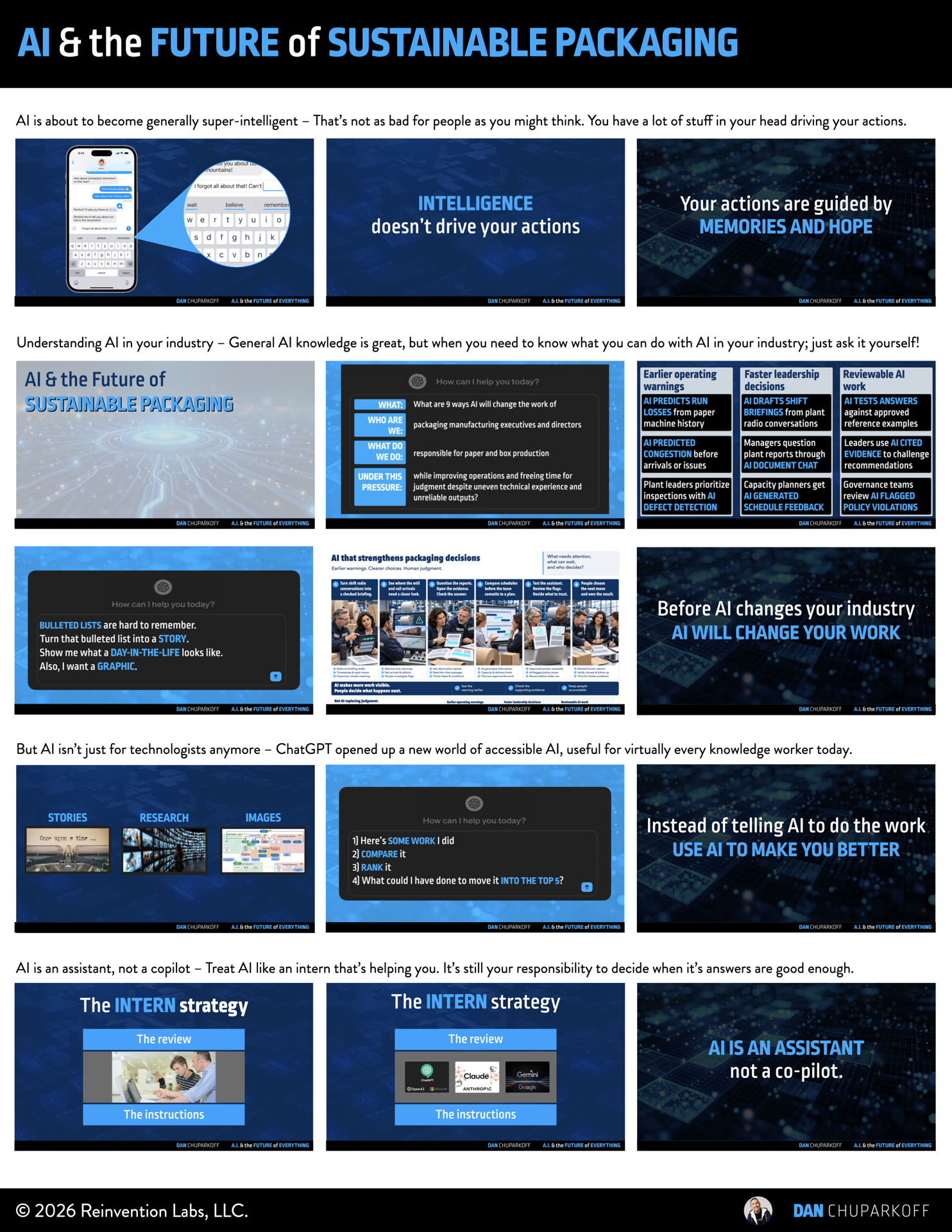
Download the 3 page
high-resolution PDF here:
Hope you find it helpful!
AI NOTES from Dan’s AI Keynote
*These notes were created using ChatGPT 5.6 pro.
Transcription errors or mistakes have not been fixed
in order to demonstrate the current state of AI notes.
Summary
At 17, Dan spent three days drawing a parking lot by hand. An architect showed him how to draw one stripe in AutoCAD and copy it across the lot in about 90 seconds. The architect still had to design the school. That distinction matters for leaders deciding where AI can help today.
AI can suggest a likely answer even when several answers are plausible. Your phone does this when you type a text. You accept a useful suggestion or type what you meant because you know who you’re talking to and why. The same judgment matters at work. Experience tells you which past mistakes to avoid, and your goals tell you which outcome is worth pursuing.
For packaging leaders, Dan grouped the opportunities into earlier operating warnings, faster leadership decisions and reviewable AI work. He also showed something a leader can try immediately: write a first draft, ask AI to compare it with your best previous work, and use the differences to improve your next attempt.
Action Items
[ ] Try the packaging question below in an AI tool. Choose one suggestion and ask what data it needs and what a person should check before acting.
[ ] Pick one piece of work you do repeatedly. Ask AI to compare your latest example with your five strongest earlier examples and identify one thing you could do better next time.
[ ] For an upcoming decision, ask how sure the tool is about its suggestion. Decide how much confidence the stakes require and what you can check yourself.
[ ] Pick one recurring meeting where AI-generated notes could save time. Name the problem or decision you want to give that time to.
Key Ideas
The most likely answer can still be a poor choice. A word can win a next-word poll with 40% of the votes. In a work decision, that much uncertainty might be a reason to wait or check.
Popularity can reward the joke. In the pizza story, 167 people upvoted the suggestion to use glue to keep cheese on a slice. Agreement can make a suggestion look convincing even when following it would be a mistake.
Memories & hopes shape judgment. You may want to lead like the best boss you ever had or avoid repeating your worst project. Those experiences and ambitions give you context an AI suggestion can miss.
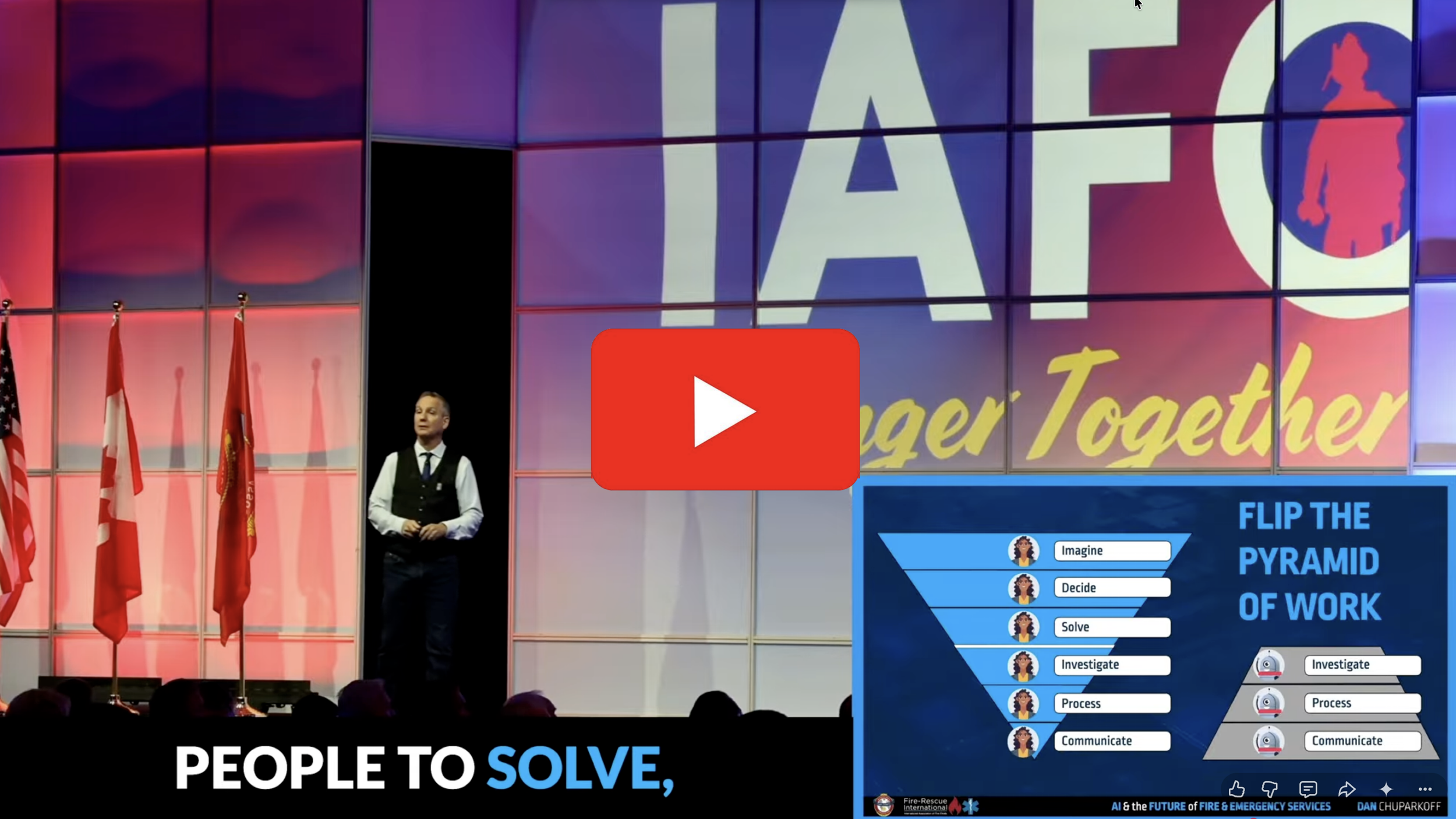
Make the bottom of the work pyramid faster. Communication, process and investigation are necessary. When they absorb the whole week, problem solving, decisions and imagination get whatever time is left.
Opportunities for packaging leaders
Try the question Dan used in Memphis:
> What are nine ways AI is going to change the work of packaging executives responsible for paper and box production while improving operations, freeing time for judgment, despite uneven technical experience and unreliable outputs?
Use the three groups from the keynote to discuss the answers with your team:
Earlier operating warnings. What would you want to notice sooner in paper or box production? What data would let you recognize that signal?
Faster leadership decisions. Where does gathering information take longer than deciding what to do? Which part could an assistant prepare?
Reviewable AI work. When a suggestion reaches a leader, what would that person need to see to judge whether to act on it?
Talk Flow
What changes when the tool gets better
The AI-generated introduction
Dan used roughly the same prompt across five versions of his opening video. Comparing results on the same task gave him a way to see what had changed.
A parking lot drawn two ways
Drawing and measuring every stripe made the value of copy and paste immediately visible. The tool sped up a task while the architect kept responsibility for the design.
The AI piñata
For leaders choosing what to try, the useful question is which application creates more value than risk or confusion.
How to judge a convincing answer
“Once upon a” and the word after “time”
The first completion was easy to anticipate. Asking for the next word produced several plausible choices. A leading answer can still leave plenty of uncertainty.
Glue on pizza
Sarcasm and expertise can appear in the same source. Check whether the advice makes sense for the job you need it to do.
Autocomplete, memories & hopes
You already overrule your phone when it suggests words you would never send. Bring that same knowledge of the situation and your intentions to decisions at work.
Where to put an assistant to work
A question for packaging executives
A prompt gets more useful when it names the work, the outcome you want and what makes that outcome difficult. Ask follow-up questions about data and guardrails.
A coach for work you already do
When AI struggled to write in Dan’s voice, he wrote the post himself and asked how it compared with his earlier posts. The comparison gave him something he could practice.
What to do with the time you recover
The work pyramid
Think about what would fill a Friday afternoon if routine work took 10% less time. Choose a problem worth solving or a decision that deserves more thought.
Meeting notes & a song
Notes let people revisit or share an idea. Turning the notes into a chorus gave the main point another way to stick: solve, decide and imagine.
A bilingual construction crew
Dan’s brother and his construction crew used translation to work together in their preferred languages. Removing a communication barrier helped people do their work together.
The future of packaging
The number of hours in the week stays fixed. Put the time you save toward the decisions and ideas that will shape the future of packaging.