
NiCE Wings 2026: AI & the Future of Customer Experience
Listen to the
AI KEYNOTE SONG
The easiest way to review or share the key points of my AI Keynote is with this song: the full keynote, matched with slides, in 4m32s!
A day in the life in YOUR AI FUTURE

PDF SUMMARY of key slides
This “Slide Cheatsheet” was customized for your specific talk. It’s designed to help audience-members like you, by wrapping my AI & the Future of Everything keynote into an easy-to-skim, easy-to-share, or easy-to-print resource for future reference.
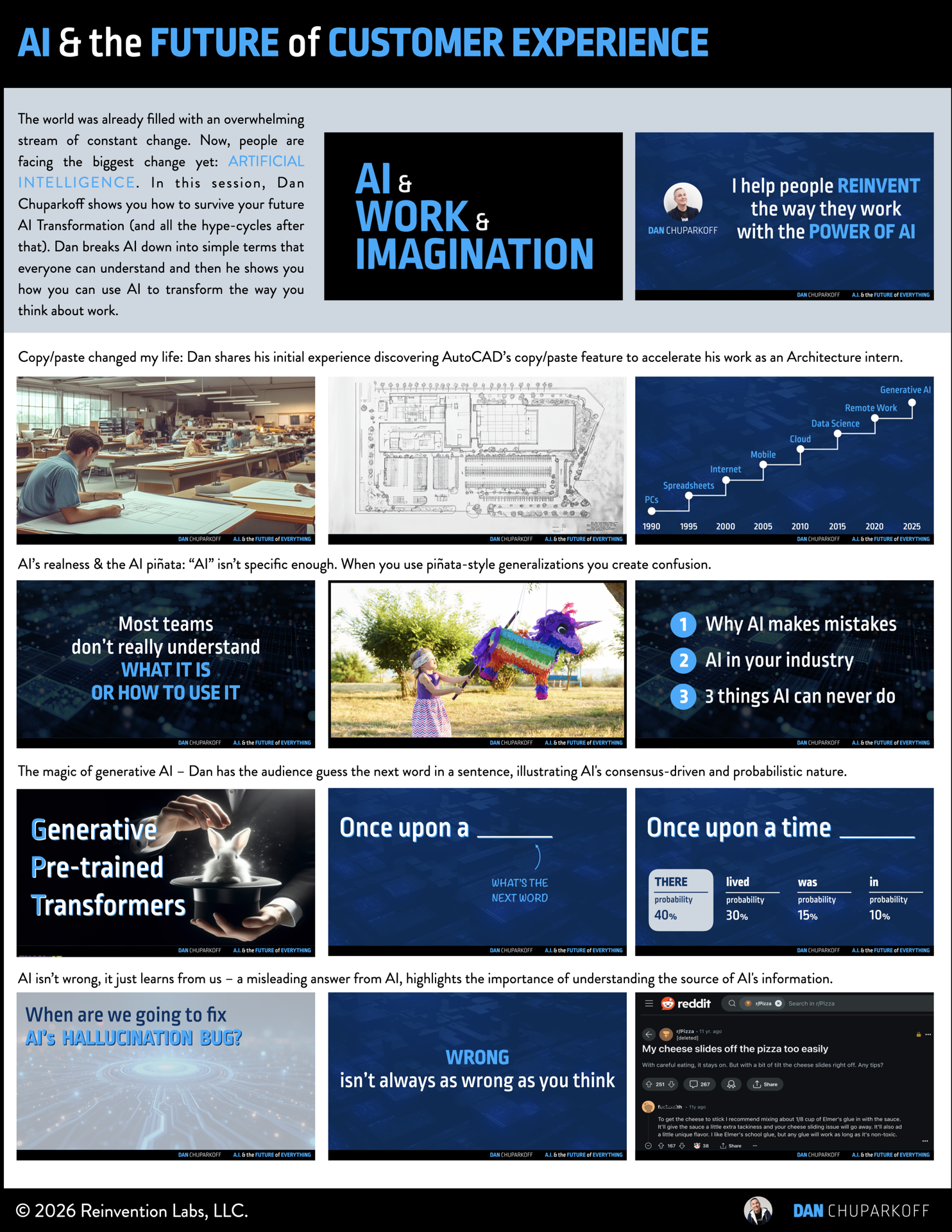
Download the 3 page
high-resolution PDF here:
Hope you find it helpful!
AI NOTES from Dan’s AI Keynote
*These notes were created using ChatGPT 5.6 pro.
Transcription errors or mistakes have not been fixed
in order to demonstrate the current state of AI notes.
One-Sentence Takeaway
Use AI to compress routine communication, process, and investigation while keeping human experts responsible for judgment, customer outcomes, and the work of solving, deciding, and imagining.
Summary
AI is becoming another foundational work tool, much like AutoCAD, spreadsheets, the internet, mobile devices, and cloud computing. The advantage does not come from asking technology to replace expertise. It comes from pairing a powerful assistant with the context, standards, memories, hopes, and accountability that people bring to the work.
Generative AI predicts likely content from patterns in its training data. That makes it broadly capable, but likely is not the same as correct. Its suggestions can reflect average thinking, missing context, outdated information, or bad advice. Treat every output as a recommendation, match the level of review to the stakes, and keep sensitive information inside approved environments.
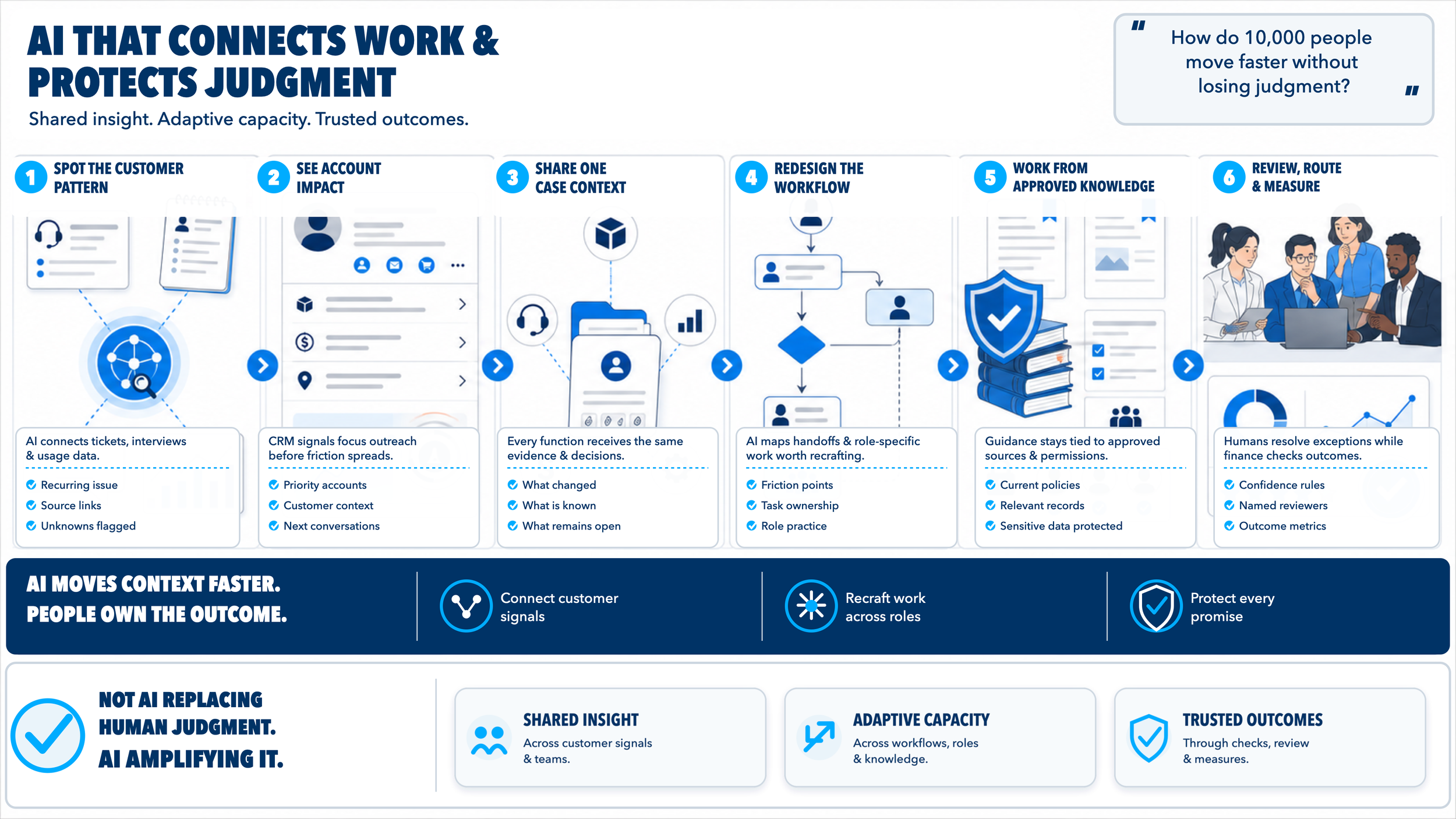
For NiCE, the opportunity extends across the whole organization and the customer experience platform work it supports. AI can help teams move from fragmented signals to shared insight, from fixed roles to adaptive capacity, and from fast automation to trusted outcomes. Those shifts can improve research, handoffs, workflow design, coaching, knowledge access, exception handling, and outcome measurement while preserving human review.
The practical path is to use AI both as a transformation consultant and as a performance coach. Let it help you rethink how your role creates value, then use it to compare and improve work you have already done. Compress the lower layers of the work pyramid so more human capacity can flow toward harder customer problems, better decisions, and a future worth building.
Action Items
[ ] Choose one recurring communication, process, or investigation task that could be improved with an approved AI assistant.
[ ] Ask AI how your specific role and service could change, including the outcomes you need and the constraints you must protect.
[ ] Treat each AI output as a recommendation, with review points that reflect the stakes, confidence, data sensitivity, and accountability involved.
[ ] After completing an important piece of work, ask AI to compare it with your prior attempts and identify how the next version could improve.
[ ] Reinvest recovered time in harder customer problems, better decisions, and new possibilities for customer experience.
Key Ideas
AI is an assistant, not an automator.
The strongest use of technology expands what experts can accomplish without transferring their judgment or responsibility to the tool.
Likely is not the same as correct.
Generative AI predicts plausible content. It does not know how much certainty a particular customer, product, or business decision requires.
Remain the A-plus expert.
Use a broadly capable AI assistant to extend your reach while continuing to deepen the expertise that makes your work distinctive.
Memories and hopes guide decisions.
People bring lived experience, goals, ethics, and situational context that cannot be fully captured in a prompt.
Use AI to make your work better.
AI can critique, compare, organize, and coach after you create, helping each repeated task improve without creating dependency.
Capacity should move upward.
Compress communication, process, and investigation work so people can spend more time solving, deciding, and imagining.
Customer Experience opportunities
From fragmented signals to shared insight
Synthesize research from tickets, interviews, and usage data.
Use predicted account signals to inform commercial outreach.
Carry summarized case context across cross-functional handoffs.
From fixed roles to adaptive capacity
Map workflows to reveal tasks worth redesigning.
Let employees rehearse decisions with role-specific AI coaches.
Generate work guidance from approved organizational knowledge.
From fast automation to trusted outcomes
Check outputs against permissions, policies, and source records.
Route exceptions through confidence rules and human review.
Compare model actions with auditable outcome measures.
Talk Flow
See AI as the next great work assistant
The quality threshold is moving
AI-supported work is becoming part of the expected baseline.
NiCE is both adapting its own work and helping customers navigate the same shift.
The AutoCAD copy-and-paste moment
A parking-lot drafting task that took days became a roughly 90-second task with AutoCAD.
The architect still supplied the intent, constraints, and responsibility.
Assistant versus automator
AutoCAD assisted architects rather than independently designing and approving schools.
AI creates the same distinction between augmenting expert work and attempting to replace expert judgment.
The AI pinata
Random experimentation does not guarantee useful outcomes or return on investment.
Teams need a clear understanding of what AI does well, where it fails, and which real work is worth improving.
Understand probability and keep humans in the loop
Once upon a time
Generative AI predicts the next likely piece of text, code, or visual content.
Consensus-driven prediction can miss unusual, expert, or genuinely creative answers.
Confidence and uncertainty
AI may present the most likely answer even when certainty is too low for the stakes.
Users and product builders should make confidence, review, and escalation part of the workflow.
Glue in the pizza
Training data contains expertise alongside mistakes, sarcasm, and deliberately bad advice.
AI output must be checked before it reaches a customer, product, or decision.
Autocomplete
People already know how to accept a useful suggestion and ignore a bad one.
A poor recommendation does not require abandoning the assistant; it requires retaining control.
Memories and hopes
Human decisions draw on lived experience, goals, ethics, and context.
AI can inform a decision, but the accountable person must still make it.
Explore NiCE's AI-enabled customer experience future
Ask a role-specific transformation question
Define the roles, service, desired outcomes, and operating constraints before asking how AI may change the work.
Use the response to begin a strategic conversation rather than treat it as a prescribed answer.
Remember the three shifts
Fragmented signals can become shared insight across teams.
Fixed roles can become adaptive capacity as workflows and skills evolve.
Fast automation can become trusted outcomes through permissions, evidence, confidence rules, and human review.
Turn the list into a day in the life
Stories and visuals make a complex transformation easier to understand and discuss.
The useful question is not whether one forecast is perfect, but what future NiCE wants to create for employees and customers.
Use AI to improve performance and reclaim capacity
AI as a performance coach
Complete important work, then compare it with your prior attempts.
Use the differences to improve the next customer call, brief, strategy, presentation, or repeated task.
The work pyramid
Communication, process, and investigation form the foundation of work.
Problem solving, decision making, and imagination are the higher-value layers where human context matters most.
Smarter organizational memory
AI-supported notes can make information easier to retrieve, share, and use across teams.
Privacy and maturity requirements should determine which tools and environments are appropriate.
Make important information memorable
Turning a core message into a song showed how AI can reshape information for recall and sharing.
The enduring refrain is that people will always be needed to solve, decide, and imagine.
Closing Message - Collaborate across boundaries in a world of more
Real-time translation
AI-supported translation is already helping people collaborate across languages.
Teams should use approved tools while preserving privacy review and the value of human language expertise.
The world of more
Systems, information, expectations, and distributed collaboration keep increasing while the hours in the week do not.
Continuing to handle every lower-layer task manually widens the gap between expectations and capacity.
Solve, decide, and imagine
Compress routine information work without weakening communication, trust, or customer experience.
Reinvest the time in harder customer problems, better-informed decisions, and the future of CX platform development and services.