
Avidex Spring 2026: AI & the Future of AV Solutions Services
Hello my new Avidex friends, colleagues, & partners!
AI took notes for me as I presented my AI & the Future of AV Solutions Services keynote. Then, AI turned those notes into a song and here it is! Your specific AI notes and the key slides are also here. Feel free to share any of these materials.
On this page, you will find:
– the custom AI GENERATED SONG based on the AI keynote (it’s actually good!)
– the AI NOTES from your session transcribed by Otter.ai
– a downloadable PDF SUMMARY of the most important slides
Please let me know how I can be helpful in the future!
Dan

Dan Chuparkoff
A.I. & Innovation Keynote Speaker
CEO, Reinvention Labs
Former Technology Leader from
Google, McKinsey, & Atlassian
Listen to the
AI KEYNOTE SONG
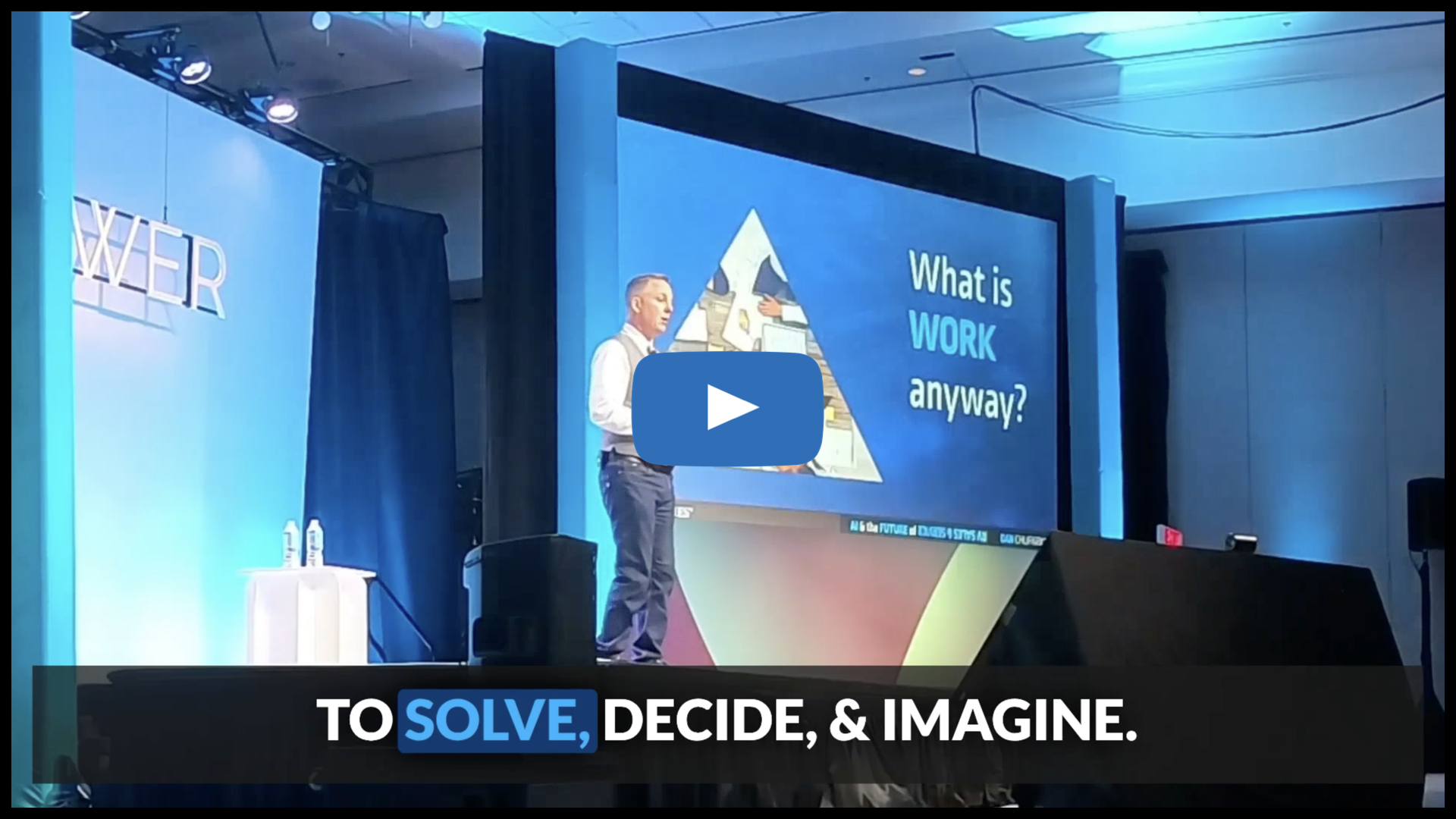
The easiest way to review or share the key points of my AI Keynote is with this song: the full keynote, matched with slides, in 4m32s!

PDF SUMMARY of key slides
This “Slide Cheatsheet” was customized for your specific talk. It’s designed to help audience-members like you, by wrapping my AI & the Future of Everything keynote into an easy-to-skim, easy-to-share, or easy-to-print resource for future reference.
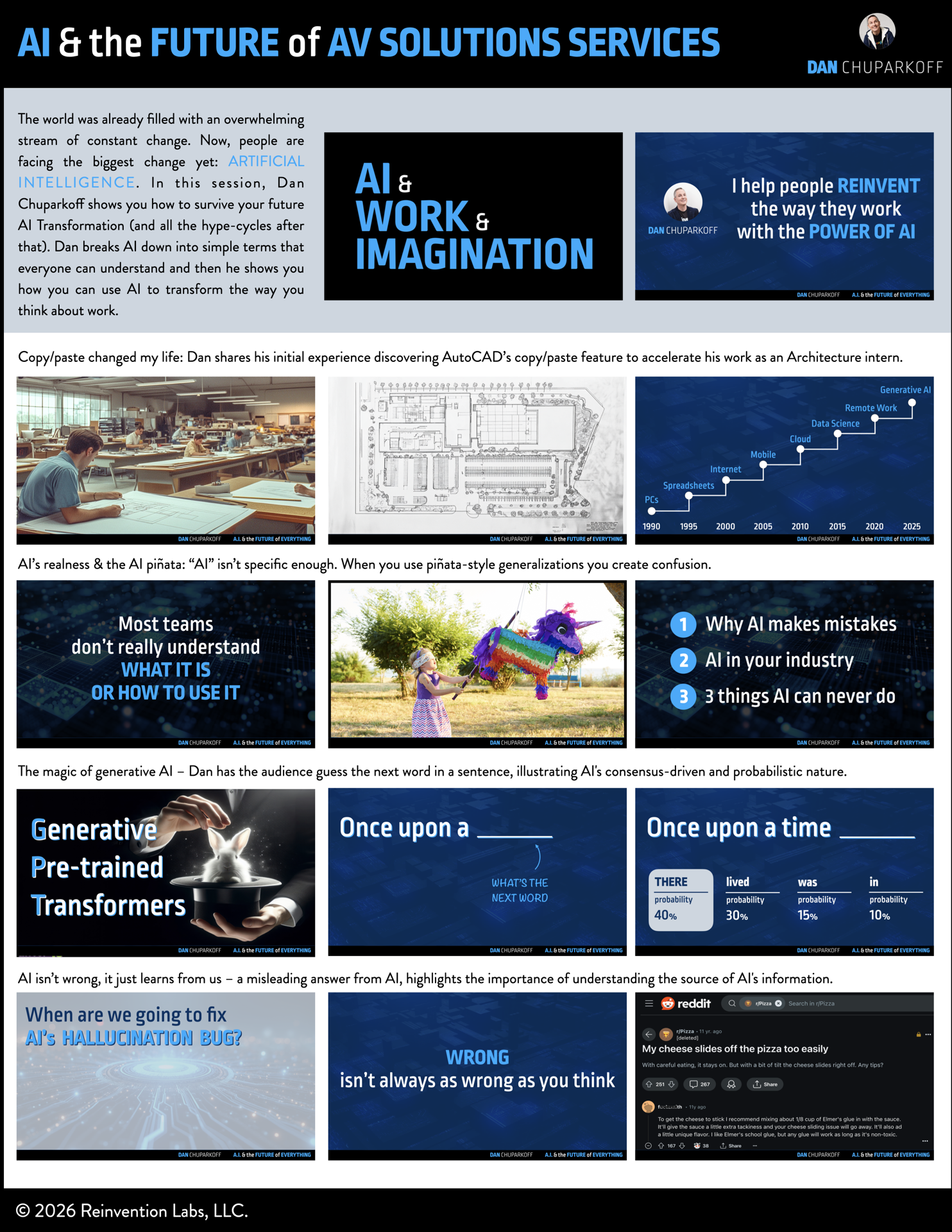
Download a 3 page
high-resolution PDF here:
Hope you find it helpful!
AI NOTES from Dan’s AI Keynote
*These notes were created automatically by Otter.ai. Transcription errors or mistakes have not been fixed
in order to demonstrate the current state of AI notes.
Summary
Dan Chuparkoff discussed the transformative impact of AI on various industries, emphasizing its role as an assistant rather than an automator. He highlighted AI's current limitations, such as its reliance on pre-trained data and its inability to replace human expertise in problem-solving and decision-making. Chuparkoff outlined how AI can enhance efficiency in tasks like meeting notes, translation, and decision support, but stressed the importance of human oversight. He also introduced the concept of AI as a co-pilot, likening it to an intern that requires guidance and review. Finally, he underscored the need for continuous adaptation to AI's evolving capabilities.
Action Items
[ ] Review the notes from Otter and the Solve, Decide, & Imagine keynote song after the session
[ ] Review the slides sent after scanning the QR code.
[ ] Type the prompt: ‘What are 10 ways that AI is changing my industry…?‘ so that you can stay informed about the transformations in your work.
[ ] Try the prompt: 'I am a [job title]; every Monday, give me one new AI thing I should try' so attendees can set up a weekly AI tip feed
Outline
Introduction to Dan Chuparkoff and AI's Current State
Speaker 1 introduces Dan Chuparkoff, highlighting his extensive experience in technology and his role in helping leaders see the future.
Dan Chuparkoff begins by showing an AI-generated video, noting the progress in AI-generated content from rough to almost indistinguishable from human-made content.
Dan emphasizes the transformative impact of AI on various aspects of life, including information management and professional growth.
He mentions the rapid changes AI will bring, suggesting that future lists of tasks will look very different from present ones.
Dan's Personal Journey and Early AI Experience
Dan shares his personal journey from a troubled childhood in Tampa, Florida, to becoming a leader at Google, highlighting the pivotal moment in his life when he discovered AutoCAD.
He describes his first job in the architecture and engineering division, where he learned to draw parking lot lines, and the transformative impact of AutoCAD on his productivity.
Dan explains the difference between an assistant and an automator, using AutoCAD as an example, and stresses the importance of understanding this distinction in the context of AI.
He reflects on how each technological advancement, from PCs to spreadsheets, has changed the way we store and manage information.
The Evolution of Technology and AI's Role
Dan discusses the evolution of technology, from the introduction of PCs to the rise of the internet, mobile, cloud, data science, and remote work.
He compares AI to previous technological advancements, suggesting that AI will become as ingrained in daily life as previous technologies.
Dan emphasizes the importance of understanding AI's capabilities and limitations, noting that AI is currently in a phase similar to the early days of AutoCAD.
He highlights the need for leaders to navigate the AI landscape, understanding both its potential and its limitations.
Understanding AI's Capabilities and Limitations
Dan explains the concept of GPT (Generative Pre-trained Transformer), emphasizing that it is a probability content creator, not a search engine.
He discusses the limitations of AI due to its pre-trained data cutoff, suggesting that users should adjust their questions accordingly.
Dan demonstrates how AI works by asking the audience to predict the next word in a sentence, illustrating AI's consensus-driven nature and its limitations in making decisions.
He advises users to ask AI for its confidence level and to verify the information it provides, emphasizing the importance of human expertise in decision-making.
AI's Impact on Various Industries
Dan outlines the ways AI will change the work of sellers, design engineers, programmers, and leaders in the AV industry, focusing on accelerating proposals, reducing reinvention, and improving programming.
He suggests using AI to ground product choices with historical data, generate proposal packages from customer notes, and generate control code from standard-based AV requirements.
Dan emphasizes the importance of using AI to compare options with cost, complexity, and margin models, and to create reusable room templates.
He highlights the need for AI to summarize client needs from kickoff calls and provide vendor market signals to influence seller strategy.
AI as a Co-Pilot and the Importance of Human Expertise
Dan compares AI to an intern, suggesting that users should provide instructions, review the work, and iterate until the AI's capabilities are understood.
He emphasizes that AI will never replace human expertise, memories, and hopes, and that users should always retain control over the final decisions.
Dan discusses the importance of understanding AI's knowledge gaps and the need for human oversight in AI-driven operations.
He advises users to think of AI as an assistant that helps with structure and polish, while retaining their expertise in the middle.
The Future of Communication and Collaboration with AI
Dan highlights the potential of AI to revolutionize communication and collaboration, making it possible for people to work in their native languages.
He demonstrates real-time translation with lip sync and gesture matching using Hey Gen, and mentions Apple's new AirPods 4 for real-time translation.
Dan suggests that AI will make language a toggle on devices, allowing people to switch between languages instantly.
He emphasizes the profound implications of this technology on collaboration and information equity, particularly in the context of AV solutions.
AI's Role in Efficiency and Problem-Solving
Dan discusses the importance of AI in making communication more efficient, using meeting notes as an example.
He highlights the potential of AI to create meeting agendas, interrupt repetitive discussions, and ensure that subject matter experts are involved.
Dan suggests that AI will help teams become more efficient by managing language and providing the right words at the right time.
He emphasizes the need for users to focus on the bottom layer of work, where AI can provide significant efficiency gains, while retaining human expertise for problem-solving and decision-making.
The Importance of Human Expertise in Decision-Making
Dan reiterates that AI will never replace human expertise in problem-solving, decision-making, and imagining new solutions.
He advises users to focus on the bottom layer of work, where AI can provide significant efficiency gains, while retaining human expertise for higher-level tasks.
Dan emphasizes the importance of human expertise in making decisions with the right information at the right time.
He suggests that AI will help teams become more efficient by managing language and providing the right words at the right time, while retaining human expertise for higher-level tasks.
Conclusion and Call to Action
Dan concludes by emphasizing the importance of understanding AI's capabilities and limitations, and the need for human expertise in problem-solving, decision-making, and imagining new solutions.
He advises users to focus on the bottom layer of work, where AI can provide significant efficiency gains, while retaining human expertise for higher-level tasks.
Dan highlights the potential of AI to revolutionize communication and collaboration, making it possible for people to work in their native languages.
He encourages users to embrace AI as a tool to help them become more efficient and effective in their work, while retaining human expertise for the most critical tasks.