
3M Product Expo 2026: AI & the Future of Science Product Collaboration
Hello my new 3M friends, colleagues, & partners!
AI took notes for me as I presented my AI & the Future of Science Product Collaboration keynote. Then, AI turned those notes into a song and here it is! Your specific AI notes and the key slides are also here. Feel free to share any of these materials.
On this page, you will find:
– the custom AI GENERATED SONG based on the AI keynote (it’s actually good!)
– the AI NOTES from your session transcribed by Otter.ai
– a downloadable PDF SUMMARY of the most important slides
Please let me know how I can be helpful in the future!
Dan

Dan Chuparkoff
A.I. & Innovation Keynote Speaker
CEO, Reinvention Labs
Former Technology Leader from
Google, McKinsey, & Atlassian
Listen to the
AI KEYNOTE SONG
The easiest way to review or share the key points of my AI Keynote is with this song: the full keynote, matched with slides, in 4m32s!

PDF SUMMARY of key slides
This “Slide Cheatsheet” was customized for your specific talk. It’s designed to help audience-members like you, by wrapping my AI & the Future of Everything keynote into an easy-to-skim, easy-to-share, or easy-to-print resource for future reference.
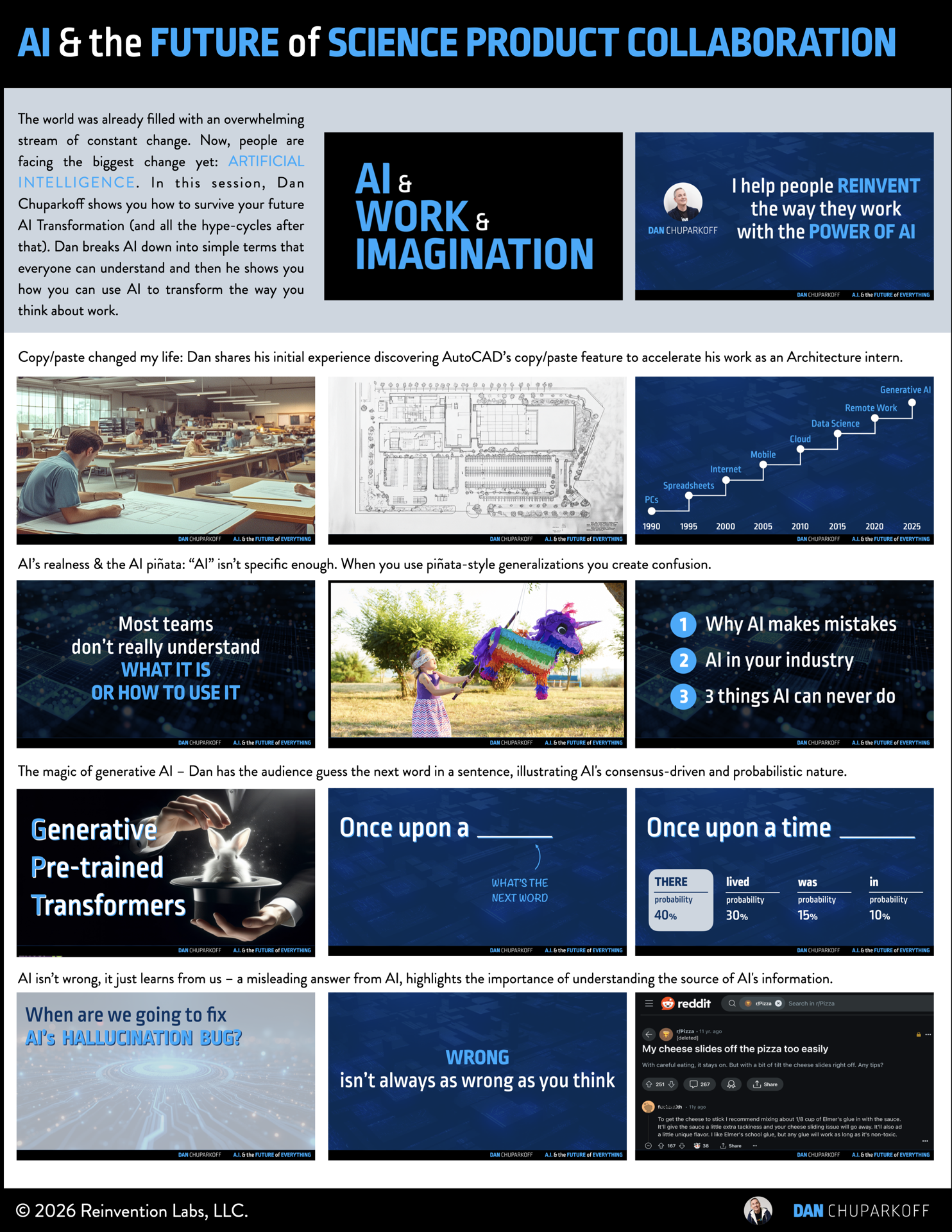
Download a 3 page
high-resolution PDF here:
Hope you find it helpful!
AI NOTES from Dan’s AI Keynote
*These notes were created using GPT 5.5 pro.
Transcription errors or mistakes have not been fixed
in order to demonstrate the current state of AI notes.
One-Sentence Takeaway
Use AI to shrink the routine work around communication, process, and investigation so 3M people can spend more time solving, deciding, and imagining the next generation of science, products, and customer value.
Summary
Dan Chuparkoff explained AI as the next major technology shift in a long pattern of work-changing tools, comparing today's AI moment to his first encounter with AutoCAD and copy-paste as a teenage drafting assistant. The core lesson was that the most useful technology does not replace expert judgment. It helps people work at a lower level of effort so they can create more value with the time, knowledge, and judgment they already have.
For the 3M audience, Dan framed AI as a practical assistant for science, product collaboration, customer solutions, communication, and workflow capacity. He emphasized that AI can produce useful drafts, summaries, translations, analysis, and ideas, but it still makes mistakes because it predicts likely answers rather than truly knowing the world. That means people remain responsible for review, validation, context, and decisions.
The keynote connected AI to 3M's real work: making technical knowledge more accessible, helping people share product expertise across teams, translating complex ideas for broader audiences, supporting customer-answer loops, identifying workload risks, and reducing administrative friction through secure workflow agents. Dan closed by arguing that AI should help shrink routine communication, process, and investigation work so people have more time to solve hard problems, make better decisions, and imagine better futures.
Action Items
[ ] Try the industry prompt: `What are 9 ways AI will change the work of manufacturing and material science teams responsible for product innovation, customer solutions, safety, and collaboration?`
[ ] Pick one routine communication, workflow, or investigation task from your week and test how an approved AI assistant could help you do the first draft, summary, comparison, or synthesis.
[ ] Treat AI output like work from an intern: give clear instructions, review the output, correct mistakes, and improve the next prompt.
[ ] Use approved 3M tools and security guidance when asking AI to work with company information.
[ ] Look for one place where AI could make technical knowledge easier for another team, customer, or stakeholder to understand.
Key Ideas
AI is an assistant, not an automator
The AutoCAD copy-paste story showed that technology can dramatically improve productivity without eliminating the need for human expertise. AI should be understood the same way: it helps people do more valuable work, but people still guide the work.
AI is generative, not search
GPT systems generate likely answers from prior training and patterns. They can be useful, but they can also blend facts, miss current context, or sound confident when they are wrong. That is why review matters.
The average answer is not always the right answer
AI often gives the middle-of-the-bell-curve answer. That can be helpful when you need a starting point in an unfamiliar area, but 3M's most important work depends on expert judgment, specialized context, and careful validation.
Private and approved AI tools matter
Because 3M works with proprietary knowledge, customer information, product science, and internal workflows, the right question is not just what AI can do. It is where AI can safely and appropriately be used.
AI can make expertise more accessible
AI can help translate jargon, summarize technical material, build reusable knowledge, and help non-experts understand complex product and science concepts faster.
Human work moves upward
AI is strongest in communication, workflow support, and investigation. Humans remain essential for solving new problems, making decisions with judgment and values, and imagining futures that do not exist yet.
3M-Specific AI Opportunities
MAP PRODUCT KNOWLEDGE across labs, lines & teams
Teams query PRIVATE AI NAVIGATOR for safe drafts
Capture expert judgment as REUSABLE DESIGN MEMORY
SURFACE EXPERTISE GAPS before customer demos
Translate technical acronyms into ACCESSIBLE EXPO STORIES
Turn chatbots into CUSTOMER ANSWER LOOPS
PREDICT WORKLOAD RISKS during transformation waves
Engineers test concepts with MATERIAL SIMULATION COPILOTS
Reduce admin work with SECURE WORKFLOW AGENTS
Talk Flow
AI Generated Opening
Dan opened with an AI-generated video to show how quickly AI content quality is improving. The point was not that AI is perfect, but that the threshold is changing: work created without AI help may soon feel slower, rougher, or less complete than work improved with AI assistance.
The AutoCAD Copy-Paste Moment
Dan told the story of drawing parking-lot lines by hand as a teenager before seeing AutoCAD copy and paste a precise line in seconds. That experience changed how he saw technology. The lesson was that great tools do not have to replace people to be transformative. They can remove tedious work and expand what people can accomplish.
Assistant Versus Automator
AutoCAD did not become an architect. It became an architect's assistant. Dan argued that AI should be viewed the same way. It can help people draft, summarize, compare, translate, and investigate, but it still needs human instruction, review, and judgment.
Why AI Makes Mistakes
Dan explained that AI predicts likely words and patterns. It is not a truth machine and it is not the same as search. Because it is trained on past information and produces probable answers, it can make confident mistakes. The right response is not to ignore AI, but to build workflows that include verification.
AI for 3M Work
Dan connected AI to 3M's context by showing how it could support product knowledge, material science collaboration, customer support, technical explanation, expert knowledge reuse, workload risk detection, and secure workflow assistance. The opportunity is not generic AI use. It is using AI to make 3M's science, product, and customer knowledge easier to find, explain, and apply.
AI as an Intern
Dan recommended thinking of AI as an intern rather than a copilot. You give it instructions, review its work, correct it, and learn what it can and cannot handle. The better you get at giving instructions and reviewing output, the more useful the assistant becomes.
The Work Pyramid
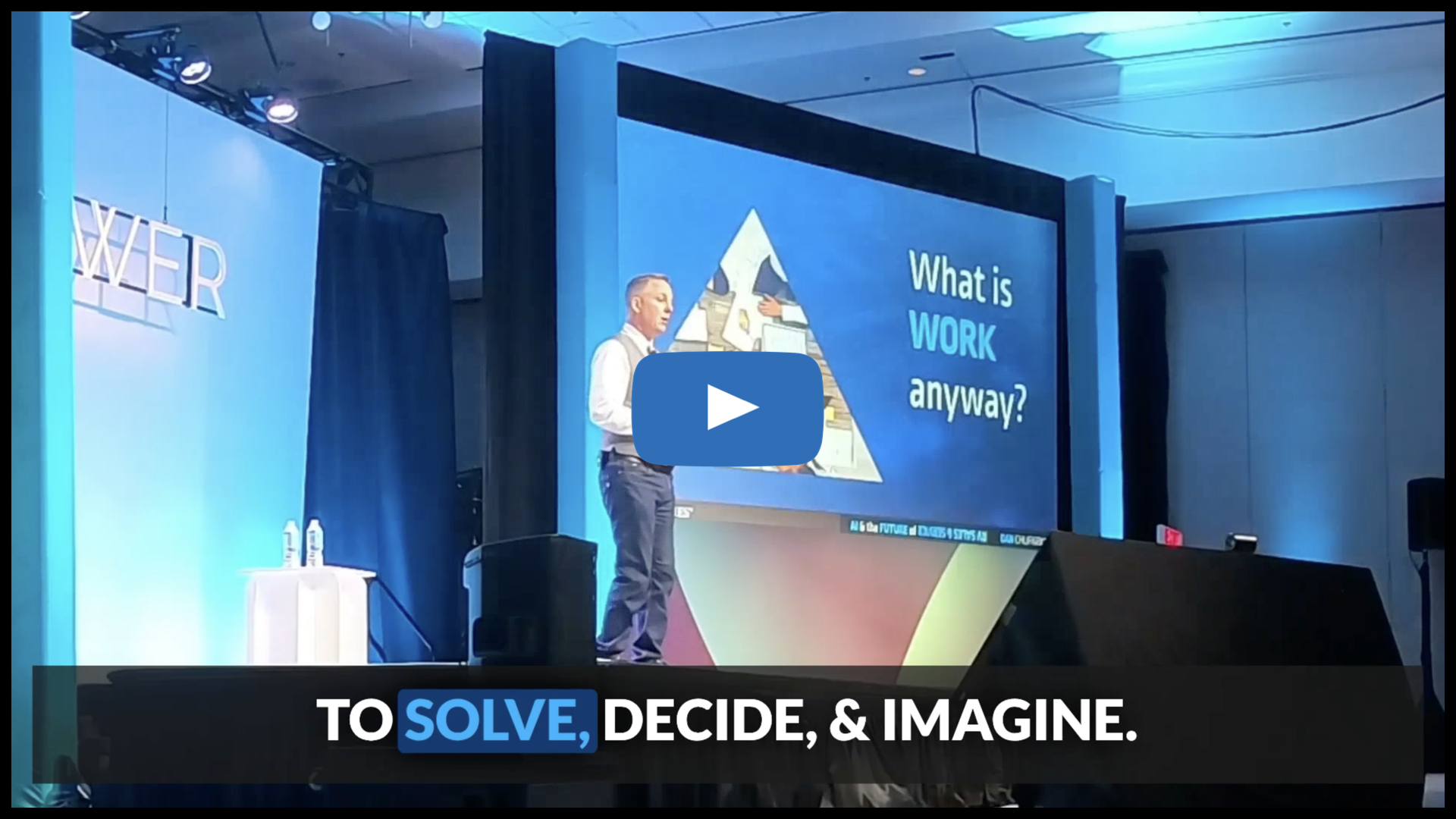
Dan described six kinds of work: communication, workflows, investigation, problem solving, decision making, and imagining. AI is most useful at the bottom of the pyramid, where people spend too much time talking, processing, searching, summarizing, and coordinating. If AI helps shrink that work, people can spend more time solving, deciding, and imagining.
Collaboration, Notes, and Translation
Dan showed how AI can change collaboration through better meeting notes, smarter meeting facilitation, new ways to share information, and real-time translation. These tools can help people collaborate across teams, languages, regions, and disciplines with less friction.
Closing Message
Dan closed by reminding the audience that the amount of work will keep growing, but the number of hours in a week will not. AI should be used to reduce routine work and create more capacity for the work only people can do: solve hard problems, make judgment-based decisions, and imagine better ways forward.