
Unum Aspire 2026: AI & the Future of Insurance
Hello my new Unum friends!
AI took notes for me as I presented my AI & the Future of Insurance keynote. Then, AI turned those notes into a song and here it is! Your specific AI notes and the key slides are also here. Feel free to share any of these materials.
On this page, you will find:
– the custom AI GENERATED SONG based on the AI keynote (it’s actually good!)
– the AI NOTES from your session transcribed by Otter.ai
– a downloadable PDF SUMMARY of the most important slides
Please let me know how I can be helpful in the future!
Dan
Dan Chuparkoff
A.I. & Innovation Keynote Speaker
CEO, Reinvention Labs
Former Technology Leader from
Google, McKinsey, & Atlassian
Listen to the
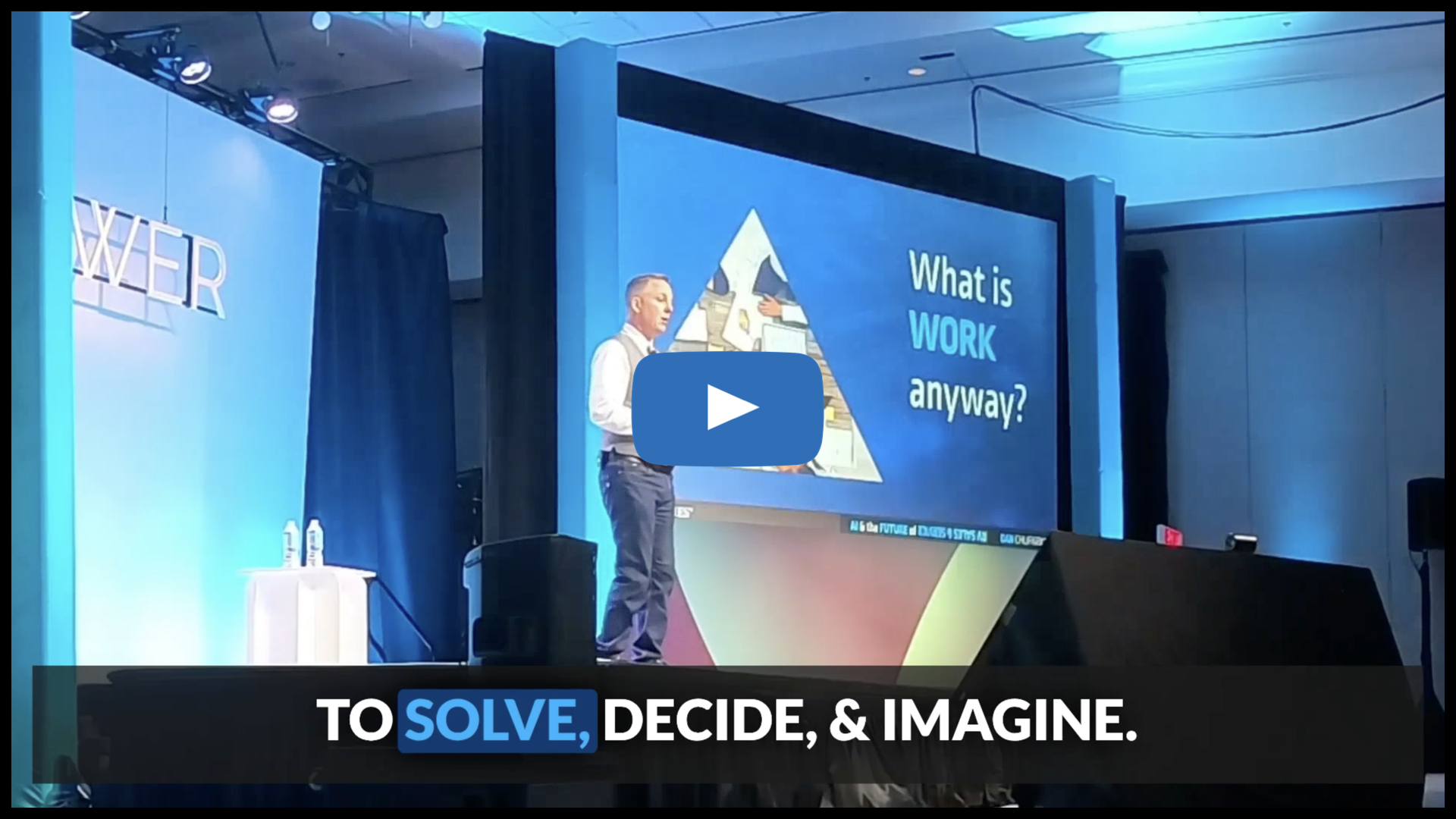
AI KEYNOTE SONG
The easiest way to review or share the key points of my AI Keynote is with this song: the full keynote, matched with slides, in 4m32s!

PDF SUMMARY of key slides
This “Slide Cheatsheet” was customized for your specific talk. It’s designed to help audience-members like you, by wrapping my AI & the Future of Everything keynote into an easy-to-skim, easy-to-share, or easy-to-print resource for future reference.
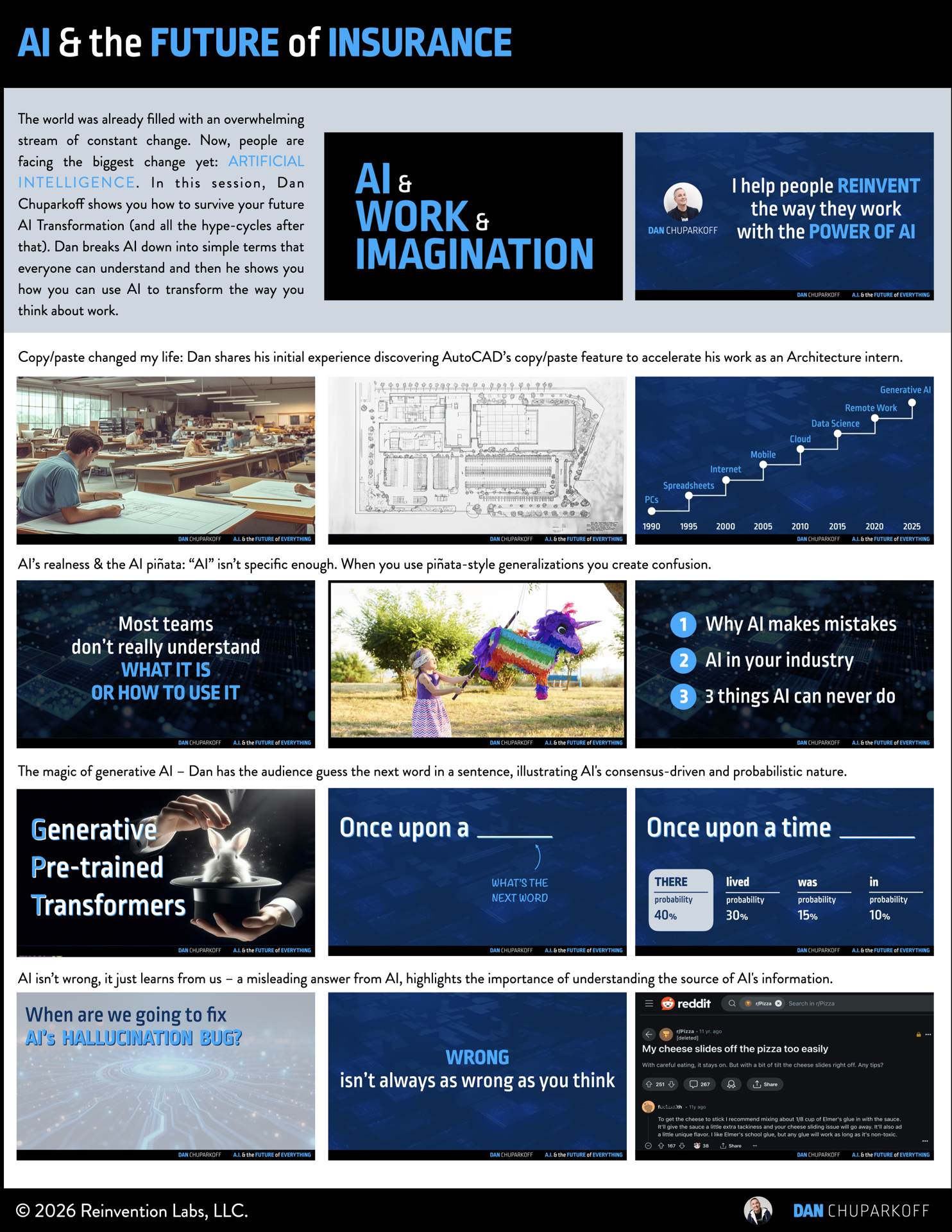
Download a 3 page
high-resolution PDF here:
Hope you find it helpful!
AI NOTES from Dan’s AI Keynote
*These notes were created using GPT 5.5 pro.
Transcription errors or mistakes have not been fixed
in order to demonstrate the current state of AI notes.
One-Sentence Takeaway
Use AI as an assistant for the routine work around communication, process, and investigation so Unum people can spend more time solving problems, making judgment-based decisions, and imagining better ways to serve customers.
Summary
Dan Chuparkoff framed AI as the next major tool in a long history of technology changing how work gets done. He compared today's AI moment to seeing AutoCAD copy and paste a precise parking-lot line in 1987: once a tool makes work dramatically easier, it becomes hard to return to the old manual way. The lesson was not that technology replaces experts. It gives experts leverage.
For the Unum audience, Dan explained that AI is useful because it can draft, summarize, compare, translate, organize, and suggest. But he also emphasized that AI is not search, not certainty, and not judgment. It generates likely answers based on patterns, which means it can be useful and wrong at the same time. People still need to ask where answers came from, test confidence, challenge weak suggestions, and make the final decisions.
The keynote connected AI to insurance and financial-services work: mapping customer friction, summarizing claim context, recommending next actions, spotting workload spikes, using change-readiness cues, reducing status work, improving governed knowledge, turning handoffs into value-stream signals, and sensing routine risk earlier. Dan closed by arguing that AI should shrink the bottom of the work pyramid so people have more room for the work only people can do well: solve, decide, and imagine.
Action Items
[ ] Try the industry prompt: `What are 9 ways AI is going to change the work of insurance top performers, managers, executives responsible for operations, claims, underwriting, HR and improvement under change and burnout and service quality pressure?`
[ ] Pick one routine communication, workflow, or investigation task from your week and ask an approved AI assistant to help with a draft, summary, comparison, or synthesis.
[ ] Before relying on an AI answer, ask: `How sure are you? Where did that information come from? What decisions did you make that I might disagree with?`
[ ] Treat AI like an intern: give clear instructions, review the work, correct mistakes, and learn where its capability ceiling is.
[ ] Look for one place where AI could help you serve customers better without handing away human judgment.
Key Ideas
AI is an assistant, not an automator.
The AutoCAD story showed that a tool can change productivity without replacing the expert. AI should be used the same way: to help people do better work, not to remove people from the work.
AI predicts likely answers.
GPT systems generate probable responses from training patterns. That makes them powerful for drafts, summaries, and starting points, but it also means their answers need human review.
The confidence table matters.
AI may sound certain even when the underlying confidence is weak. Ask how sure it is, what sources it used, and where its assumptions may be fragile.
Bad source material creates bad AI output.
The pizza-glue example showed that AI learns from a messy internet filled with jokes, sarcasm, errors, and mixed levels of expertise. Verification is part of the work.
Human judgment comes from memories and hopes.
AI can process patterns, but people bring lived experience, context, values, goals, and the future they are trying to build. That is why disagreement with AI is useful.
AI should create capacity for higher-value work.
AI is strongest in communication, workflow support, and investigation. When those layers get easier, people can spend more time solving problems, making decisions, and imagining better services.
Unum-Specific AI Opportunities
MAP CUSTOMER FRICTION across claims & service journeys
SURFACE NEXT ACTIONS during complex claim decisions
Summarize calls into CLAIM CONTEXT
PREDICT WORKLOAD SPIKES before burnout spreads
Managers use CHANGE READINESS CUES during coaching
Create strategy time by AUTOMATING STATUS WORK
Teams ask GOVERNED KNOWLEDGE before customer replies
Turn handoffs into VALUE STREAM SIGNALS
Route routine cases by RISK SENSING
Talk Flow
AI Generated Opening
Dan opened by showing the current quality of AI-generated content. The point was that the threshold is shifting: work created without AI help may start to feel slower or rougher than work improved by an AI assistant.
The AutoCAD Copy-Paste Moment
Dan told the story of drawing parking-lot lines by hand as a teenager, then watching AutoCAD copy and paste a precise line in seconds. That moment showed him how technology can remove tedious work and make expert output dramatically faster.
Assistant Versus Automator
AutoCAD did not become an architect. It became an architect's assistant. Dan used that distinction to explain AI: the most useful posture is not to hand over the work, but to use AI to make people better at the work.
Why AI Makes Mistakes
Dan explained that GPT systems are generative and pre-trained. They are not search engines and they are not certainty machines. They predict likely answers, which means people need to inspect confidence, check sources, and challenge output when it does not fit.
The Pizza-Glue Lesson
The pizza example showed how AI can pick up bad information from the internet because the internet contains jokes, sarcasm, experts, novices, and mistakes all mixed together. The practical lesson is to stay alert for confident nonsense.
Memories, Hopes, and Judgment
Dan argued that intelligence alone does not drive action. People make decisions based on memories, hopes, values, customer context, and what they want to create or avoid. AI can inform decisions, but people remain responsible for judgment.
AI for Insurance Work
Dan connected AI to Unum's work by showing how it can support claims, operations, underwriting, HR, service quality, coaching, workload management, governed knowledge, handoffs, and risk sensing. The opportunity is to use AI for better service and better capacity, not generic tool adoption.
AI as an Intern
Dan recommended thinking of AI as an intern rather than a copilot. You assign work, review the output, give better instructions, and learn what it can and cannot handle. That loop is where AI becomes useful.
The Work Pyramid
Dan described six kinds of work: communication, process, investigation, problem solving, decision making, and imagining. AI is strongest at the bottom of the pyramid. If it helps shrink routine communication, workflow, and investigation, people can spend more time on the higher-value layers.
Collaboration, Notes, and Translation
Dan showed how AI can change collaboration through meeting notes, smarter summaries, AI-generated recap songs, and real-time translation. These tools can make information easier to share across teams, languages, and customer groups.
Closing Message
Dan closed by naming the pressure of a world with more customer expectations, more systems, more tasks, and the same number of hours in the week. His recommendation was to use AI to create capacity for the human work of solving, deciding, and imagining a better future for insurance.