
ASSP Safety 2026: AI & the Future of Safety
Listen to the
AI KEYNOTE SONG
The easiest way to review or share the key points of my AI Keynote is with this song: the full keynote, matched with slides, in 4m32s!

PDF SUMMARY of key slides
This “Slide Cheatsheet” was customized for your specific talk. It’s designed to help audience-members like you, by wrapping my AI & the Future of Everything keynote into an easy-to-skim, easy-to-share, or easy-to-print resource for future reference.
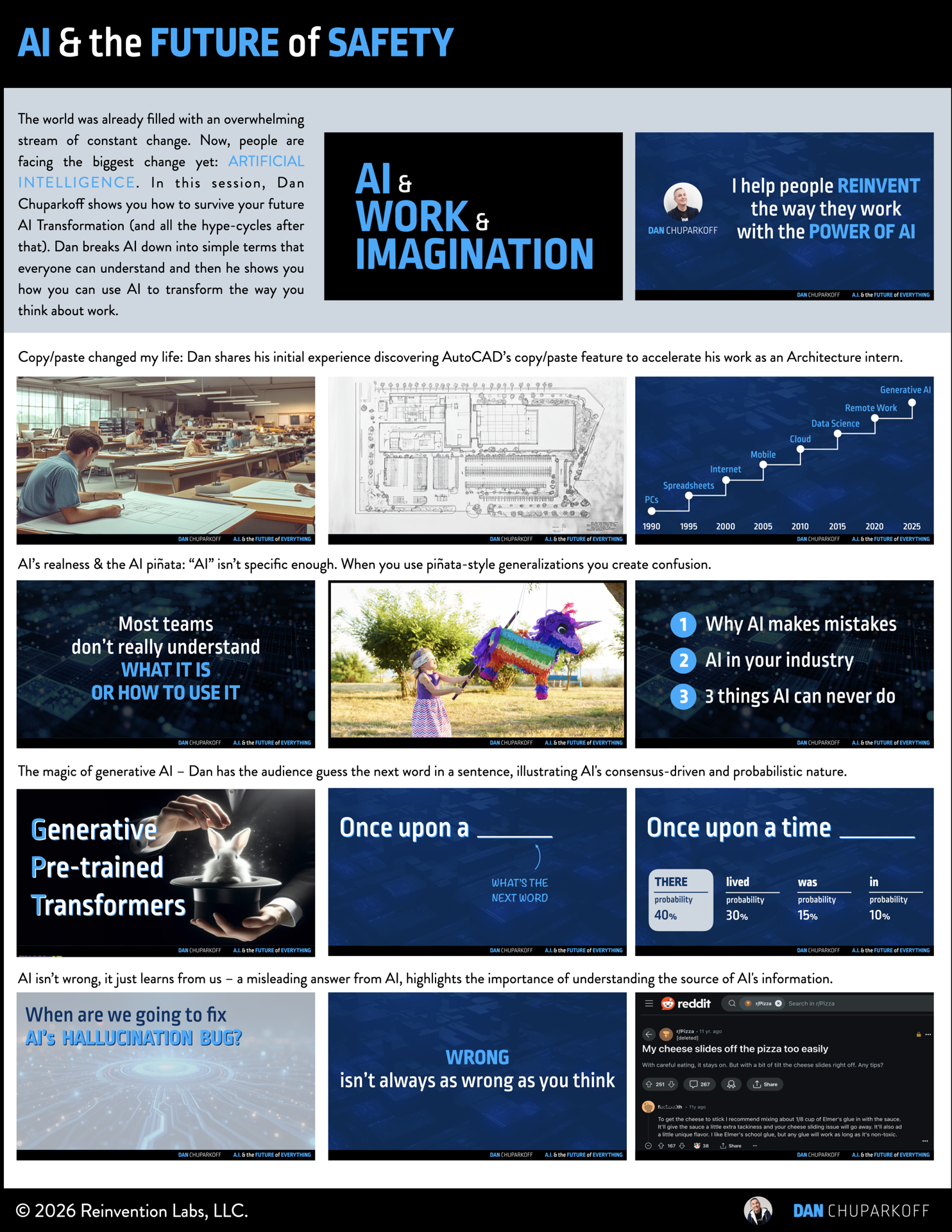
Download the 3 page
high-resolution PDF here:
Hope you find it helpful!
AI NOTES from Dan’s AI Keynote
*These notes were created using GPT 5.5 pro.
Transcription errors or mistakes have not been fixed
in order to demonstrate the current state of AI notes.
One-Sentence Takeaway
AI is most useful for safety professionals when it compresses repeatable communication, workflow, and investigation work so humans have more time to solve problems, make decisions, and imagine safer ways to work.
Summary
Dan Chuparkoff opened the keynote by framing AI as the next major technology shift in a long line of work-changing tools. His early AutoCAD story showed the difference between a tool that replaces work and a tool that assists experts. AutoCAD did not become an architect. It helped architects work faster and at a finer level of detail. Dan used that lesson to frame AI as an assistant, not an automator.
He then explained how generative AI works in plain language: it predicts the next probable word based on patterns it learned from prior information. That makes AI powerful, but also imperfect. It can sound confident when it is uncertain, repeat average internet consensus, and miss context that only the human user has. The practical response is not to avoid AI entirely. It is to ask better questions, check confidence, look for source grounding, and keep human judgment in the loop.
For safety professionals, Dan connected AI to the work of reducing recurring hazards, making trusted standards easier to access, and moving from reactive compliance toward proactive prevention. He showed how AI can help with live hazard insight, grounded standards answers, near-miss patterns, task-specific warnings, toolbox talks, and retraining signals. The larger point was that safety leaders should use AI to make trusted knowledge more available at the moment it matters.
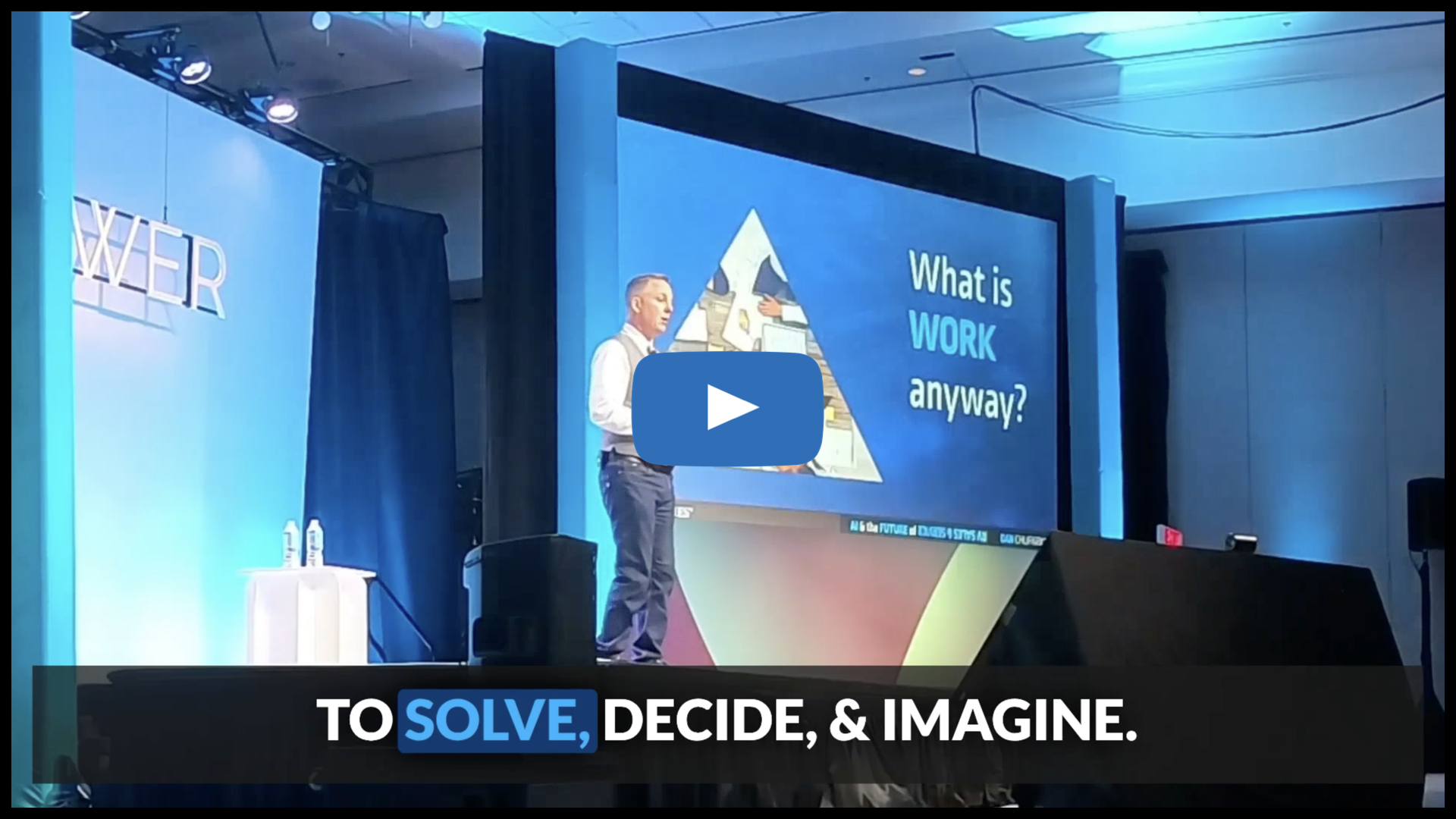
The keynote closed with the work pyramid: communication, process, and investigation sit at the bottom, while problem solving, decision making, and imagination sit at the top. AI is strongest at the bottom of that pyramid. The opportunity is to let AI reduce the lower-level load so safety professionals can spend more time on the uniquely human work that protects people.
Action Items
[ ] Ask your preferred AI assistant: "What are nine ways AI will change the work of safety leaders responsible for workplace safety and injury prevention in occupational safety and health?"
[ ] Pick one recurring safety communication, report, meeting summary, training outline, or incident write-up and ask AI to improve it, not replace your judgment.
[ ] When AI gives an answer, ask: "How sure are you? What source did you use? What assumptions did you make? What would a safety expert need to verify?"
[ ] Identify one workstream where trusted standards or procedures are hard to access at the moment of work, then design a small pilot for source-grounded AI assistance.
[ ] Review your own work pyramid. Look for communication, process, and investigation tasks that AI could compress so you can spend more time solving, deciding, and imagining.
Key Ideas
AI is an assistant, not an automator.
The AutoCAD story showed the core distinction. New technology can create massive efficiency gains without removing the need for human expertise. AI should help safety professionals work better, not take over safety judgment.
AI predicts probable answers.
Generative AI works one word at a time, based on patterns and probability. That is why it can be useful, but also why it can be wrong, average, overconfident, or missing context.
You have an information advantage.
AI does not know the hallway conversation, the jobsite culture, the history of a team, the risk tolerance of a leader, or the experience that shaped your judgment. Humans bring memory, hope, ethics, and local context to decisions.
Treat AI like an intern.
Give it instructions, review its work, improve the instructions, and keep going until you understand its capability ceiling. Do not hand off responsibility to the tool.
Use AI to improve your work, not only to produce work.
Dan described using AI to evaluate calls, presentations, and work products against clear criteria. That turns AI into a feedback engine that helps people get better, not just faster.
Safety needs trusted answers at the moment of work.
The safety opportunity is not generic AI advice. It is making validated standards, patterns, warnings, and prevention signals available when people can still act on them.
Flip the work pyramid.
Most people spend too much time on communication, process, and investigation, leaving too little time for problem solving, decision making, and imagination. AI can help reverse that balance.
Opportunities for Safety Professionals
Move from annual compliance oversight to live hazard insight by using AI to spot repeat hazards, connect jobsite risk to grounded standards, and turn near misses into prevention signals.
Move from buried standards to instant guidance by making trusted safety standards easier to ask, search, translate, and apply in context.
Move from inspection snapshots to continuous prevention by using AI-supported checks, incident trend summaries, toolbox talk drafts, and retraining triggers.
Use AI for first drafts, summaries, planning, workflow diagrams, inbox triage, and translation, while keeping safety professionals responsible for verification and action.
Build pilots around reliable source material, guardrails, and review habits before applying AI to higher-risk safety workflows.
Talk Flow
AI-generated content is crossing a threshold
Dan opened with AI-generated video to show that AI content is becoming harder to identify. He used that moment to make the shift feel immediate: AI is not a distant future topic. It is already changing the way people make, review, and share information.
The AutoCAD copy-paste moment
Dan told the story of drawing parking lot lines by hand as a high school co-op student, then seeing AutoCAD copy and paste those same lines in minutes. The lesson was that transformative tools can feel threatening at first, but the best ones act as assistants that let experts create more value.
AI is the next step in the work staircase
PCs, spreadsheets, the internet, mobile, cloud, data science, and remote work all changed collaboration with people and information. Dan positioned AI as the next step in that staircase, one that will eventually become so normal that people stop naming it separately.
Crack open the AI pinata
Dan warned that many people talk about AI without knowing what it does or does not do. For safety leaders, the job is to figure out what is actually useful inside AI without creating more risk than value.
How GPTs work
Using the "once upon a..." audience exercise, Dan explained that AI predicts likely next words. This showed three practical lessons: AI works one word at a time, AI is consensus-driven, and AI can miss the unique answer that is drowned out by the average.
Why AI mistakes are not going away
Dan explained that AI uncertainty is not a temporary bug. It is part of probability-based systems. His pizza-glue example showed why AI can repeat bad internet consensus, and why users must stay alert for confident but weak answers.
Autocomplete taught the review habit
Dan compared AI review to autocomplete. When autocomplete suggests the wrong word, people simply type the word they meant. AI should be treated the same way: useful when it helps, but not allowed to act without review.
Memory and hope beat raw intelligence
Dan argued that intelligence alone does not drive human judgment. People make decisions based on memories, hopes, ethics, and context. That gives safety professionals an advantage AI does not have.
AI and the future of safety
Dan asked AI for nine ways the work of safety leaders will change, then used the answer to frame a safety-specific conversation: live hazard insight, grounded standards answers, prevention signals, real-time standards access, task-specific warnings, workflow-context reminders, continuous prevention, trend-based toolbox talks, and retraining triggers.
AI already helps before new safety systems arrive
Dan noted that enterprise systems, cameras, and IT projects may take time, but safety professionals can already use AI for writing, questions, workflow diagrams, email, planning, and translation. The immediate opportunity is in how people do their daily work.
Ask AI to grade and improve your work
Dan described a prompt that changed his AI usage: asking AI to compare a piece of work against prior examples and identify how it could become top-five quality. This reframed AI as a coach and evaluator, not just a content generator.
AI is an intern, not a copilot
Dan challenged the copilot metaphor because it suggests shared control. His preferred metaphor is an intern: give instructions, review the work, refine the instructions, and understand the tool's capability ceiling.
The work pyramid
Dan introduced six kinds of work: communicate, process, investigate, solve, decide, and imagine. AI is strongest at the bottom three layers, which should free people to spend more time on the upper layers.
AI notes and new ways to share information
Dan described using Otter to capture keynote notes and showed how notes can become more useful and memorable, including through an AI-generated song. The point was that AI will change how people capture, package, and share knowledge.
Translation and multilingual collaboration
Dan showed AI translation as a major communication shift. He used his France example and live translation tools to show how language barriers are becoming smaller, which can affect teams, workers, training, and collaboration.
Closing Message - The impossible world of more
Dan closed by naming the pressure many people feel: more information, more systems, more demands, and the same number of hours in the week. The path forward is to give AI more of the lower-level work so people can solve harder problems, make better decisions, and imagine a safer future.